Tracked price checks
Bikes in this guide
E-Ride Pro
SS 3.0
15.8 kW peak output and 62 mph top speed put it above the SS 2.0 and Light Bee class
Trade-off: Real trail range still needs verified owner or test data; claimed range is a low-speed figure
We may earn a commission if you buy through this link, at no extra cost to you.
Check price at VoroMotorsTalaria
Sting MX5 Pro
72V/2.88 kWh Samsung-cell platform is a real power and range step up from the 60V Sting and X3 family
Trade-off: Ships limited to 20 mph, so the high-speed numbers assume derestriction and local-law risk
We may earn a commission if you buy through this link, at no extra cost to you.
Check price at Luna CycleRawrr
Mantis X Pro
15 kW peak and 65+ mph — a big step above the base Mantis X for $900 more at $3,899
Trade-off: 65 mph / 15 kW is a lot of bike for newer riders
We may earn a commission if you buy through this link, at no extra cost to you.
Check price at Rawrr (official)Sur-Ron
Light Bee X
Enormous aftermarket and parts ecosystem — the most-supported e-dirt-bike platform
Trade-off: Advertised range collapses at speed — plan for real-world miles well under the claim
We may earn a commission if you buy through this link, at no extra cost to you.
Check price at ATV Wholesale Outlet79Bike
Falcon Lite
8 kW peak and 52 mph for $2,499 - the cheapest bike we track with 8 kW or more of published peak power
Trade-off: $250 shipping on both 79Bike's site and its Amazon listing - a $2,749 bike delivered, not a $2,499 one
We may earn a commission if you buy through this link, at no extra cost to you. As an Amazon Associate I earn from qualifying purchases.
Check Amazon priceThe short answer
72V is the default pack voltage for serious light electric dirt bikes — and it is a much weaker shopping filter than most buyers assume.
We track 18 72V models. Among them:
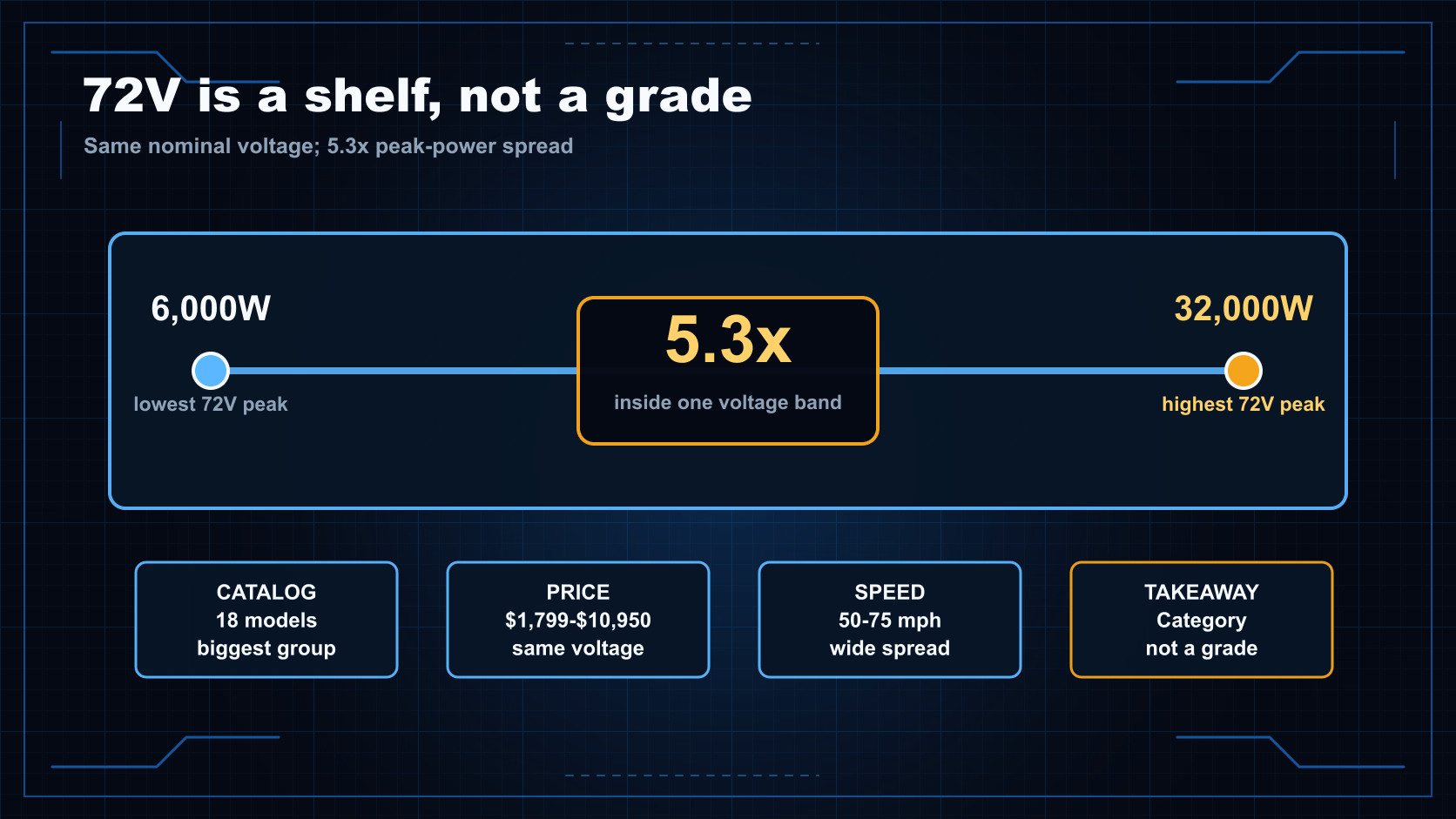
- Peak power runs from 6,000W to 32,000W — a 5.3× spread on the same nominal voltage.
- Price runs from $1,799 to $10,950.
- VoltRipper Scores run from 72 to 92.
- And a 60V bike — the Volcon Grunt EVO at 12,000W (Score 95) — out-powers eight of the eighteen and out-scores every one of them.
So "72V" tells you a bike belongs to the full-power light e-moto family rather than the youth or budget tiers. It does not tell you the bike is fast, well built, or worth the money. Below is every 72V model we track, ranked, plus what the number actually buys.
What 72V actually means
Voltage is not power. Power is voltage multiplied by current, so a pack's voltage is only one of the two terms.
What higher voltage genuinely buys you is efficiency at a given power level. To make 10,000W at 48V a bike must push about 208 amps; at 72V it needs about 139 amps. Lower current means less heat in the battery, controller and wiring, thinner cabling, and less energy wasted as heat. That is why, as this class grew up, 72V became the standard for bikes intended to make real power — and why the youth and budget tiers below sit at 36V and 48V, where the power targets are low enough that current is not the problem.
That is the whole honest story of the number. 72V is a design decision about how a bike delivers power. It is not a grade.
Every 72V electric dirt bike we track
Ranked by VoltRipper Score. Availability is as of our last check — five of these are discontinued, and one is still a pre-order.
| # | Bike | Score | Peak power | Top speed | Battery | Price | Status |
|---|---|---|---|---|---|---|---|
| 1 | E-Ride Pro SS 3.0 | 92 | 15,800W | 60 mph | 3,600 Wh | $4,699 | Limited |
| 2 | Arctic Leopard XE Pro S Enduro | 90 | 20,000W | 63 mph | 3,960 Wh | $5,100 | Available |
| 3 | Apollo RFN Ares | 89 | 12,500W | 50 mph | 3,132 Wh | $4,799 | Limited |
| 4 | Talaria MX5 Pro | 89 | 13,400W | 59 mph | 2,880 Wh | $4,990 | Available |
| 5 | Segway Xaber 300 | 89 | 21,000W | 60 mph | 3,168 Wh | $5,299 | Available |
| 6 | Rawrr Mantis X Pro | 89 | 15,000W | 65 mph | 2,520 Wh | $3,899 | Limited |
| 7 | Sur-Ron Light Bee X | 89 | 10,000W | 50 mph | 2,520 Wh | $4,499 | Limited |
| 8 | E-Ride Pro SS 2.0 | 88 | 12,000W | 60 mph | 2,880 Wh | $4,599 | Available |
| 9 | Arctic Leopard XF Pro | 86 | 12,000W | 60 mph | 2,520 Wh | $3,699 | Discontinued |
| 10 | Dust Moto Hightail | 86 | 32,000W | 75 mph | 4,400 Wh | $10,950 | Pre-order |
| 11 | Rawrr Mantis X | 83 | 6,500W | 50 mph | 2,160 Wh | $2,999 | Available |
| 12 | 79Bike Falcon M | 83 | 8,000W | 50 mph | 2,520 Wh | $3,699 | Discontinued |
| 13 | 79Bike Falcon Pro | 82 | 10,000W | 56 mph | 2,520 Wh | $3,599 | Available |
| 14 | Delfast Top 3.0 | 82 | 6,000W | 50 mph | 3,400 Wh | $6,999 | Discontinued |
| 15 | Torp Bike | 79 | 15,000W | 50 mph | 1,800 Wh | $7,900 | Discontinued |
| 16 | 79Bike Falcon Lite | 78 | 8,000W | 52 mph | 2,160 Wh | $2,499 | Available |
| 17 | Stealth B-52 | 76 | 6,200W | 50 mph | 2,500 Wh | $8,890 | Discontinued |
| 18 | Eskute RT-X | 72 | 6,500W | 53 mph | 2,160 Wh | $1,799 | Available |
The three things this table shows that a spec sheet will not
1. The most powerful 72V bike is not the best one. The Dust Moto Hightail makes 32,000W — half as much again as the next-most-powerful bike here, the 21,000W Segway Xaber 300 — and scores 86, below a 15,800W bike at less than half the price. Power is one input to the Score alongside value, range, support and build; a bike can win the horsepower argument and still be the wrong purchase for almost everyone.
2. Price and voltage are almost unrelated. The $8,890 Stealth B-52 makes 6,200W and scores 76 — the second-lowest here. The $2,999 Rawrr Mantis X makes 6,500W and scores 83. Same voltage, comparable power, a $5,891 difference — and the cheaper bike scores higher. If you shop by "72V" you will find both on the same results page.
3. The best value in the class sits in the middle, not at the top. The Rawrr Mantis X Pro at $3,899 makes 15,000W and scores 89. Five bikes tie at 89, and it is the cheapest of the five by $600. Within that group only the $5,299 Segway Xaber 300 out-powers it. Just two 72V bikes score higher, and each costs at least $800 more.
The floor moved: what $1,799 and $2,499 buy at 72V
Until September 2026, the cheapest 72V bike in our catalog was the $2,999 Rawrr Mantis X. Two bikes have since moved the floor. The Eskute RT-X sells for $1,799. The 79Bike Falcon Lite sells for $2,499.
Neither gives up battery to get there. All three carry the same 2,160 Wh of 72V pack, and the Falcon Lite out-powers the Mantis X, at 8,000W to 6,500W.
What the lower price buys out is support. Neither the Eskute nor the Falcon Lite has a US dealer network, parts for both are hard to source, and each earns 4 points on the Score's support factor, against 9 for the Mantis X. That gap, not the motor or the pack, is most of why they score 72 and 78 to the Mantis X's 83. Budget for delivery, too: 79Bike charges $250 to ship the Falcon Lite, which makes it $2,749 delivered.
If the cheapest possible 72V bike is the brief, these two are it. If you will need a part in year two, the $500 to the Mantis X is the cheapest insurance on this page.
Where 72V sits in the whole voltage ladder
Voltage in this category maps almost perfectly onto rider tier, which is genuinely useful — just not in the way "72V = good" implies:
| Voltage | Bikes | What it is |
|---|---|---|
| 12–36V | 12 | Kids' and teen bikes. 100W–1,400W, 8–26 mph. |
| 48–52V | 12 | Youth race bikes, budget adult bikes, and one premium outlier, the Cake Kalk OR. 1,200W–14,000W. |
| 58–60V | 8 | The value adult tier — Talaria's Sting family lives here. |
| 72V | 18 | The mainstream performance class. The biggest single group we track. |
| 74–104V | 7 | Premium and full-size: Ultra Bee, Storm Bee, Komodo, Altis. |
| 360V | 2 | Stark Varg only — a genuinely different electrical architecture. |
The ladder is the useful signal. The rung is not a ranking.
So how should you actually shop?
Use voltage to narrow the family, then decide on the numbers that vary within it:
- Peak watts — the real performance number, and it varies 5× inside 72V alone.
- Battery watt-hours — what determines range. Ranges from 1,800 Wh to 4,400 Wh here, and the biggest pack on this list belongs to a bike you cannot buy yet: the pre-order Dust Moto Hightail.
- Weight and seat height — whether you can actually ride it.
- Support and parts — the reason the Sur-Ron Light Bee X still scores 89 on 10,000W while bikes with more power score lower.
Not sure which family you belong in? Run the Find Your Ride configurator, or read how to read electric dirt bike specs — the companion piece on which numbers manufacturers inflate.
The bottom line
72V is the mainstream performance standard, and 18 of the bikes we track use it — but it is a category, not a grade. Inside that one number sits a 5× power range, a $9,151 price range, and a 20-point Score range. The best-scoring 72V bike is the E-Ride Pro SS 3.0 at 92, with the Arctic Leopard XE Pro S Enduro at 90 and five bikes tied at 89; the best value is the Rawrr Mantis X Pro at $3,899; and the most powerful, the Dust Moto Hightail, is neither. Shop the watts, the watt-hours and the support — the voltage just tells you which shelf you are standing in front of.
The other power and voltage bands:
- 36V Electric Dirt Bikes: The Kids' Band, Decoded by Age and Fit
- 48V Electric Dirt Bikes: Every Model, and the $5,637 Question
- 60V Electric Dirt Bikes: Every Model, and Why the Step to 72V Is Real
- 1000W Electric Dirt Bike: The Entry Class, Explained
- 3000W Electric Dirt Bike: The Sur-Ron Class
- 5000W Electric Dirt Bike: The Value Power Tier
- 8000W Electric Dirt Bike
VoltRipper is independent — our rankings come from verified specs and the transparent VoltRipper Score, not commissions. We are spec-verified and data-driven rather than hands-on; we do not claim to have ridden these bikes. Affiliate disclosure is included on monetized pages.
FAQ
What does 72V mean on an electric dirt bike?
72V is the nominal voltage of the battery pack. Higher voltage lets a bike deliver a given amount of power at lower current, which means less heat and less loss in the wiring and controller — which is why 72V became the default for full-power light e-motos. But voltage on its own is not a performance rating: the 72V bikes we track range from 6,000W to 32,000W, a more than fivefold spread on identical pack voltage.
Is a 72V electric dirt bike better than a 60V?
Not automatically. Across our catalog the 60V Volcon Grunt EVO makes 12,000W, which is more peak power than eight of the eighteen 72V bikes we track, and its Score of 95 out-scores all eighteen. Voltage tells you which design family a bike belongs to; watts, battery capacity in watt-hours, weight and build quality tell you how it actually rides.
How fast is a 72V electric dirt bike?
Between 50 and 75 mph across the models we track. The slowest 72V bikes top out at 50 mph and the fastest, the Dust Moto Hightail, claims 75 mph. Top speed correlates far more closely with peak power and gearing than with pack voltage.
What is the cheapest 72V electric dirt bike?
The Eskute RT-X at $1,799 is the cheapest 72V bike in our catalog. It makes 6,500W and scores 72, the lowest Score in the band. The next-cheapest is the 79Bike Falcon Lite at $2,499, with 8,000W and a Score of 78. Third is the Rawrr Mantis X at $2,999. The best-scoring 72V bike under $4,000 is the Rawrr Mantis X Pro at $3,899, which makes 15,000W and scores 89.
Sources
Specification sources
- E-Ride Pro SS 3.0E-Ride Pro - Pro SS 3.0 official product pageChecked
- Talaria Sting MX5 ProTalaria Canada - Sting MX5 Pro specificationsChecked
- Rawrr Mantis X ProRide Rawrr — Mantis X ProChecked
- Sur-Ron Light Bee XATV Wholesale Outlet - 2026 Sur-Ron Light Bee X (72V/35Ah, 10 kW), $4,699 from $4,999Checked
- 79Bike Falcon Lite79Bike - Falcon Lite product page (8 kW, 72V 30Ah M50LT pack, 52 mph, 340 N.m, 138 lb, 830 mm seat, 200 mm front travel, 3-4 h charge, E/D/S modes, 18+)Checked