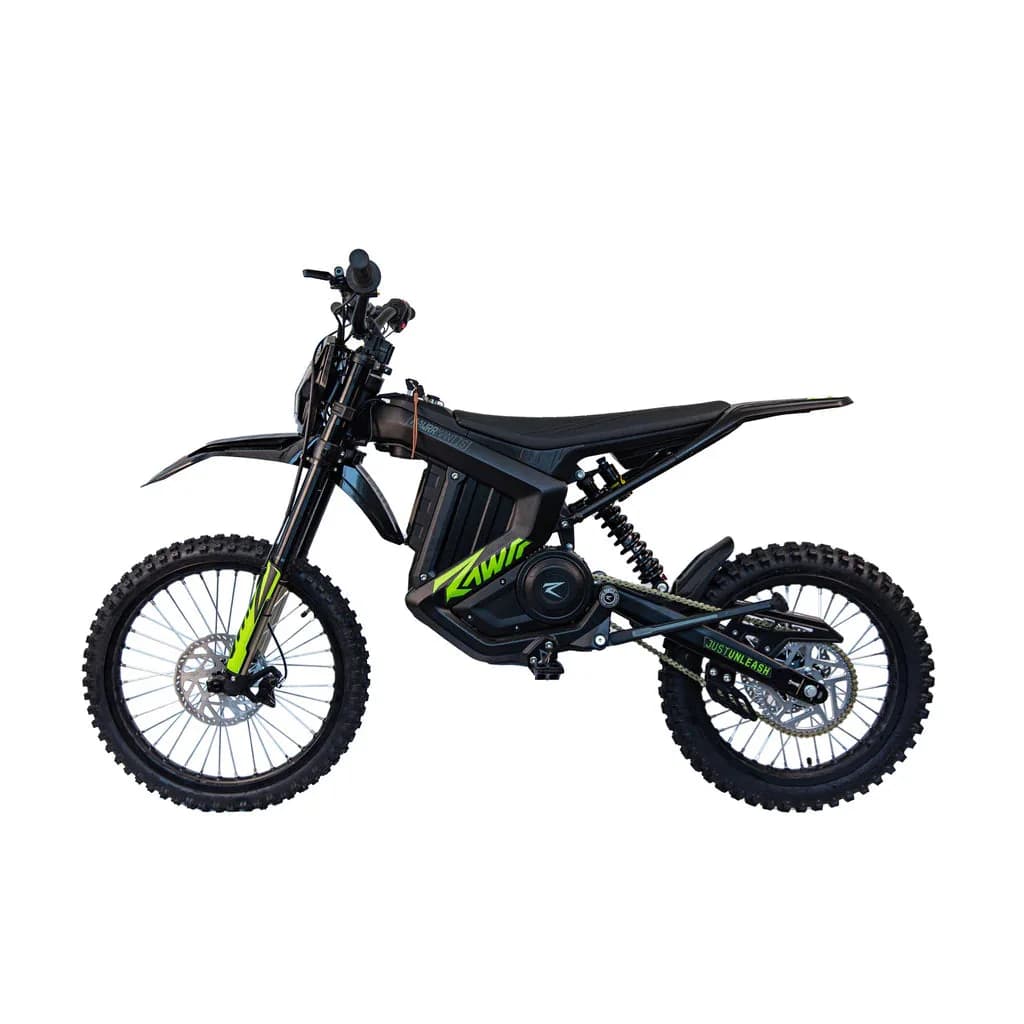
The verdict
The Rawrr Mantis X (VoltRipper Score 83, ~$2,999) is the beginner-friendly member of Rawrr's trail lineup — a genuine full-suspension, hydraulic-braked light e-dirt-bike that puts down real 50 mph trail speed. It's the tamer, lighter sibling of the Mantis X Pro: 6.5 kW peak instead of 15, 50 mph instead of 65, and a beginner-approachable 139 lb.
Read this before you buy it, though: the Pro's MSRP is $3,899 — about $900 more — for roughly 2.3× the peak power, 15 mph more top speed, a bigger battery, and an actual 12-month warranty. At that gap the base bike earns its place if you specifically want the lighter, lower-seated, gentler machine, which is a real want for beginners and smaller riders. If you don't, the Pro is the better value. See the full Mantis X vs Mantis X Pro breakdown.
What keeps it from scoring higher isn't the hardware — it's value math. At $2,999 it lands squarely in Talaria's value tier, where the Sting MX3 (86) and X3 (88) out-score it on our scale, mostly on aftermarket depth. Both Talarias are now discontinued, so the Mantis X is the one of the three you can buy new. The Mantis X answers with a touch more top speed and its own playful character — a fair pitch, just not the outright value win.
Who it's for — and who should skip it
Buy it if you want approachable, affordable trail speed: a real light e-moto with full suspension and proper brakes at value-tier money, with three power modes gentle enough for a newer rider to grow into. At 139 lb and beginner-rated, it's a forgiving first full-size bike.
Skip it if aftermarket depth and resale top your list (Talaria and Sur-Ron are meaningfully deeper), if you want maximum spec-per-dollar (the value Talarias out-value it, if you find one in remaining dealer stock), or if you're after muscle — the Mantis X Pro makes about 2.3x the peak power for only about $900 more, which is the single strongest argument against this bike.
The hardware
The Mantis X runs a 72V system with a 6.5 kW peak (3 kW nominal) motor, a 2,160 Wh (72V, 30 Ah) battery, and a 50 mph top speed. It's genuinely equipped where it counts: full suspension, dual hydraulic brakes (not the mechanical or drum brakes that betray budget bikes), and three power modes that let a new rider dial the delivery down while learning. At 139 lb it's mid-weight for the class — heavier than a Talaria Sting (123–125 lb) or a Light Bee X (130 lb), but far from a handful.
Real-world range
Rawrr rates the Mantis X at ~50 miles. In mixed, throttle-happy trail riding, plan for ~30 miles — the same claimed-vs-real gap that applies across this whole class, and not unique to Rawrr. The 2,160 Wh pack is on the smaller side for the tier (a Talaria X3 carries ~2,400 Wh), so budget your ride distance off the real number, not the spec sheet. Our range guide breaks down exactly why claimed and real range diverge.
Where it wins, where it costs
Where it wins: affordable real trail speed (50 mph for $2,999), a beginner-friendly and dial-down-able three-mode delivery, and grown-up chassis hardware — full suspension and dual hydraulic brakes — that a lot of bikes at this price cut corners on.
Where it costs you: the aftermarket is OK, not deep (nowhere near Talaria's or Sur-Ron's parts-and-community ecosystem), there's no stated warranty (the Pro gets 12 months), and the smaller 2,160 Wh battery trims range. Most of all, the Talaria Sting MX3 (86) and X3 (88) out-score it, though both are now discontinued.
Street-legal reality
Off-road only — the Mantis X ships as an off-road machine, with no factory lighting or DOT path. Like the rest of this class, road use would mean a conversion kit and a state that allows it — a narrow route. Ride it on private land or designated OHV areas, and check our street-legal guide before planning any pavement.
How it compares
| Bike | Price | Peak power | Top speed | Weight | Score |
|---|---|---|---|---|---|
| Rawrr Mantis X | $2,999 | 6.5 kW | 50 mph | 139 lb | 83 |
| Talaria X3 (xXx), discontinued | $3,550 | 6.5 kW | 47 mph | 125 lb | 88 |
| Talaria Sting MX3, discontinued | $3,700 | 6 kW | 47 mph | 123 lb | 86 |
| Rawrr Mantis X Pro | $3,899 | 15 kW | 65 mph | 158.5 lb | 89 |
The honest read: the Mantis X is squeezed from above, and it used to be squeezed from below. The Talaria X3 was the smarter value until it was discontinued: lighter, higher-scoring, and better-supported. The Mantis X Pro sits $900 above it with more than double the power and an actual warranty. That leaves the base Mantis X with a narrow but legitimate lane: riders who want a light (139 lb), low-seated, beginner-rated bike and specifically prefer Rawrr's chassis. If that's not you, the Mantis X Pro is the better buy.
Every head-to-head we have published on this bike:
Go deeper on the Rawrr Mantis X:
Bottom line
The Rawrr Mantis X is a competent, honest value trail bike — full-suspension hardware and 50 mph trail speed at a beginner-friendly price, with a delivery you can tame while you learn. Talaria's Sting MX3 and X3 had deeper support, and both are now discontinued. But if you want affordable trail speed with a distinct character and don't need the deepest aftermarket, it earns its place. Want the pick matched to your size, terrain, and budget? Run the Find Your Ride configurator.
VoltRipper is spec-verified and data-driven — we do not claim hands-on testing of this bike. Specs and prices are cross-checked against the sources listed above and re-verified regularly; real-world figures are our own estimates, clearly labeled.
FAQ
Is the Rawrr Mantis X a good electric dirt bike?
For the money, it's a competent, beginner-friendly trail bike — full suspension, dual hydraulic brakes, 50 mph, and three power modes for $2,999, earning a VoltRipper Score of 83. Its main weakness isn't the hardware; it's value math: the Talaria Sting MX3 (86) and X3 (88) out-score it, mostly on a deeper aftermarket, but both are now discontinued. Buy the Mantis X for approachable trail speed and its own character, not as the outright spec-per-dollar winner.
What's the difference between the Rawrr Mantis X and the Mantis X Pro?
The Mantis X is the tamer, lighter one: 6.5 kW peak, 50 mph, 139 lb, beginner-rated, $2,999 (plus $200 freight). The Mantis X Pro makes about 2.3x the peak power (15 kW), hits 65 mph, weighs 158.5 lb, is intermediate-rated, adds a 12-month warranty — and after July 2026 pricing it costs only about $900 more ($3,899, Score 89 vs 83). At that gap the Pro is the better buy for most riders who can handle it; the base Mantis X now makes sense mainly for beginners and smaller riders who specifically want the lighter, lower-seated, gentler bike.
Rawrr Mantis X vs Talaria — which is better?
On our Score, the Talaria value tier wins: the Sting MX3 (86) and X3 (88) are better-supported, with Talaria's larger aftermarket the deciding edge. Both are now discontinued, though. The Mantis X is still sold new, at $2,999. It also has a slightly higher top speed (50 vs 47 mph) and a distinct look and feel. If aftermarket depth and resale matter most, look for a Talaria in remaining dealer stock or on the used market; if you want a new bike and a bit more speed for the money, the Mantis X is a fair pick.