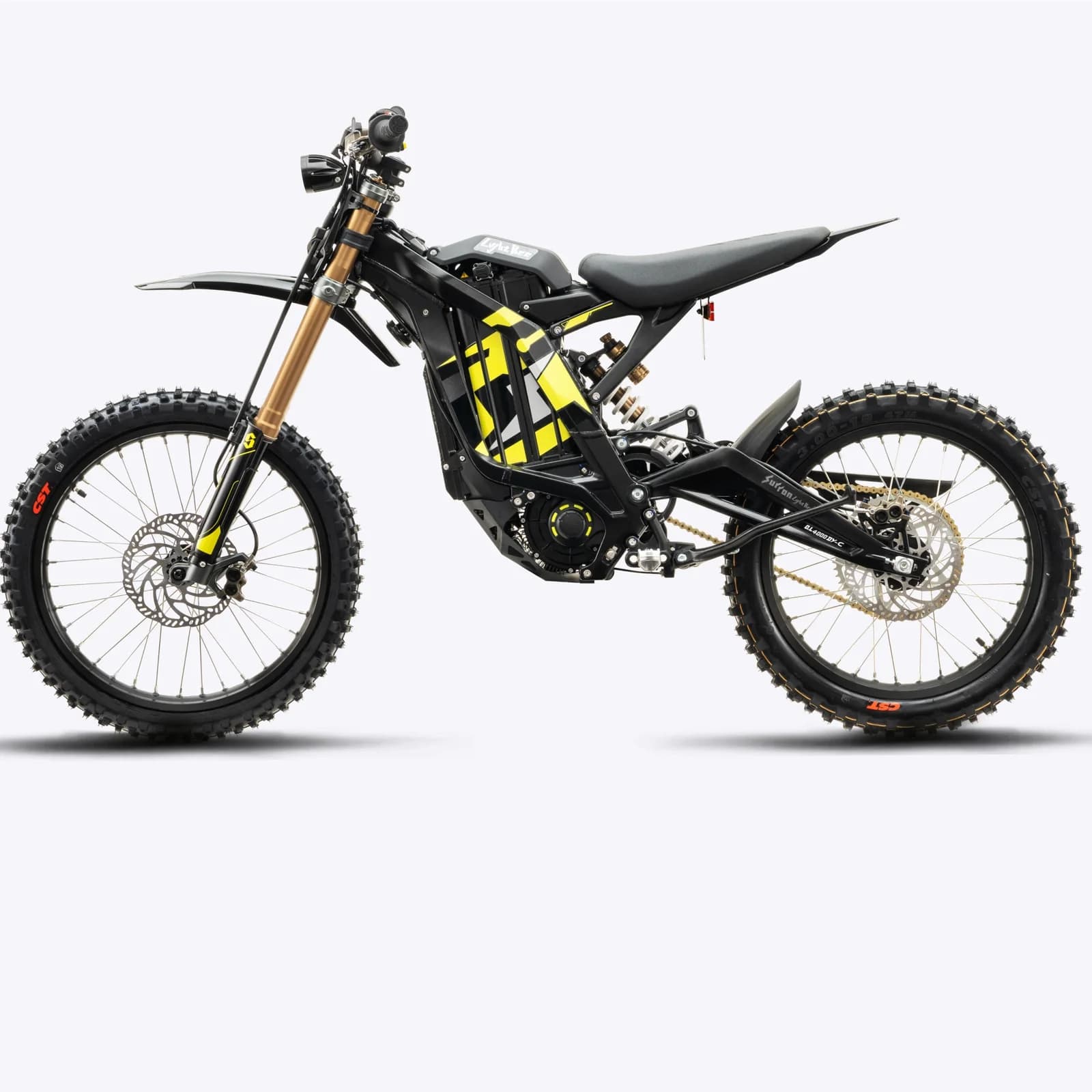
The verdict
If you want the most-supported, most-upgradable electric dirt bike you can buy in 2026 — and you're honest with yourself about range — the Sur-Ron Light Bee X is still the default answer. It earns a VoltRipper Score of 89/100, near the top of our trail class, and it gets there without a single point for raw halo-bike power. What it wins on is the thing that actually matters five years into ownership: an aftermarket, dealer network, and rider community that no rival comes close to matching.
It is not the fastest, the longest-range, or the most refined e-dirt-bike on our board. It's the one you can still get parts, batteries, and advice for in 2030 — and for a lot of riders, that's the whole game.
Who it's for — and who should skip it
Buy it if you're a first-time serious e-dirt-bike buyer, a trail rider who values a light and flickable chassis, or a tinkerer who wants a platform with endless bolt-on upgrades. At ~130 lb it's forgiving to pick up, loft, and correct — a genuinely beginner-approachable full-size bike.
Skip it if you need street-legal registration out of the box (this is an off-road machine — see below), if you want moto-style adjustable suspension and a hydraulic clutch feel (look at the Talaria Sting R MX4), or if you're chasing the biggest battery and most power for the money (the larger Sur-Ron Ultra Bee steps up in every dimension, for more money).
What the 2026 update actually changed
Older Light Bees were 60V bikes. The current Light Bee X runs a 72V system with a ~3 kW nominal / 10 kW peak motor, a 2,520 Wh (72V, 35 Ah) battery, and a genuine 50 mph top speed with 295 Nm at the wheel. That's a real step up in usable punch over the 60V bikes people cross-shop it against — enough that the jump is the single biggest reason to buy new rather than used. Charge time is about 3 hours, and the pack is removable (though not hot-swappable), so a second battery is the cleanest way to double a ride day.
At $4,699, it sits right in the middle of the premium trail tier — more than a budget import, less than a Talaria Sting R MX4 or a Stark, and far below anything from the halo brands.
The number nobody advertises: real-world range
Sur-Ron rates the Light Bee X at ~47 miles. In mixed, real-world trail and throttle-happy riding, plan for ~25–35 miles — our reality-check panel above logs the gap, and it is not unique to Sur-Ron. Manufacturer range figures across this whole category are measured at low, steady speed; the moment you're carrying momentum on singletrack or pinning it on fire roads, the 2,520 Wh pack drains far faster.
This isn't a knock on the bike so much as a rule of the class — we break down exactly why claimed and real range diverge, and how to stretch it, in our range guide. Buy the Light Bee X for the ride quality and the ecosystem, budget your ride distance off the real number, and you'll never be disappointed.
By the numbers: what your dollar actually buys
Our computed value metrics, derived from the verified spec set (the same data behind every table on this site) — useful because sticker prices hide what you're actually paying for:
| Metric | Light Bee X | How it reads |
|---|---|---|
| Battery per dollar | 0.57 Wh/$ | Below the class value leaders (Sting MX3: 0.74, SS 3.0: 0.72) — you pay a premium per watt-hour |
| Power to weight | 77 W/lb | The sweet spot: enough to be quick, light enough to be flickable |
| Price per real-world mile | ~$147/mi | Vs ~$111 for the Sting MX3 — the ecosystem premium, quantified |
Read honestly: on raw spec-per-dollar the Light Bee X loses to the newer value players — that's the math, and pretending otherwise would be marketing. What the computed numbers can't price is the moat below: the deepest aftermarket, community, and resale in the class. You're paying roughly a 20–25% premium per unit of hardware for the platform, and for most riders it's worth it. If it isn't for you, the Sting MX3 is the value math's winner — though it has been discontinued. The buyable version of that answer is now the Rawrr Mantis X Pro, which matches the Light Bee X's Score for $600 less.
Where it wins: the ecosystem is the moat
This is why the Light Bee X still tops its class. Its parts availability is the strongest of any bike we track, the dealer network is real, and its rider community is a 5/5 — the largest and most active in the segment. Practically, that means:
- Upgrades for everything — controllers, batteries, suspension, brakes, seats, tires — from dozens of vendors, not one.
- You can actually get it serviced, and troubleshoot common issues with a huge base of owners who've already solved them.
- Resale holds, because the platform isn't going anywhere.
A slightly quicker or longer-range rival that you can't get parts for in two years is the worse buy. The Light Bee X is the safe long-term bet.
Living with it: the belt, the chain, and real maintenance
One thing the spec sheet skips: the Light Bee X runs a belt primary drive feeding a chain final drive, and living with both is part of ownership. The belt — a Gates-style cogged belt — is quiet, efficient, and genuinely low-maintenance, but it wants an occasional tension check and a wipe-down; left caked in mud it wears faster. Owners report the stock belt lasts a long time with basic care, and the popular durability upgrade is a Gates GT4 belt. The chain to the rear wheel is normal dirt-bike upkeep — clean and lube it regularly (roughly every 60 miles of hard riding).
The wear items that forum and service-center reports flag on hard-ridden bikes are the usual light-e-moto points: belt and sprocket wear, the reduction drive area, and frame/mount bolts — all worth a periodic look every couple of months or few hundred miles. None are dealbreakers, and here's where the ecosystem moat pays off again: every one has a cheap part and a well-documented fix, so a "known wear item" doesn't mean an "expensive problem." (Riders chasing more power or a stronger tune commonly add an aftermarket X-controller — one of the most common Sur-Ron upgrades.)
Where it costs you: the honest cons
- Range collapses at speed. Covered above — plan for real miles well under the 47 mi claim.
- It's sold off-road; street use needs a kit and varies by state. There are no factory turn signals or DOT lighting.
- Instrumentation is basic and there's no app. Newer rivals (Segway's X-series, some Talarias) feel more modern on the tech front. If a phone app and ride telemetry matter to you, this will feel spartan.
Street-legal reality
Do not buy the Light Bee X expecting to register and commute on it legally in most states. It's an off-highway vehicle; making it street-legal means a lighting/registration kit and a state that allows the conversion — a narrow and location-dependent path. Before you plan any road use, read our street-legal guide and your state's rules. If legal road riding is the goal, a purpose-built dual-sport is a better starting point than a converted Light Bee.
How it compares
| Bike | Price | Battery | Peak power | The VoltRipper take |
|---|---|---|---|---|
| Sur-Ron Light Bee X | $4,499 | 2,520 Wh (72V) | 10 kW | Lightest, best-supported, best long-term bet — just plan for real range |
| Talaria Sting MX5 Pro | $4,990 | 2,880 Wh (72V) | 13.4 kW | Newer 72V Sting that out-specs it on paper — but a young aftermarket vs Sur-Ron's depth |
| Talaria Sting R MX4 | ~$4,100 | 2,700 Wh (60V) | 8 kW | Bigger battery, more moto-style feel; a smaller aftermarket |
| Sur-Ron Ultra Bee | steps up | larger | more | More bike in every dimension, if you'll pay for it |
Its most serious new challenger is the Talaria Sting MX5 Pro ($4,990): the 72V Sting actually out-specs the Light Bee X on paper — more peak power, a bigger battery, and a higher unlocked top speed, though for $491 more — so if raw hardware-per-dollar leads your list, cross-shop it (our MX5 Pro review has the full head-to-head). What keeps the Light Bee X the safer buy is exactly what a spec sheet doesn't show: Sur-Ron's segment-deepest aftermarket, resale, and support versus the MX5 Pro's still-young platform. The Talaria Sting R MX4 is the other Talaria cross-shop (bigger battery, moto feel, smaller aftermarket); the Ultra Bee is the natural step up in the same brand (how the two compare); and if app-connected tech is a priority, cross-shop the Segway X-series.
Every head-to-head we have published on this bike:
- 79Bike Falcon Pro vs Sur-Ron Light Bee X
- Apollo RFN Ares vs Sur-Ron Light Bee X
- Arctic Leopard XF Pro vs Sur-Ron Light Bee X
- E-Ride Pro SS 3.0 vs Sur-Ron Light Bee X
- Rawrr Mantis X Pro vs Sur-Ron Light Bee X
- Segway Xaber 300 vs Sur-Ron Light Bee X
- Sur-Ron Light Bee X vs E-Ride Pro SS 2.0
- Sur-Ron Light Bee X vs Onyx RCR
- Sur-Ron Light Bee X vs Talaria MX5 Pro
- Sur-Ron Light Bee X vs Talaria Sting MX3
- Sur-Ron Ultra Bee vs Light Bee X
- Talaria Sting R MX4 vs Sur-Ron Light Bee X
- Talaria X3 vs Sur-Ron Light Bee X
Go deeper on the Sur-Ron Light Bee X:
Bottom line
The Sur-Ron Light Bee X isn't the flashiest e-dirt-bike on our board, and its real range is well short of the spec sheet. But it's the lightest to live with, the easiest to fix, and the safest platform to own for years — and the 2026 72V/10kW update finally gives it the power to back up the reputation. For a first serious e-dirt-bike or a trail-focused build you'll keep upgrading, it remains the one to beat.
VoltRipper is spec-verified and data-driven — we do not claim hands-on testing of this bike. Specs and prices are cross-checked against the sources listed above and re-verified regularly; real-world figures are our own estimates, clearly labeled.
FAQ
Is the Sur-Ron Light Bee X worth it?
For most riders, yes — it's the class benchmark. It isn't the fastest or longest-range e-dirt-bike (it earns a VoltRipper Score of 89), but it has the deepest aftermarket, the biggest dealer and rider community, and the deepest used demand in the class — the things that still matter years into ownership. At ~130 lb it's also genuinely beginner-approachable. Skip it only if you want maximum power and battery (the Sur-Ron Ultra Bee steps up) or a street-legal bike out of the box.
Is the Sur-Ron Light Bee X street legal?
No — it ships as an off-road machine with no DOT lights, mirrors, horn, or VIN, so it can't be ridden legally on public roads as sold. Making it street-legal means adding a full lighting/equipment kit, then titling, registering, and insuring it as a motorcycle and holding a motorcycle license where your state allows conversion. It's a great platform to convert, but it's more work than a road-ready-oriented bike like the Onyx RCR — check your state's rules first.
Sur-Ron Light Bee X vs Talaria — which should you buy?
Both are excellent light e-dirt-bikes. The Talaria (MX5 Pro or Sting) is typically cheaper with similar performance and the second-deepest aftermarket in the class; the Sur-Ron is the benchmark, with the deepest support, the biggest community, and the widest pool of used buyers. Buy the Sur-Ron if the ecosystem and resale value matter most; buy the Talaria to get most of the capability for less. See our full [Light Bee X vs MX5 Pro comparison](/guides/sur-ron-light-bee-x-vs-talaria-mx5-pro).
How fast is the Sur-Ron Light Bee X and what's its real range?
Top speed is about 50 mph in stock form. Real-world trail range is around 30 miles from its 72V pack — more if you ride gently in eco mode, meaningfully less if you ride hard. As with every bike here, we plan around the real number, not the optimistic low-speed claim (more in our range guide).
How much maintenance does a Sur-Ron Light Bee X need?
Less than a gas dirt bike, but not zero — and it centers on the drivetrain. The Light Bee X runs a belt primary drive (a Gates-style cogged belt that wants an occasional tension check and a wipe-down; it wears faster if left caked in mud, and a Gates GT4 belt is the popular durability upgrade) into a chain final drive (clean and lube it roughly every 60 miles of hard riding). Beyond that, inspect belt and sprocket wear, the reduction drive area, and frame/mount bolts every couple of months. The upside: thanks to Sur-Ron's deep aftermarket, every one of those wear items has a cheap part and a well-documented fix, so a 'known wear item' rarely becomes an expensive problem.