Tracked price checks
Bikes in this guide
Yozma
IN10
One of the cheapest ways into a real electric dirt bike — around $1,079 with full hydraulic brakes and suspension
Trade-off: No-name budget brand — minimal aftermarket, spare parts, or dealer/community support
We may earn a commission if you buy through this link, at no extra cost to you. As an Amazon Associate I earn from qualifying purchases.
Check Amazon priceRiding Times
GT73
Big 25-inch fat tires and dual 48V batteries (1,747 Wh) make it more usable than most sub-$2.5k e-dirt-bikes
Trade-off: A generic model resold under many labels (Riding Times, Bootime, TST, ENGWE) — no single accountable brand or aftermarket
We may earn a commission if you buy through this link, at no extra cost to you. As an Amazon Associate I earn from qualifying purchases.
Check Amazon priceSegway
Dirt eBike X160
Lighter (106 lb) and slower-topped (31 mph) — the most approachable bike here for smaller/newer riders
Trade-off: 31 mph ceiling is quickly outgrown by confident riders
We may earn a commission if you buy through this link, at no extra cost to you.
View official pageKuberg
Ranger
Czech-built quality with configurable 8/12/14 kW power options
Trade-off: 48V system and 24Ah base pack limit full-power range vs. bigger 72V rivals
We may earn a commission if you buy through this link, at no extra cost to you.
Check price at KubergGasGas
MC-E 5
The value pick of three identical bikes: the same KTM-group 5 kW platform for $5,449 - roughly $350-400 less than the SX-E 5 or EE 5
Trade-off: Still $5,449 before a $425 freight charge - a lot for a youth bike
We may earn a commission if you buy through this link, at no extra cost to you.
View official pageThe short answer
48V is where two very different kinds of bike share a voltage: cheap adult machines and serious youth machines. We track 9 of them, and the band has the widest price-to-quality mismatch we have measured anywhere in the catalogue.
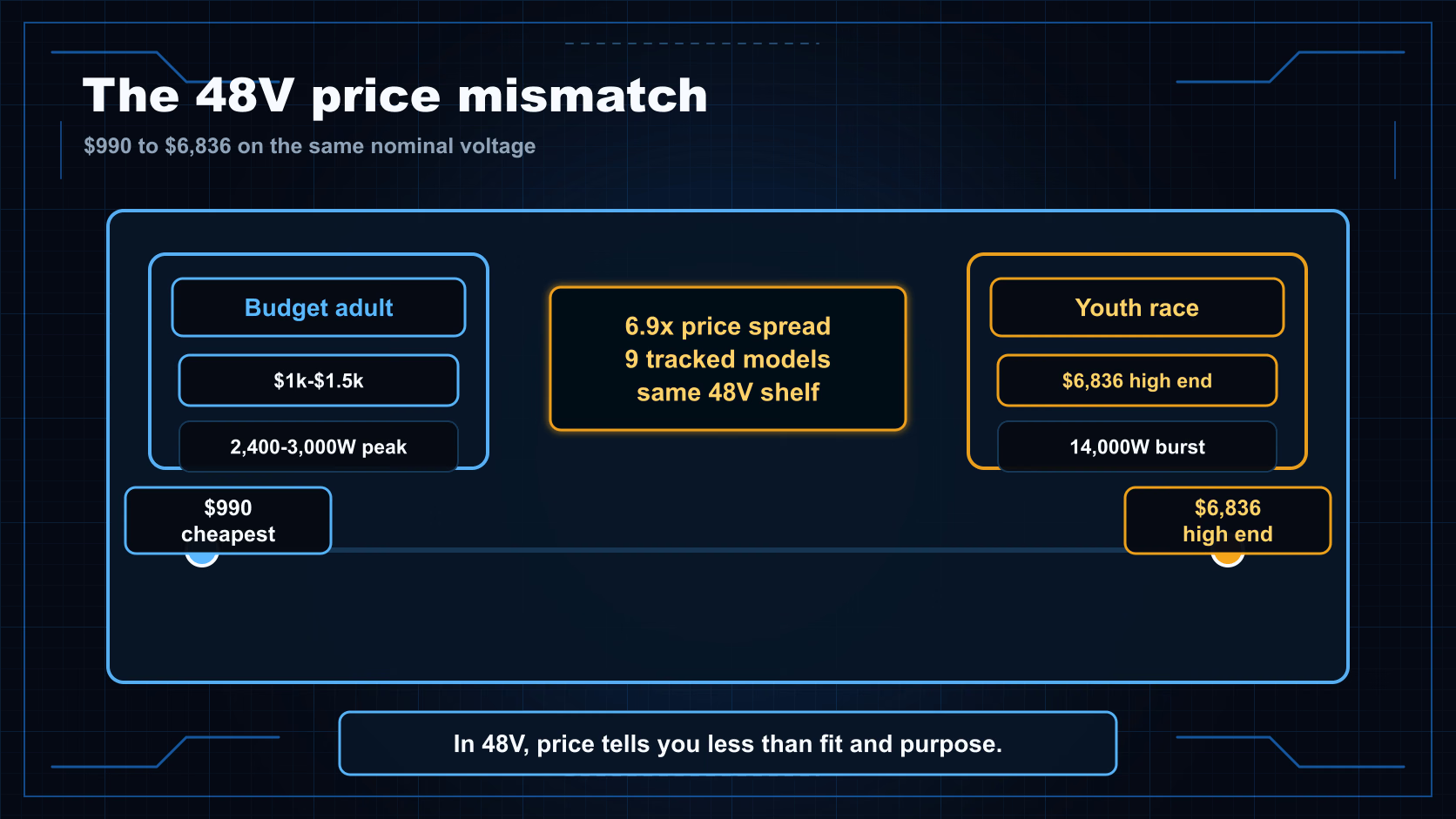
The headline number: the most expensive 48V bike costs $6,836. The cheapest costs $1,079. The gap in VoltRipper Score between them is six points — and neither is the highest-scoring bike in the band.
That is the whole guide in one line. Below is what the extra $5,637 actually buys, and when it is worth paying.
Every 48V electric dirt bike we track
Ranked by VoltRipper Score.
| # | Bike | Score | Peak power | Top speed | Battery | Price | Best for |
|---|---|---|---|---|---|---|---|
| 1 | Segway X160 | 90 | 3,000W | 31 mph | 960 Wh | $2,999 | Youth, dealer-backed |
| 2 | GasGas MC-E 5 | 87 | 5,000W | not published | 907 Wh | $5,449 | Junior MX, cheapest badge |
| 3 | KTM SX-E 5 | 86 | 5,000W | not published | 907 Wh | $5,799 | Junior MX, deepest dealer net |
| 4 | Husqvarna EE 5 | 86 | 5,000W | not published | 907 Wh | $5,849 | Junior MX, lowest seat |
| 5 | Greenger CRF-E2 / G2 | 83 | 2,500W | 20 mph | 960 Wh | $1,799 | Young MX rider (discontinued) |
| 6 | Kuberg Ranger | 78 | 14,000W | 50 mph | 1,152 Wh | $6,836 | Serious youth racing |
| 7 | GT73 | 73 | 2,400W | 35 mph | 1,747 Wh | $1,499 | Biggest pack in the band |
| 8 | Tuttio Soleil01 | 73 | 3,000W | 40 mph | 1,008 Wh | $990 | Budget alternative |
| 9 | Yozma IN10 | 72 | 2,600W | 40 mph | 1,123 Wh | $1,079 | Cheapest way in |
Note the Score spread: 72 to 92, a full twenty points — wider than the 72V band's sixteen. And it runs completely against price: the most expensive bike here, the $6,836 Kuberg, sits mid-pack at a Score of 78, while the $2,999 Segway X160 tops the band at 90.
What the $5,637 actually buys
The Kuberg Ranger is a real machine and its Score is earned: 14,000W peak is 2.8 times the next-highest in the band, and it is built for youth racing rather than backyard riding.
But read its own numbers together. 14,000W at 48V implies roughly 292 amps, and the pack holds 1,152 Wh — which is actually the second-largest pack here, and that is the point. At genuine full power it is under five minutes. Kuberg is honest about this in their own spec table, which gives 19 miles at full power on the 24Ah pack, and our record uses that figure rather than a flattering low-speed number.
So the headline 14 kW is a burst rating, not a sustained one — which is true of nearly every peak-power figure in this category, and is the single most misread number on any e-dirt-bike spec sheet.
Buy the Kuberg if you have a young rider who actually races and needs that burst. Do not buy it because 14,000W looks like five times the bike — for most riding it is not, and the Score's six-point margin over a $1,199 bike is telling you exactly that.
Where the value actually is
The value splits two ways: raw price at the bottom, and support at the top.
- Yozma IN10, $1,079 (Score 72) — the cheapest genuine way into the band, 2,600W and 40 mph.
- GT73, $1,499 (Score 73) — nearly the same money, with 1,747 Wh, comfortably the biggest battery in the band and 52% more than the Kuberg's. If you want range rather than burst, this is the budget pick.
- Tuttio Soleil01, $990 (Score 73) — the third budget option, a point above the Yozma with 3,000W and 40 mph.
And then there is the tier the price list makes look like a mistake. The GasGas MC-E 5 ($5,449, Score 87), KTM SX-E 5 ($5,799, 86) and Husqvarna EE 5 ($5,849, 86) are one motorcycle wearing three badges — the same 907 Wh pack, the same 5,000W motor, the same WP suspension — sold through franchised dealers to families running a race programme. They cost four times a Yozma and score fourteen points above it, which is the clearest illustration on this page of what 48V actually tells you: nothing. Buy the cheapest badge unless you need the Husqvarna's lower seat (full three-way →).
The band's top Score, though, belongs to the Segway X160 at 92 — and that is the honest tension here. At $2,999 it is beaten on raw price, power and battery by the sub-$1,500 bikes. But it is a dealer-backed, speed-limited 31 mph youth bike, and the VoltRipper Score rates each machine against its job: a polished youth bike you can service at a local dealer is doing its job better than a faceless budget import doing its own. A dealer you can walk into is worth something no spec sheet records.
Who should be shopping 48V at all
- A young rider moving up from a balance bike → the Segway X160 at 31 mph, with Segway's dealer backing and app speed limits. The Greenger CRF-E2 / G2, gentler at 20 mph, was the other 48V answer until it was discontinued.
- A young rider who actually races → the GasGas MC-E 5 at $5,449, or the Husqvarna EE 5 if seat height is the constraint. These are competition bikes, not big toys.
- A first adult bike on a tight budget → the Yozma IN10 or GT73, with clear eyes about what sub-$1,500 buys.
- A youth racer → the Kuberg Ranger, and only if the racing is real.
- An experienced adult → not this band. Read the 60V guide for the value tier, or the 72V guide for the class standard. The 48V band tops out at 90, but that is a dealer-backed youth bike; nothing here is built as an adult performance machine, where 72V reaches 95.
The bottom line
48V is the band where price tells you least. Nine bikes, a Score spread of eighteen points, and a 6.9× price range across it — and the two do not line up. The priciest, the Kuberg Ranger at $6,836, is a genuine youth race bike whose 14,000W headline lasts under five minutes at full throttle, yet it scores 78 — below the band-topping Segway X160 at 92. The smart budget buys are the Yozma IN10 at $1,079 and the GT73 at $1,499, which sit seven to nine points below a bike costing nearly seven grand — and the Segway X160 if a dealer network is worth the step to $2,999, which for a kid's first real bike it might well be.
The other power and voltage bands:
- 36V Electric Dirt Bikes: The Kids' Band, Decoded by Age and Fit
- 60V Electric Dirt Bikes: Every Model, and Why the Step to 72V Is Real
- 72V Electric Dirt Bikes: Every Model, and Why the Number Tells You Less Than You Think
- 1000W Electric Dirt Bike: The Entry Class, Explained
- 3000W Electric Dirt Bike: The Sur-Ron Class
- 5000W Electric Dirt Bike: The Value Power Tier
- 8000W Electric Dirt Bike
VoltRipper is independent — our rankings come from verified specs and the transparent VoltRipper Score, not commissions. We are spec-verified and data-driven rather than hands-on; we do not claim to have ridden these bikes. Affiliate disclosure is included on monetized pages.
FAQ
Is 48V enough for an electric dirt bike?
It depends entirely on who is riding. 48V is where the budget adult bikes and the serious youth bikes both live, and the band spans 2,400W to 14,000W. For a first adult bike or a young rider it is genuinely enough; for an experienced adult who wants a Sur-Ron-class machine it is not, and 72V is the band to shop.
How fast is a 48V electric dirt bike?
Between 20 and 50 mph across the models we track. The spread is wide because the band mixes youth bikes built to be speed-limited with budget adult machines built to hit a price. Top speed inside 48V tells you which of those two a bike is, more than it tells you how good it is.
What is the best 48V electric dirt bike?
The highest-scoring 48V bike is the Segway X160, at a Score of 90 — a dealer-backed youth bike for $2,999. The priciest, the Kuberg Ranger, scores 78 at $6,836: a genuine youth race bike, but not the band's best. For a budget adult first bike, the value sits with the Yozma IN10 at $1,079 (Score 72) or the GT73 at $1,499 (Score 73).
Why do 48V bikes score lower than 72V bikes?
Because the VoltRipper Score weighs capability and value together, and most 48V bikes are built to a price or to a youth speed limit. The 48V band tops out at 90 — the dealer-backed Segway X160 — while 72V reaches 95. That gap at the ceiling is real, but the Score rates each bike against its own job: a strong youth or budget bike can score in the 80s or 90s for being excellent at what it is designed to do.
Sources
Specification sources
- Yozma IN10Yozma Sport — IN 10 product pageChecked
- Riding Times GT73Riding'times — GT73 product pageChecked
- Segway Dirt eBike X160Segway Store — Dirt eBike X160Checked
- Kuberg RangerKuberg - RangerChecked
- GasGas MC-E 5GasGas - MC-E 5 2027 (official model page)Checked