The verdict
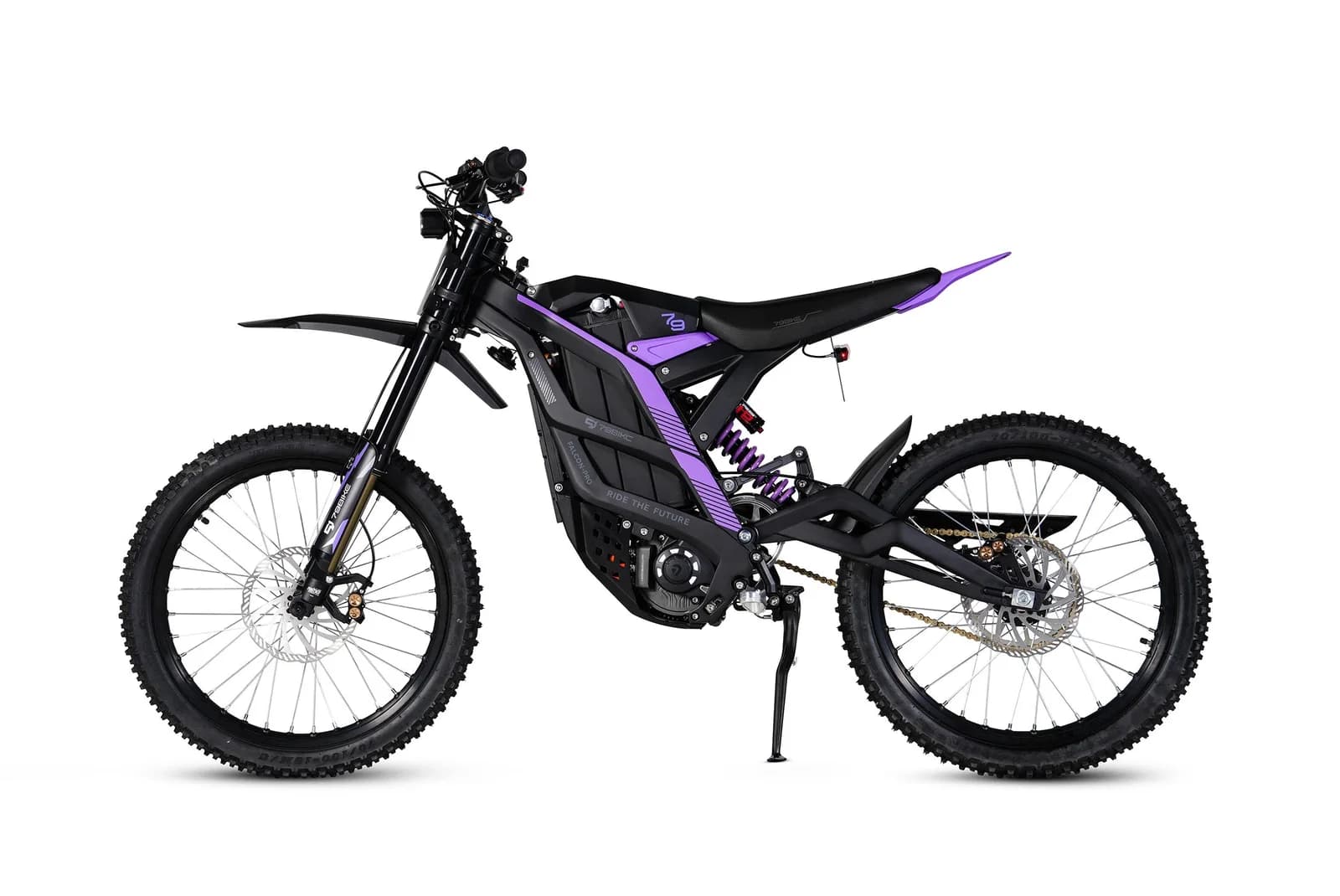
The 79Bike Falcon Pro earns a VoltRipper Score of 82/100, and its case rests on one number most of this class ignores: a published 300 lb rider capacity.
The rest is a competent 2026 light e-moto — 10 kW peak, 56 mph, a 72V/35Ah LG-cell pack (2,520 Wh), 130 lb, a 200 mm inverted fork, and a stated 12-month warranty — for $3,599. Nothing there rewrites the class. But at this price the Sur-Ron Light Bee X and every Talaria Sting publish 220 lb, and the E-Ride Pro SS 2.0 publishes 265 lb. If you are a bigger rider, that gap is the whole review.
Two things the product page does not put in front of you, both of which change the maths:
- $250 shipping, disclosed only in the shipping policy. The Falcon Pro is a ~$3,849 delivered bike, not a $3,599 one. Amazon charges the same $250, so there is no channel that avoids it.
- The warranty only applies if you buy direct. 79Bike services bikes bought through its own website and refers everyone else back to their seller.
Who it's for — and who should skip it
Buy it if you are a heavier rider who has been squeezed by 220 lb ratings, or you want the most rider capacity available near $4,000 and can live with a small brand.
Skip it if you want the deepest aftermarket (Sur-Ron, comfortably), the best performance-per-dollar at this price (the Rawrr Mantis X Pro is $3,899 for 15 kW and 65 mph — see the comparison below), or a brand with a long support record — see the honest section below.
The capacity number, in context
Rider capacity is the least-marketed spec in this category and one of the most consequential: it is a manufacturer limit covering suspension travel, brake performance and frame stress, not a suggestion.
| Bike | Published capacity | Price |
|---|---|---|
| 79Bike Falcon Pro | 300 lb | $3,599 |
| E-Ride Pro SS 2.0 | 265 lb | $4,599 |
| Sur-Ron Light Bee X | 220 lb | $4,499 |
| Talaria Sting R MX4 | 220 lb | $4,100 |
A 240 lb rider in full gear is over the Sur-Ron's and Talaria's published limits and comfortably inside the Falcon Pro's. That is a real, checkable advantage — and it is why this bike is worth writing about despite a mid-pack Score.
Treat it as a design limit rather than a target. For the full picture of who publishes what, see electric dirt bike weight limits. And note the honest flip side: 79Bike publishes capacity on the Pro but not on its Falcon GT, Falcon Lite, Lynx or Viper S, so the brand is not systematically transparent here — it happens to be on this model.
What you actually get
The Pro runs 10 kW peak on a 72V/35Ah LG-cell pack for a claimed 75 miles and a 3.5-hour charge, in a 130 lb chassis with a 200 mm Fastace inverted fork and dual hydraulic discs. Seat height is 32.7 in.
One genuine oddity: it runs 19-inch wheels front and rear. Nearly everything in this class pairs a 19 front with an 18 rear, and a matched 19/19 changes how the bike turns and how easily you will find replacement rears. It is not a fault — it is a choice you should know about before buying tyres.
Two spec figures we will not repeat uncritically:
- 410 N·m is torque at the wheel, after reduction, not at the motor shaft. A rival quoting shaft torque will look roughly ten times weaker on paper while being nothing of the sort.
What it costs you
A small brand that retires models quietly. The Falcon M — this bike's direct predecessor — got no discontinuation notice. Its original product page now returns a 404, and a shorter link to it redirects to this bike's page — so a link to the older model either breaks or silently becomes a link to the newer one, and nothing tells you which. Buyers of a $4,000 machine should factor in that level of communication, and it is part of why the Score sits at 82 rather than higher despite competitive hardware.
A parts store with no fitment data. 79Bike runs its own parts and gear shop, but listings do not state which models they fit — so ordering the right part is guesswork.
Buying anywhere but 79bike.com costs you the warranty. Worth repeating because it is unusual and expensive: the Amazon listing is $200 cheaper than 79Bike's own site, but by 79Bike's policy a third-party purchase gets referred back to that seller for support.
How it compares near $4,000
| Bike | Score | Price | Peak power | Capacity |
|---|---|---|---|---|
| Rawrr Mantis X Pro | 89 | $3,899 | 15 kW | 220 lb |
| Sur-Ron Light Bee X | 89 | $4,499 | 10 kW | 220 lb |
| 79Bike Falcon Pro | 82 | $3,599 | 10 kW | 300 lb |
Rawrr publishes 220 lb for the Mantis X Pro — we sourced that from Rawrr's own spec page on 2026-07-19, having previously carried it as unpublished.
On raw performance-per-dollar the Mantis X Pro wins and it is not close — 15 kW and 65 mph for $300 more. On ecosystem the Light Bee X wins, as it does against everything. The Falcon Pro's argument is narrower and more specific: it carries 80 lb more rider than the Sur-Ron, on paper, for $900 less sticker and about $650 less delivered. If that describes your problem, it is the bike here that solves it.
Every head-to-head we have published on this bike:
Go deeper on the 79Bike Falcon Pro:
Bottom line
A competent bike with one genuinely differentiated spec and two buried costs. If you are a heavier rider, the 300 lb rating makes the Falcon Pro worth serious consideration near $4,000 — nothing mainstream at this price publishes a number close to it. Everyone else is better served by the Rawrr Mantis X Pro for outright performance or the Sur-Ron Light Bee X for the ecosystem.
Whatever you decide: budget $3,849 delivered, not $3,599. On the warranty, 79Bike services bikes bought through its own website and refers everyone else back to their seller — and its policy makes no exception for its own Amazon storefront. If the warranty is what decides it for you, buy direct; it costs $200 more.
VoltRipper is spec-verified and data-driven — we do not claim hands-on testing of this bike. Specs come from 79Bike's product page and compare-models spec table, cross-checked against an independent seller, captured 2026-07-19. Where a published figure looks mislabelled we say so rather than repeat it.
FAQ
Is the 79Bike Falcon Pro worth it?
For a heavier rider, it is one of the most interesting bikes at the price. It publishes a 300 lb rider capacity where the Sur-Ron Light Bee X and Talaria Stings publish 220 lb. The Falcon Pro makes 10 kW and 56 mph for $3,599, at a VoltRipper Score of 82. Two caveats the product page does not put in front of you: 79Bike charges $250 shipping, so the real cost is about $3,849 delivered, and its warranty applies only to bikes bought directly from 79Bike — buy through a dealer and you lose factory support.
What is the difference between the 79Bike Falcon M and the Falcon Pro?
The Falcon M is discontinued — its product page is gone — and the Falcon Pro replaced it. They share a chassis, a 72V/35Ah pack and a 130 lb weight, but the Pro makes 10 kW to the M's 8 kW and runs 56 mph to the M's 50. If you find a listing quoting 8 kW or 50 mph, that is old Falcon M stock whatever the title says.
How much does the 79Bike Falcon Pro actually cost?
$3,599 on Amazon through 79Bike's own 79MOTOS storefront, plus $250 delivery — about $3,849 delivered before tax. 79Bike's own site charges $200 more and has stock, and it is the only channel 79Bike's warranty covers — so that $200 is the price of factory support. Both channels charge the same $250; on 79Bike's side it is disclosed only in the shipping policy. Electric Ride Co. also lists $3,799, with a $4,399 'regular' price that sits above 79Bike's own $3,999 compare-at, so treat that discount depth as marketing.
Does the 79Bike Falcon Pro have a warranty?
12 months on battery, motor, controller and frame — but only if you buy direct. 79Bike states that after-sales service is available only for bikes purchased through its official website, and refers third-party buyers back to their seller. That makes the channel a real decision: Amazon's 79MOTOS storefront is $200 cheaper, and it is the link that pays us, but by 79Bike's own policy it comes without factory support. 79bike.com costs $200 more and is the only channel the warranty covers.
Is the Falcon Pro good for a heavy rider?
It is the most credible option we track in its price class on paper. Its 300 lb published capacity is well above the 220 lb that Sur-Ron and Talaria publish, and above the E-Ride Pro SS 2.0's 265 lb. Bear in mind rider capacity is a manufacturer rating covering suspension, brakes and frame stress, so treat it as a design limit rather than a target to ride at.