Tracked price checks
Bikes in this guide
Yozma
IN10
One of the cheapest ways into a real electric dirt bike — around $1,079 with full hydraulic brakes and suspension
Trade-off: No-name budget brand — minimal aftermarket, spare parts, or dealer/community support
We may earn a commission if you buy through this link, at no extra cost to you. As an Amazon Associate I earn from qualifying purchases.
Check Amazon priceSTACYC
20eDRIVE
The gold-standard kids' electric balance bike — the on-ramp to real dirt riding for ages 11–12
Trade-off: Short 30–60 min runtime per battery
We may earn a commission if you buy through this link, at no extra cost to you. As an Amazon Associate I earn from qualifying purchases.
Check Amazon priceBurromax
TT750R
750W, 26 mph and a 250 lb rider limit — teens and adults can both ride it
Trade-off: Mini-bike size (20" seat) is cramped for tall adults on longer rides
We may earn a commission if you buy through this link, at no extra cost to you.
Check price at BurromaxTriumph/OSET
TXP-20
Current Triumph/OSET TXP-20 keeps the youth-trials focus with four rider modes and PIN lock
Trade-off: Premium price: $3,295 MSRP - real money for a youth trials bike
We may earn a commission if you buy through this link, at no extra cost to you.
Check price at JSC MotorsportsThe short answer
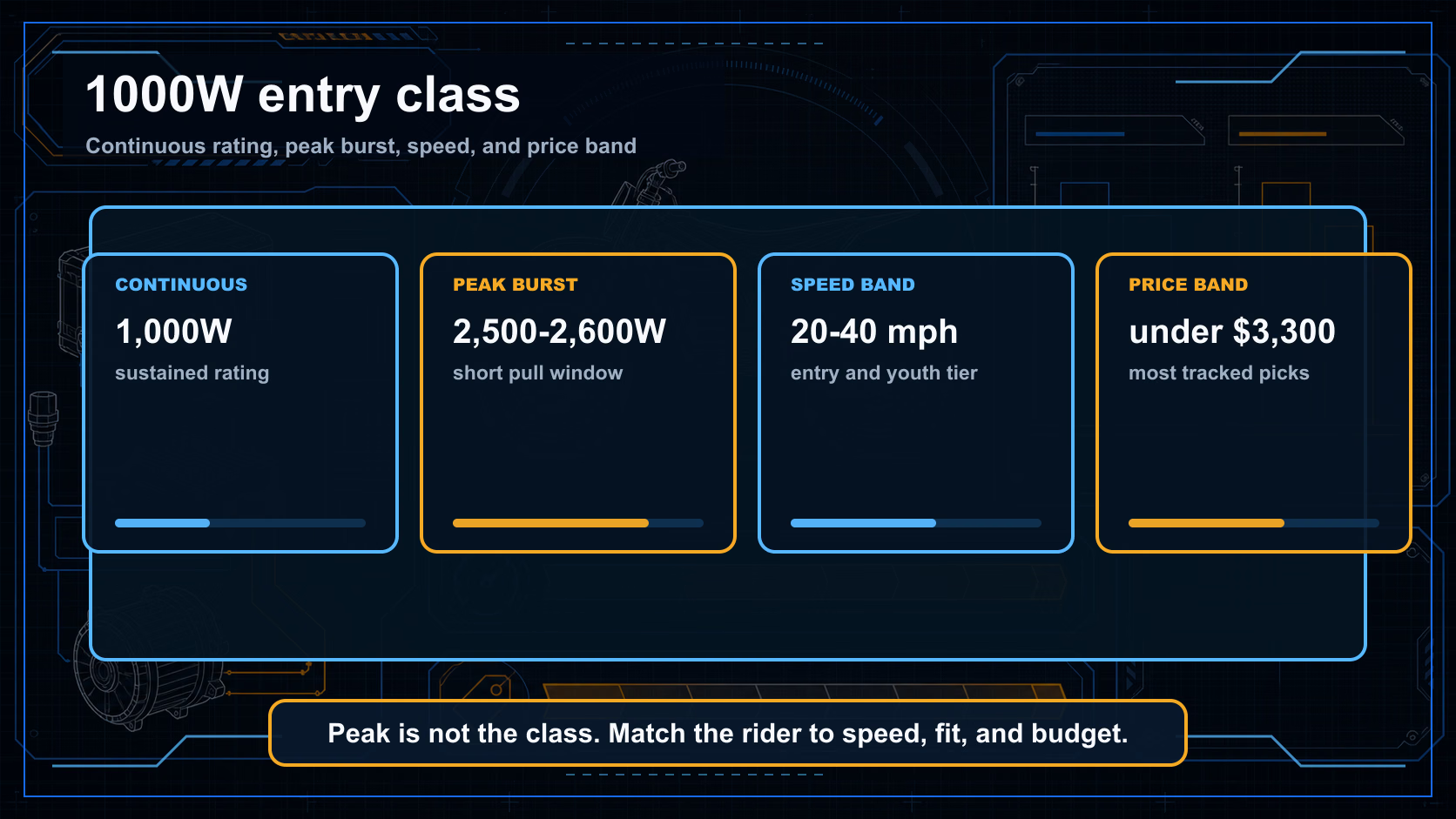
A "1000W electric dirt bike" is the entry and youth tier — first bikes, kids' bikes, and light-duty trail toys — not a scaled-down Sur-Ron. Expect roughly 20–40 mph, and prices from $995 to $3,295 across the bikes we track here.
The first thing to understand is that the number is used inconsistently. Some makers quote the motor's continuous rating, some quote its peak, and at least one budget bike advertises both at once:
| Bike | Score | Continuous | Peak | Top speed | Seat | Price |
|---|---|---|---|---|---|---|
| Yozma IN10 | 72 | 1,000W | 2,600W | 40 mph | 28.0 in | $1,079 |
| Greenger CRF-E2 / G2 | 83 | 1,000W | 2,500W | 20 mph | 24.8 in | $1,799 |
| Burromax TT750R | 79 | 750W | 1,400W | 26 mph | 21.0 in | $995 |
| OSET / Triumph TXP-20 | 76 | 1,200W | not published | 22 mph | 20.7 in | $3,295 |
Read the two power columns together and the whole guide falls out of them: "1000W" can mean a 2,600W-peak trail bike, a 20 mph youth MX bike, or a 750W kid's mini-moto. The label tells you the tier, not the bike.
What "1000W" actually describes
Continuous (nominal) wattage is the power a motor can hold without overheating. In this class it clusters around 750W to 1,200W, and that band maps almost exactly onto a rider profile: young riders, smaller riders, and first-timers doing slow trail, backyard, or practice-track riding.
That is the honest signal in the number. A 1,000W-continuous motor is not a de-tuned performance bike — it is a different class of machine from the 3,000W Sur-Ron tier, where continuous power roughly triples. If you are an experienced adult expecting 50 mph and aggressive trail power, this is not your band, and no amount of "peak wattage" on a listing changes that.
The peak-vs-continuous trap (the Yozma proves it)
The Yozma IN10 is sold as a 1,000W bike and a 2,600W bike — the same bike, two numbers. Its own listings cite the motor as both, and that is not a typo. Continuous is 1,000W; peak is 2,600W, a 2.6× burst the motor can hit for a few seconds. Yozma's own spec sheets disagree with each other on more than the motor, too — the battery is listed as both 12Ah and 23Ah in different places — which is exactly the "optimistic and inconsistent" pattern of budget-brand specs.
Here is how the four featured bikes report power:
- Greenger CRF-E2 / G2 — 1,000W continuous, 2,500W peak (2.5×).
- Yozma IN10 — 1,000W continuous, 2,600W peak (2.6×).
- OSET / Triumph TXP-20 — 1,200W continuous, no published peak at all.
- Burromax TT750R — 750W continuous against a published 1.4 kW peak (1.9×), which Burromax states on its own product page.
So the multiplier is not a constant, and one of these bikes doesn't inflate at all. When you compare "1000W" bikes, compare the same number on each — and if a listing shows only the big one, assume it is peak. Our companion guide on how to read electric dirt bike specs walks through every number sellers round up.
The four we'd point you to
Each with its own price, Score, and what it is actually for — and watch how little the Score tracks the price.
Yozma IN10 — $1,079, Score 72. The value entry. It scores the lowest of these four, but it is the cheapest genuine way in — it pairs full hydraulic brakes and suspension with a removable 48V pack, and steps through 18 / 29 / 40 mph modes so a new rider can grow into it. The catch is the one every budget bike shares: a no-name brand with a thin parts and support network, so treat the headline specs as ceilings.
Greenger CRF-E2 / G2 — $1,799, Score 83. The dealer-backed youth-MX option — a genuine youth-MX bike with an aluminum twin-spar frame, hydraulic discs, and a swappable 960 Wh pack, sold through authorized dealers rather than a marketplace listing. It tops out near 20 mph on 12-inch wheels, so taller or older kids outgrow it. Note the sticker: the $1,799 price excludes a $400 freight charge plus dealer fees, so the out-the-door number is higher.
Burromax TT750R — $995, Score 79. The smallest and cheapest here — a 750W, 26 mph mini-moto with a 14 mph learner mode, hydraulic discs, and a surprisingly high 250 lb rider limit, so a parent can ride it too. The 20-inch seat is cramped for tall adults on anything but short laps, and range is only about 14 miles.
OSET / Triumph TXP-20 — $3,295, Score 76. The outlier, and the most instructive one. It is a youth-trials specialist now sold under Triumph's OSET line, with four rider modes, PIN-lock, and adjustable air suspension — a precise, low-speed skills bike, not a fast trail machine at 22 mph. It is also the priciest of the four yet earns a Score of just 75 — below the $995 Burromax and the $1,799 Greenger — because the VoltRipper Score weighs value and capability, and a $3,295 trials bike is built for a narrow job. Price and Score barely track in this class — spend up here only if trials is genuinely the goal.
Who a 1000W bike is for (and who should skip it)
- A young rider moving up from a balance bike → a bike rated for their age, which here means the Triumph/OSET TXP-20 (rated 7–10). The Greenger was the other until it was discontinued in July 2026, and the Burromax TT750R is rated 16+.
- A first adult bike, tight budget, slow riding → the Yozma IN10, with clear eyes about no-name support.
- A youth-trials rider → the OSET / Triumph TXP-20, and only if the trials focus is real.
- An adult who wants Sur-Ron-class trail performance → not this band. Continuous power here tops out at 1,200W; the Sur-Ron class runs 3,000W continuous and 10,000W peak. Start with how to choose an electric dirt bike instead.
One more honest note for the youngest riders: seat height and rider rating matter more than watts here. Seats run from 20.0 to 28.0 inches across these four, and rider ratings from 99 lb (Greenger) to 264 lb (Yozma) — our weight-limits guide covers why that rating is a real buying constraint, not a footnote.
The bottom line
"1000W" is a tier, not a spec. It marks the entry and youth class — 20–40 mph, mostly under $2,000, built for new and smaller riders — and inside it the power figure is quoted so inconsistently that the same Yozma is a "1,000W" and a "2,600W" bike at once. The value pick is the Yozma IN10 at $1,079 (Score 72); the dealer-backed youth-MX pick is the Greenger CRF-E2 / G2 at $1,799 (Score 83); and the pricey OSET / Triumph TXP-20 at $3,295 (Score 76) proves that in this band, the sticker tells you almost nothing about the bike. Shop the continuous watts, the seat height, and the rider rating — not the biggest number on the listing.
The other power and voltage bands:
- 36V Electric Dirt Bikes: The Kids' Band, Decoded by Age and Fit
- 48V Electric Dirt Bikes: Every Model, and the $5,637 Question
- 60V Electric Dirt Bikes: Every Model, and Why the Step to 72V Is Real
- 72V Electric Dirt Bikes: Every Model, and Why the Number Tells You Less Than You Think
- 3000W Electric Dirt Bike: The Sur-Ron Class
- 5000W Electric Dirt Bike: The Value Power Tier
- 8000W Electric Dirt Bike
VoltRipper is independent — our guidance comes from verified specs and the transparent VoltRipper Score, not commissions. We are spec-verified and data-driven rather than hands-on. Affiliate disclosure is included on monetized pages.
FAQ
How fast is a 1000W electric dirt bike?
Between about 20 and 40 mph across the entry bikes we track. A youth-trials or trainer-class bike like the Greenger CRF-E2 tops out near 20 mph; a budget trail mini-moto like the Yozma IN10 reaches about 40 mph in its top mode but ships in an 18 mph learner setting. It is a first-bike and youth speed band, not a Sur-Ron replacement.
Is 1000W enough for an adult on a dirt bike?
For a light adult doing slow trail or backyard riding, a 1,000W-continuous bike that peaks around 2,600W is genuinely usable — the Yozma IN10 carries a 264 lb rider rating. For an adult who wants real off-road performance, it is not; that starts in the 3,000W Sur-Ron class, where continuous power roughly triples and peak power reaches 10,000W.
Why does a 1000W bike also say 2600W?
Because the two numbers measure different things. Continuous (nominal) wattage is what the motor can sustain; peak wattage is a short burst it can hit for seconds. The Yozma IN10 is sold as both a 1,000W and a 2,600W bike for exactly this reason. Peak is the bigger, louder number, so it dominates marketing — and it is the single most misread figure on any e-dirt-bike spec sheet.
What is the best 1000W electric dirt bike?
For a genuine first bike, the Yozma IN10 (about $1,079, VoltRipper Score 72) is the value pick, and the Greenger CRF-E2 / G2 (Score 83) was the dealer-backed youth-MX option until it was discontinued in July 2026, so look for remaining stock or a used one. The pricey OSET/Triumph TXP-20 (about $3,295, Score 76) is a youth-trials specialist — proof that in this class price and Score barely track.
Sources
Specification sources
- Yozma IN10Yozma Sport — IN 10 product pageChecked
- STACYC 20eDRIVESTACYC — 20eDRIVE product page ("Perfect for 9-12yr olds under 115lbs"), read 2026-09-14Checked
- Burromax TT750RBurromax — TT750RChecked
- Triumph/OSET TXP-20RideApart - Triumph/OSET TXP youth e-dirt-bikes launch (US pricing $3,995)Checked