Sur-Ron Storm Bee
45 real / 75 claimed mi
Stark Varg MX 1.2
35 real / 50 claimed mi
Volcon Grunt EVO
45 real / 70 claimed mi
Onyx RCR
45 real / 130 claimed mi
Segway Dirt eBike X160
22 real / 40 claimed mi
Altis Sigma
35 real / 50 claimed mi
Sur-Ron Light Bee X
30 real / 47 claimed mi
Apollo (RFN) RFN Ares Rally Pro
40 real / 90 claimed mi
Tracked price checks
Bikes in this guide
Altis
Sigma
Highest top-speed claim in the catalog: 97.2V, 25 kW peak, 80+ mph claimed for the fastest gearing (real-world ~70+ mph)
Trade-off: Newer brand, so parts depth, resale, and owner history are far behind Sur-Ron or Talaria
We may earn a commission if you buy through this link, at no extra cost to you.
Check price at REVRidesOnyx
RCR
Moped-style comfort with a seat, lights, and a street kit — the most commuter-friendly bike here
Trade-off: Heavy (~155 lb) and moped-shaped — less capable in technical off-road than a true dirt bike
We may earn a commission if you buy through this link, at no extra cost to you.
Check price at Onyx Motors (official)Sur-Ron
Storm Bee
Full-size motorcycle performance — ~75 mph and a huge 5.7 kWh (104V/55Ah) pack
Trade-off: Heavy (~280 lb) and fast — an expert bike, not a beginner's
We may earn a commission if you buy through this link, at no extra cost to you.
View official pageSegway
Xaber 300
Established brand with a real US dealer network, app ecosystem, and smart-vehicle features rare in this class
Trade-off: New model, so aftermarket parts and owner knowledge are nascent versus Sur-Ron and Talaria
We may earn a commission if you buy through this link, at no extra cost to you.
Check price at SegwayThe number on the spec sheet is not the number you'll get. We hold both a claimed and a real-world figure for 30 of the bikes we track, so we can measure the gap rather than assert it: the average bike returns 59% of its advertised range. A bike advertised at 40-75 miles usually delivers 25-35 miles.
But the average hides how wide the spread is, and the spread is the useful part. Of those 31 bikes: 3 return under 40% of the claim, 11 land between 40% and 60%, 14 between 60% and 80%, and 3 come in above 80%. The extremes are real — the Delfast Top 3.0's 200-mile touring claim returns about 20% off-road, while the Kuberg Ranger's modest 19-mile claim is one you can actually hit. So "expect roughly 60%" is a starting point, not a rule, and a bike whose claim was measured at walking pace will miss it by more than one measured sensibly.
One honest note on our own number: four of those 31 real-world figures are our own battery-based estimates rather than measurements, and they happen to sit at exactly 60% of claim. Exclude all four and the average barely moves, to 59% across the remaining 27 — so the figure survives its own worst objection. This is the single most common disappointment for new buyers, and it's entirely predictable once you know how the claim is measured. Here's the data, the why, and how to buy for the range you actually need.
For a bike-specific band, run the electric dirt-bike range estimator. It shows the claimed-range multiplier, rider-weight adjustment, terrain, temperature, and uncertainty band instead of hiding the arithmetic.
The claimed-vs-real data
We publish a real-world range estimate on every model page, and we hold both figures for 31 bikes. Below is a cross-section of 14 of them, chosen to span the battery range from 1.9 to 7.2 kWh — manufacturer claim vs. our own real-world estimate for aggressive riding, ordered by battery size. Where a claim was measured in a particular mode, the row says so, because that is usually the whole explanation for a flattering number:
| Bike | Battery | Claimed range | Real-world (hard riding) |
|---|---|---|---|
| Segway X260 | 1.9 kWh | 74.6 mi | ~25-30 mi |
| Sur-Ron Light Bee X | 2.5 kWh | 47 mi | ~25-35 mi |
| Arctic Leopard XF Pro | 2.5 kWh | 50 mi | ~30 mi |
| Rawrr Mantis X Pro | 2.5 kWh | 62 mi (eco) | ~35 mi |
| Talaria Sting R MX4 | 2.7 kWh | 46 mi | ~28 mi |
| Talaria Sting MX5 Pro | 2.9 kWh | 62 mi | ~35 mi |
| E-Ride Pro SS 2.0 | 2.9 kWh | 50 mi | ~35 mi |
| Apollo RFN Ares | 3.1 kWh | 90 mi | ~40 mi |
| Segway Xaber 300 | 3.2 kWh | 62 mi | ~35 mi |
| Delfast Top 3.0 | 3.4 kWh | 200 mi (eco) | ~30-50 mi (throttle) |
| Altis Sigma | 3.4 kWh | 50 mi | ~35 mi |
| Onyx RCR | 3.6 kWh | 130 mi | ~45 mi |
| Sur-Ron Storm Bee | 5.7 kWh | 75 mi (low-speed) | ~45 mi |
| Stark Varg | 7.2 kWh | 50 mi | ~35 mi |
The pattern is consistent: the bigger the headline number relative to the battery, the more it was measured at crawl speed. The Delfast's 200-mile claim is a pedal-assisted eco figure; ridden as a moto on the throttle it's a fraction of that — the widest claim-vs-real gap on the board.
But bigger battery doesn't automatically mean more miles. Notice the heavy full-size motos: the Storm Bee (5.7 kWh) and Stark Varg (7.2 kWh) return only ~35-45 real miles despite the largest packs here, because a fast, heavy race/moto bike burns far more energy per mile than a light trail bike. How you ride matters as much as pack size — a 45 mph trail bike sips; a 75 mph moto at race pace gulps.
The one bike here with an instrumented independent test
Notice that the Sur-Ron Ultra Bee is missing from that table. It is missing on purpose, and the reason is the most useful thing on this page.
Almost every "real-world" range figure in this class — including most of ours — is an estimate derived from battery capacity, not a measurement. The Ultra Bee is the exception we could find: Cycle News tracked it with a GPS app across multiple rides and reported up to 60 miles on trails, at roughly a 24 mph moving average, on the same 74V/60Ah pack our record carries.
That is a real number, and it still doesn't belong in the column above, because the column is hard riding and 24 mph on trails is not hard riding. Sur-Ron's own 71-mile claim for the same bike is a constant-31-mph figure. Three honest numbers for one motorcycle — 71 claimed at a steady 31 mph, 60 measured at trail pace, and an unknown figure ridden hard — and the only dishonest thing you could do is average them.
That is why we leave the Ultra Bee's real-range cell empty rather than filling it. When you read anyone's range table, including ours, the question that matters is not what number but measured how.
Why the gap exists
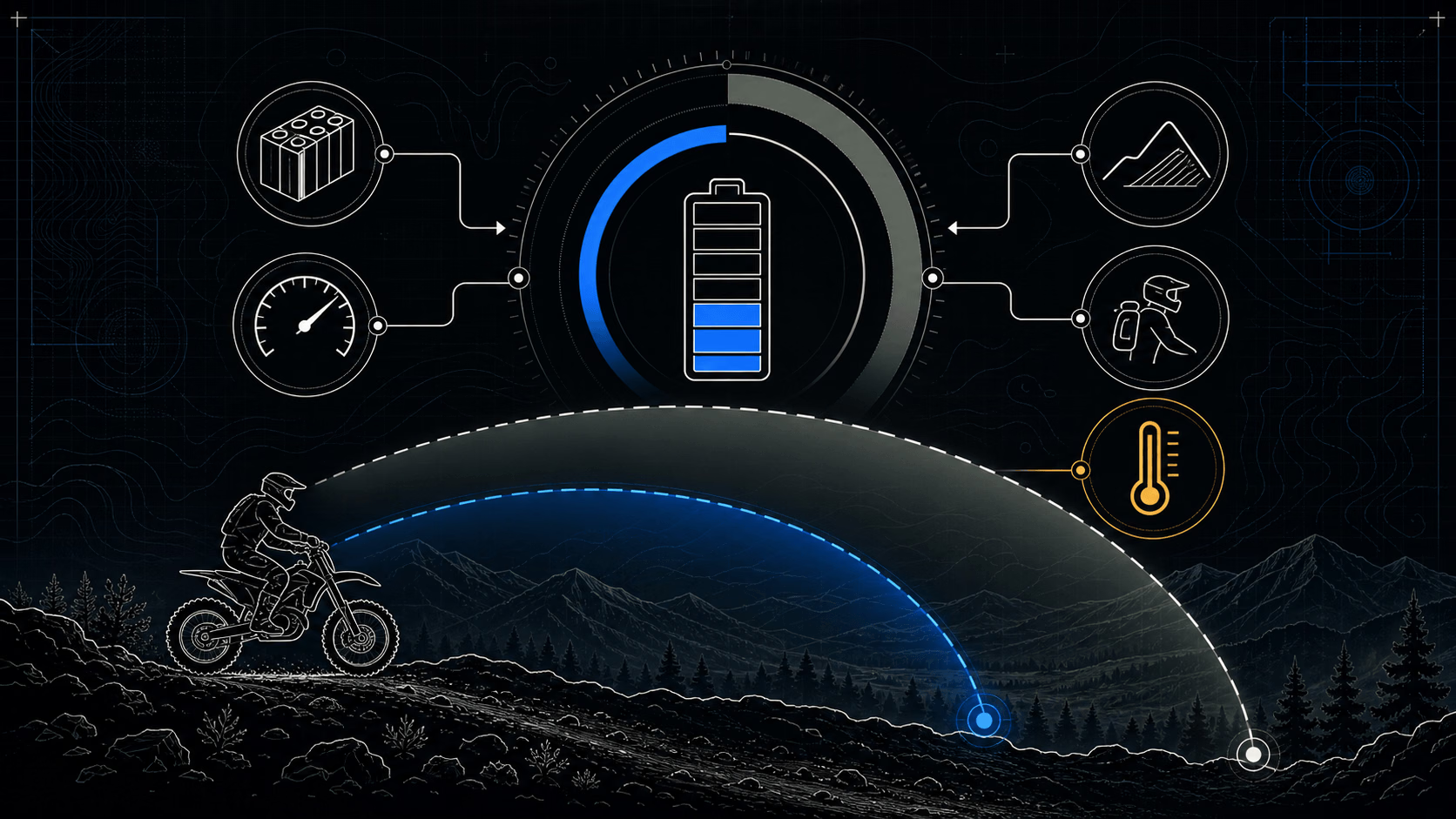
Manufacturers quote range under ideal conditions — a low, constant speed (often 12-20 mph), a light rider, flat ground, and warm weather. Real riding breaks every one of those assumptions:
- Speed is the big one. Aerodynamic drag rises with the square of speed, so doubling your pace far more than doubles the energy per mile.
- Terrain — hills, mud, and jumps spike current draw.
- Rider weight and cargo add load.
- Cold weather temporarily cuts usable battery capacity.
- Throttle style — aggressive, punchy riding is dramatically less efficient than smooth cruising.
None of this is a defect. It's the difference between a lab number and a trail number.
How to read the spec (the honest way)
Ignore the advertised miles and look at two things:
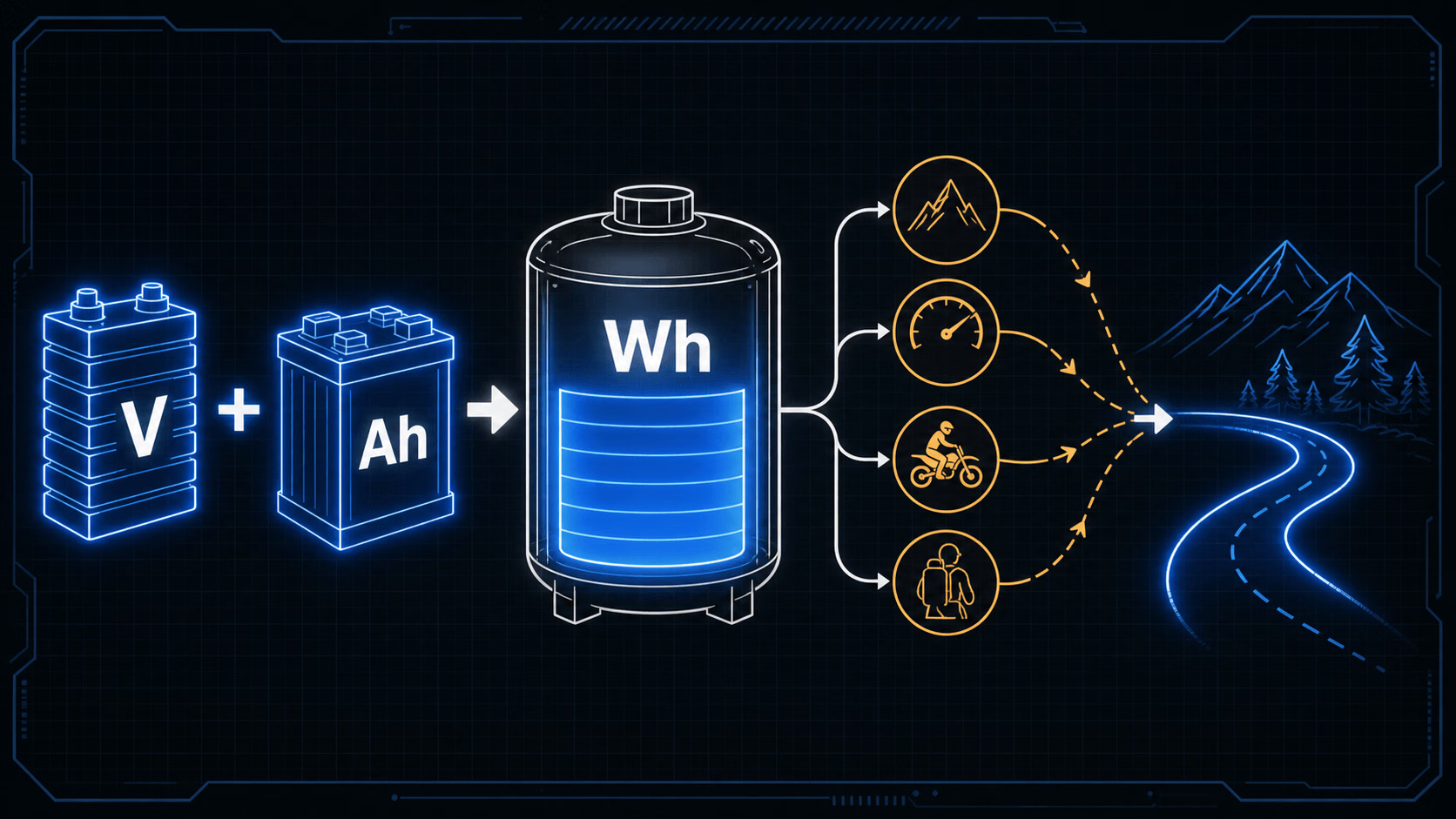
- Watt-hours (Wh) — the true size of the tank. Multiply battery voltage × amp-hours if it isn't listed (e.g., 60V × 45Ah = 2,700 Wh). The adult trail class is ~2,000-2,700 Wh; 3,000+ Wh is long-range.
- A real-world rule of thumb: expect roughly 40-70 Wh per mile for light trail bikes when ridden hard; full-size motos can burn much more. A 2,500 Wh trail pack ÷ ~55 Wh/mi ≈ ~45 minutes to an hour of hard trail riding, or ~25-40 miles depending on how you ride.
That single calculation predicts real range better than any sticker.
How to get more range
- Ride in eco/low-power mode and keep your speed down — the biggest lever by far.
- Air up your tires and keep the battery warm in the cold.
- Buy a bigger pack — the Sur-Ron Storm Bee (5.7 kWh) genuinely goes further. The Delfast Top 3.0 (3.4 kWh) does too, but it is discontinued with no purchasable path we can find, so treat it as a used-market option.
- Buy a swappable-battery bike — models like the E-Ride Pro SS and the Rawrr Mantis X let you carry a second charged pack. The Segway X260 did the same and is now discontinued, replaced by the Xaber 300, so treat it as a used-market option. A spare pack and hot-swap it, effectively doubling range on the trail — see our charging guide for charge times and trail-charging tips.
Bottom line
Buy on watt-hours and our real-world estimate, never the advertised miles. If range is your priority, filter for it: the Find Your Ride configurator and our best long-range picks rank bikes on usable energy, not marketing claims. Set expectations at ~25-35 real miles for the trail class, plan for a swappable pack if you ride all day, and you'll never be caught out on the trail with a dead battery.
Range estimates are VoltRipper's own, based on battery capacity and third-party owner data; your mileage varies with speed, terrain, weight, and weather. VoltRipper is reader-supported — we may earn a commission on purchases through our links at no extra cost to you, and it never affects our rankings. See our disclosure.
FAQ
How far can an electric dirt bike really go on one charge?
For the adult trail class (Sur-Ron, Talaria), plan on 25-35 real miles of aggressive riding, even when the sticker says 40-75. Ridden gently at low speed you can approach the claim; ridden hard you'll see roughly 40-60% of it. Big-battery bikes like the Delfast Top 3.0 go further; small kids' bikes give 30-60 minutes of playtime, not miles.
Why is my electric dirt bike range so much lower than advertised?
Manufacturers measure range at a low, constant speed (often 12-20 mph) with a light rider. Real riding — full throttle, hills, jumps, a heavier rider, cold weather — draws far more current, so real range is typically 40-60% of the claim. It's not a defect; it's how the number is measured.
What is a good battery size for an electric dirt bike?
Look at watt-hours (Wh), not advertised miles. The adult trail class runs about 2,000-2,700 Wh, which is roughly 25-40 real miles. Under ~2,000 Wh is short-range or youth-oriented; 3,000+ Wh (Altis Sigma, Onyx RCR, Delfast, Sur-Ron Storm Bee) is genuinely long-range, though very fast bikes burn it quickly. A useful rule of thumb: expect ~40-70 Wh per real mile ridden hard.
How can I get more range from my electric dirt bike?
Ride in eco/low-power mode, keep speed down, air up your tires, and keep the battery warm in cold weather. For real gains, buy a bike with a bigger pack or a swappable battery you can hot-swap on the trail (Segway, E-Ride Pro, Rawrr, Cake). Carrying a second charged pack effectively doubles your range.
Sources
Editorial sources
Specification sources
- Altis SigmaAltis Powersports - Sigma product pageChecked
- Onyx RCROnyx Motors — RCR 80V 45AhChecked
- Sur-Ron Storm BeeSur-Ron USA - Storm BeeChecked
- Segway Xaber 300Segway - Xaber 300 official specificationsChecked