Tracked price checks
Bikes in this guide
Sur-Ron
Light Bee X
Enormous aftermarket and parts ecosystem — the most-supported e-dirt-bike platform
Trade-off: Advertised range collapses at speed — plan for real-world miles well under the claim
We may earn a commission if you buy through this link, at no extra cost to you.
Check price at ATV Wholesale OutletRawrr
Mantis X
Sur-Ron-class performance (72V, 50 mph) at a value price (~$2,999)
Trade-off: Smaller aftermarket and shorter track record than Sur-Ron
We may earn a commission if you buy through this link, at no extra cost to you.
View official pageTalaria
Sting R MX4
Bigger 2,700 Wh (60V/45Ah) LG-cell pack than a stock Sur-Ron — more usable range
Trade-off: Ships factory-limited to 20 mph — needs derestriction to reach its ~40+ mph potential
We may earn a commission if you buy through this link, at no extra cost to you.
Check price at Luna CycleThe short answer
A "3000W electric dirt bike" is the Sur-Ron Light Bee class — the machine most people picture when they say "electric dirt bike." It is the mainstream adult trail tier: roughly 47–50 mph, $2,999 to $4,499, and built on a genuine 3,000W-continuous motor rather than a youth-bike label.
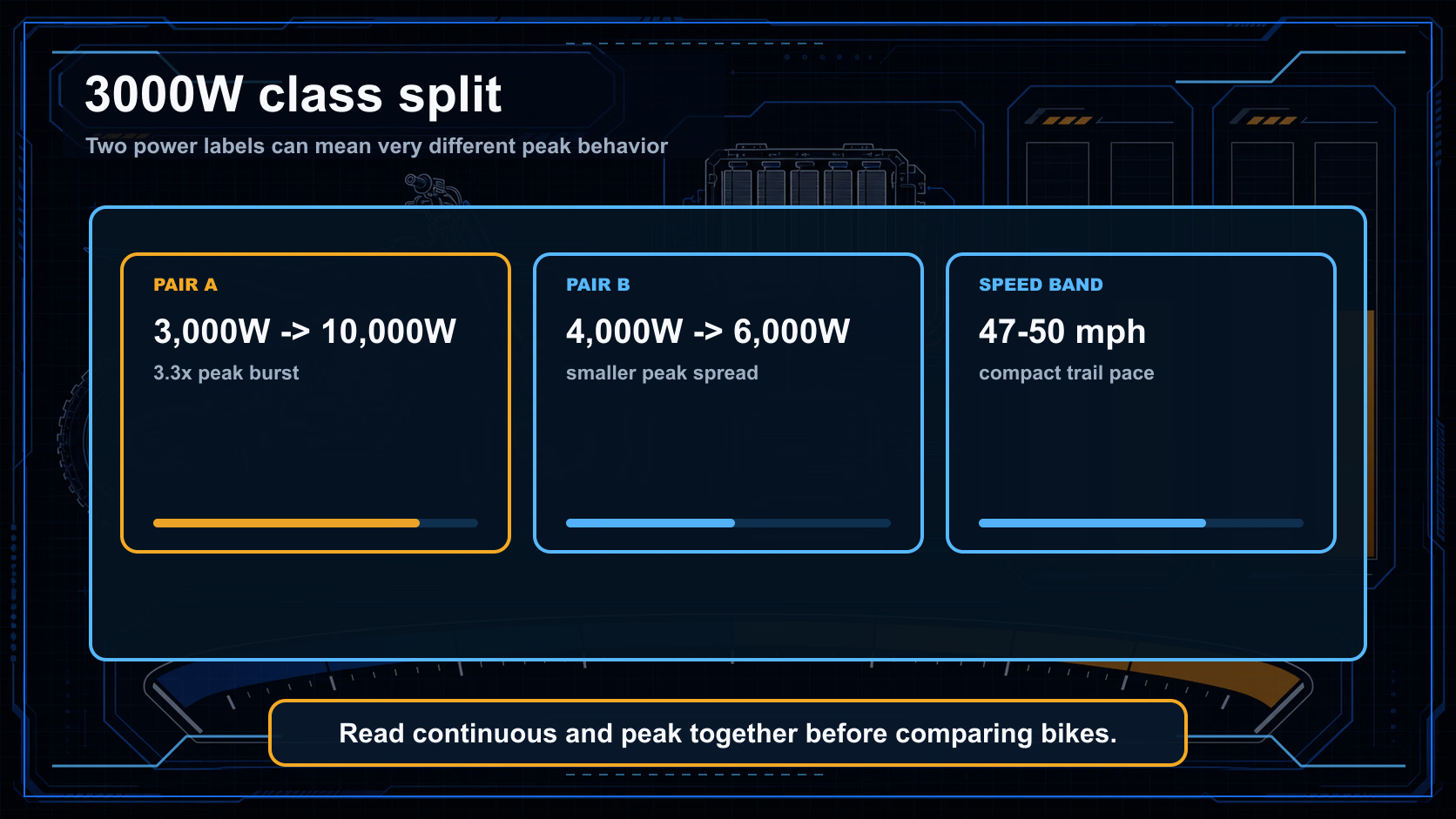
And the single most important fact in the whole class: that "10,000W" Sur-Ron is a 3,000W bike. The 10 kW figure is peak — a burst the motor holds for seconds. The 3,000W continuous rating is what it sustains.
| Bike | Score | Continuous | Peak | Top speed | Price |
|---|---|---|---|---|---|
| Sur-Ron Light Bee X | 89 | 3,000W | 10,000W | 50 mph | $4,499 |
| Talaria X3 (xXx), discontinued | 88 | 3,000W | 6,500W | 47 mph | $3,550 |
| Talaria Sting MX3, discontinued | 86 | 4,000W | 6,000W | 47 mph | $3,700 |
| Rawrr Mantis X | 83 | 3,000W | 6,500W | 50 mph | $2,999 |
Why "3000W" is the clearest peak-vs-continuous example anywhere
Take the two Sur-Ron numbers side by side. The Sur-Ron Light Bee X is rated 3,000W continuous and 10,000W peak — a 3.3× gap, the widest in this guide. That is not Sur-Ron being dishonest; it is how electric motors are specified. But it means the number a shopper sees first (10 kW) is over three times the number that describes the bike's sustained behavior (3 kW).
Now line up the class and watch the two figures refuse to move together:
- Sur-Ron Light Bee X — 3,000W continuous, 10,000W peak (3.3×).
- Rawrr Mantis X — 3,000W continuous, 6,500W peak (2.2×).
- Talaria X3 (xXx) — 3,000W continuous, 6,500W peak (2.2×).
- Talaria Sting MX3 — 4,000W continuous, 6,000W peak (1.5×).
Look at the Sting MX3 against the Light Bee — the MX3 is discontinued now, but its numbers still make the point. The Talaria Sting MX3 makes more continuous power than the Light Bee — 4,000W to 3,000W — yet less peak — 6,000W to 10,000W. If you shopped on the continuous number you would rank them one way; on the peak number, the opposite. Neither single figure tells you which bike is stronger, which is the entire reason our specs guide exists.
Every bike in this class, on its own terms
Each pick with its own price, Score, and honest caveat.
Sur-Ron Light Bee X — $4,499, Score 89. The class benchmark and the highest-scoring of these four. What earns the Score is not raw output — its 10,000W peak is mid-pack against newer rivals — but the deepest aftermarket and parts ecosystem of any bike in the category, which is why it holds value and why a broken part is a quick fix rather than a project. The 2026 model's jump to 72V/10 kW peak is a real step up over older 60V Light Bees, but confirm any listing says 72V — previous-generation 60V bikes still sell alongside it. Rated range is ~47 mi; plan for ~25–35 mi ridden hard.
Talaria X3 (xXx) — $3,550, Score 88, discontinued. The strongest-scoring of the value bikes, now found only as remaining dealer stock or used. Luna Cycle, Talaria's only listed US dealer, has replaced it with the XXX Pro, which is not in our catalog. A compact ~125 lb chassis on a 60V/2.4 kWh pack, with strong Talaria parts support and a genuine street-kit path (it scores as kit-legal). The honest catch: it ships limited to 20 mph and needs derestriction to reach its rated 47 mph, which carries local-law risk.
Talaria Sting MX3 — $3,700, Score 86, discontinued. The value Sting — a 60V/2.28 kWh LG-cell bike with four-piston hydraulic brakes and a gearbox drive, now selling through final stock at roughly $3,700, below the bigger Sting R MX4. Talaria discontinued it in August 2026. Like the X3 it ships speed-limited to 20 mph, and the base trim is off-road only. It carries the most continuous power of these four on paper (4,000W) — but the lowest peak (6,000W).
Rawrr Mantis X — $2,999, Score 83. The value alternative and the cheapest of the four. It delivers Sur-Ron-class 72V, 50 mph performance and a swappable Samsung pack for $2,999, which is a genuine budget route into the class. It scores below the others because of a smaller aftermarket, basic instrumentation, and no app — you trade Sur-Ron's support depth for the lower price.
So which 3000W bike should you buy?
- Buy the Light Bee X if you want the platform with the deepest aftermarket and support — the reason it holds value — and the extra money over the value bikes is worth long-term peace of mind.
- Buy the Rawrr Mantis X if price is the priority — it is the cheapest of the four here at $2,999, and a fair value pick from our budget guide.
- Buy a Talaria X3 only if you find remaining dealer stock or a good used one, and you want the strongest value Score and a real street-kit path — accepting the 20 mph speed limit it ships with and the derestriction step. The X3 is discontinued, and so is the Sting MX3 that did the same job.
The wattage will not decide this for you. All four sit within a 3,000–4,000W continuous band, and the things that actually separate them are support, price, the 20 mph limit, and street-legal path — not the number on the motor.
The bottom line
"3000W" is the Sur-Ron class, and it is the honest heart of this whole category. The headline "10,000W" on a Light Bee is a peak burst; the 3,000W continuous rating is the real one, and across the class continuous power (3,000–4,000W) and peak power (6,000–10,000W) do not move together. The benchmark is the Sur-Ron Light Bee X at $4,499 (Score 89) for its support depth, and the value pick is the Rawrr Mantis X at $2,999 (Score 83). The strongest value Score belongs to the Talaria X3 (Score 88), but it is discontinued. Match the bike to what you value — support, price, or a street kit — and treat the peak-watt number as marketing, not measurement.
The other power and voltage bands:
- 36V Electric Dirt Bikes: The Kids' Band, Decoded by Age and Fit
- 48V Electric Dirt Bikes: Every Model, and the $5,637 Question
- 60V Electric Dirt Bikes: Every Model, and Why the Step to 72V Is Real
- 72V Electric Dirt Bikes: Every Model, and Why the Number Tells You Less Than You Think
- 1000W Electric Dirt Bike: The Entry Class, Explained
- 5000W Electric Dirt Bike: The Value Power Tier
- 8000W Electric Dirt Bike
VoltRipper is independent — our guidance comes from verified specs and the transparent VoltRipper Score, not commissions. We are spec-verified and data-driven rather than hands-on. Affiliate disclosure is included on monetized pages.
FAQ
Is a Sur-Ron really 3000W?
Yes — continuously. The 2026 Sur-Ron Light Bee X is rated at 3,000W nominal (continuous) and 10,000W peak. The '10kW' number that dominates the marketing is a short burst the motor can hit for seconds, not sustained output. So a '10,000W Sur-Ron' and a '3,000W Sur-Ron' are the same bike described two ways, and the 3,000W figure is the one that describes how it behaves most of the time.
How fast is a 3000W electric dirt bike?
About 47–50 mph across this class. The Sur-Ron Light Bee X and Rawrr Mantis X reach roughly 50 mph; the Talaria X3 and Sting MX3 are rated near 47 mph but ship factory-limited to 20 mph and need derestriction to get there. Top speed in this class tracks gearing and derestriction more than the raw wattage.
Is 3000W enough for an adult electric dirt bike?
For most riders, yes — this is the mainstream adult trail class. A 3,000W-continuous bike that peaks around 6,500–10,000W handles real trail riding, jumps, and 50 mph. Step up to the 5,000W value tier or the 8,000W high-power class only if you specifically want more top-end and can handle a heavier, faster bike.
What is the best 3000W electric dirt bike?
The Sur-Ron Light Bee X (about $4,499, VoltRipper Score 89) is the class benchmark, mainly for its deep aftermarket and parts support. The Rawrr Mantis X (about $2,999, Score 83) is the value alternative. The Talaria X3 (Score 88) was the strongest-scoring of the value bikes until it was discontinued. The right one depends on whether you value support, price, or a street kit.
Sources
Specification sources
- Sur-Ron Light Bee XATV Wholesale Outlet - 2026 Sur-Ron Light Bee X (72V/35Ah, 10 kW), $4,699 from $4,999Checked
- Rawrr Mantis XRide Rawrr — Mantis XChecked
- Talaria Sting R MX4Talaria Canada - Sting R MX4 specificationsChecked