The verdict
The Segway Xaber 300 is the most credible established-brand entry into a segment otherwise ruled by boutique makers — and it backs the brand name with serious hardware. It earns a VoltRipper Score of 89/100 — an upper-tier result on our board, one point behind the Sur-Ron Light Bee X (89). What you're paying for is threefold: an unusually strong 21 kW peak / 600 N·m powertrain in a ~187 lb package, a premium chassis (Marzocchi inverted fork, 4-piston hydraulic brakes), and something Sur-Ron and Talaria don't offer — a real US dealer network, a companion app, and smart-vehicle features. It also ships ready to run at ~60 mph with no factory speed limiter. The trade-offs are a higher $5,299 price and a brand-new aftermarket. Buy it if you want dealer-backed, ships-ready performance and don't need the deepest parts ecosystem.
Who it's for — and who should skip it
Buy it if you want an established brand with genuine dealer support and an app, you value premium suspension and brakes out of the box, you want strong power-to-weight, and you'd rather ride at full speed on day one than derestrict anything.
Skip it if you want the lowest price in the class, need the single deepest parts-and-community ecosystem (still Sur-Ron), need a street-legal bike as delivered, or you specifically want a trail-swappable battery for extended-range days (the Xaber's pack is service-removable, not a quick-swap).
What sets it apart: an established brand in a boutique segment
Most bikes at this level come from small, direct-to-consumer specialists. The Xaber 300 is different: Segway brings a nationwide dealer footprint, a real warranty channel, an app, and smart-vehicle features that are rare in off-road electrics. For a buyer who's nervous about mail-order support from a boutique brand, that's a legitimate reason to pay a premium — you have somewhere to take the bike, and a company with scale behind it. It's the closest thing this class has to a "grown-up" purchase.
What you're actually buying: power-to-weight and a premium chassis
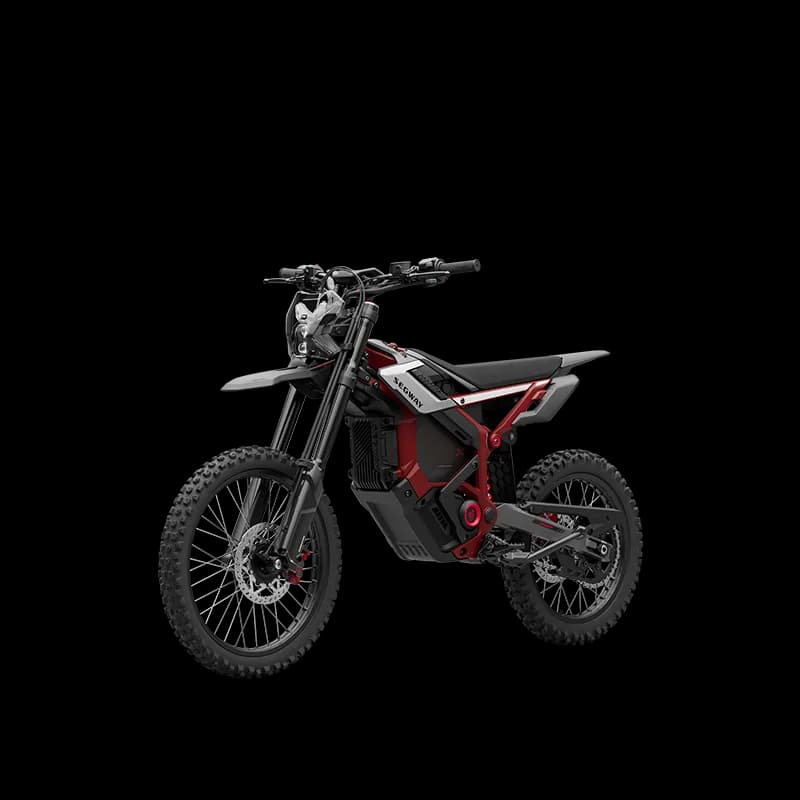
The hardware justifies the price. The Xaber runs a 72V, 44 Ah (3,168 Wh / ~3.2 kWh) pack feeding a motor rated to 21 kW peak and 600 N·m — genuinely strong numbers — in a bike that weighs only about 187 lb. That power-to-weight, plus four power modes, gives it roughly 60 mph out of the box with no factory limiter to unlock. Underneath, it's better-equipped than most rivals at the price: a Marzocchi inverted fork with matched 220 mm travel front and rear, four-piston hydraulic brakes, and 19/18-inch knobbies. This is a properly specced trail machine, not a parts-bin build.
By the numbers: the premium, computed
Our standard computed metrics from the verified spec set:
| Metric | Xaber 300 | How it reads |
|---|---|---|
| Battery per dollar | 0.60 Wh/$ | Mid-pack — you're not buying this bike for watt-hours per dollar |
| Power to weight | 112 W/lb | The real headline: near-Ultra-Bee punch (126) for $1,200 less |
| Price per real-world mile | ~$151/mi | The premium-tier norm (Light Bee X: ~$147) — real range costs real money in this class |
Read plainly: the Xaber's computed case is power-to-weight and chassis hardware, not battery value — 112 W/lb with a Marzocchi/4-piston spec undercuts the Ultra Bee's price by $1,200 while giving up only 14 W/lb. If you want maximum watt-hours per dollar instead, the SS 3.0 (0.72) is that bike.
The other number nobody advertises: a 330 lb payload
Segway publishes a 150 kg payload — 330 lb for the Xaber 300, and almost nobody mentions it. It matters because the class norm is 220 lb: every Sur-Ron, every Talaria Sting, and Segway's own X260 all publish that same 100 kg figure. The Xaber carries 110 lb more rider than the bike it replaces.
That makes it one of only two bikes we track pairing a rating above 300 lb with real power — the other being the Talaria Komodo at 353 lb and $700 more. For a heavier rider this is the most under-discussed reason to look at a Xaber at all, and it is why it appears on our best bikes for heavy riders list.
Worth keeping in proportion: it is a 187 lb machine, so a bigger rider is also handling a bigger bike, and the rating is a design limit for frame, suspension and brakes rather than a target to sit at.
The number nobody advertises: real-world range
Segway rates the Xaber 300 at ~62 miles. In mixed, real-world riding, plan for ~35 miles — the same claimed-vs-real gap that runs across this entire category, and the reason we publish both figures. The 3.2 kWh pack is among the larger ones in the class and helps, but aggressive trail riding in the top power mode drains it far faster than the low-speed rating implies. Budget your loop off the real number, not the box number — our range guide explains why the gap is so consistent.
Where it wins, where it costs you
Wins: the established brand with a real dealer network and app; excellent 21 kW / 187 lb power-to-weight; a premium Marzocchi-and-4-piston chassis for the money; and ready-to-ride ~60 mph with no derestriction step.
Costs you: the highest price among the mainstream trail bikes here at $5,299; a nascent aftermarket and owner knowledge base versus Sur-Ron and Talaria; off-road only as sold (the lights and smart features don't make it street-legal); and a service-removable, not trail-swappable, battery. Those are the honest reasons it scores 89 rather than pushing to the 95-97 top of our board — the hardware is there; the ecosystem and price aren't yet.
Street-legal reality
The Xaber 300 is off-road only. Its factory lighting and app do not make it road-legal — it's an off-highway machine, and there's no clean conversion path in most states. Any pavement plan means checking your state's rules first; treat it as a trail and private-land bike. See our street-legal guide before counting on road use.
Xaber 300 vs Light Bee X
On raw hardware the Xaber wins comfortably — more than double the peak power, a bigger battery, a faster ready-to-run top speed, an app and a premium fork — and it still only draws level on the Score, 89 apiece. The Light Bee X answers with $900 in savings and the deepest aftermarket in the segment, where parts, mods and know-how are everywhere and resale is proven.
Full head-to-head: Segway Xaber 300 vs Sur-Ron Light Bee X →
Compared with
Every head-to-head we have published on this bike:
- Altis Sigma vs Segway Xaber 300
- E-Ride Pro SS 3.0 vs Segway Xaber 300
- Onyx RCR vs Segway Xaber 300
- Segway Xaber 300 vs Sur-Ron Light Bee X
- Segway Xaber 300 vs Sur-Ron Ultra Bee
- Segway Xaber 300 vs X260
- Talaria Komodo vs Segway Xaber 300
- Talaria MX5 Pro vs Segway Xaber 300
Go deeper on the Segway Xaber 300:
Bottom line
The Segway Xaber 300 is the strongest case yet that a mainstream brand can compete with the boutique specialists — the pick for riders who want dealer support, an app, premium chassis, and ready-to-rip power, and who don't need the deepest parts ecosystem. Its 89 Score reflects real hardware and a real support channel, held back only by a premium price and a brand-new aftermarket. If dealer backing and out-of-the-box performance matter more to you than the last dollar or the biggest mod scene, it's an easy bike to recommend.
VoltRipper is spec-verified and data-driven — we do not claim hands-on testing of this bike. Specs and prices are cross-checked against the sources listed above and re-verified regularly; real-world figures are our own estimates, clearly labeled.
FAQ
Is the Segway Xaber 300 worth it?
If you want an established brand with genuine dealer support, a companion app, and premium suspension and brakes out of the box, yes — it's the most credible big-brand entry in the class (VoltRipper Score 89), with a strong 21 kW / 600 N·m powertrain in a ~187 lb package, and it ships ready to run at ~60 mph with no factory limiter to undo. The trade-offs: a higher $5,299 price and a brand-new aftermarket. Skip it if you want the lowest price or the single deepest parts ecosystem (still Sur-Ron).
Segway Xaber 300 vs Sur-Ron Light Bee X — which should you buy?
The Xaber offers more power (21 kW peak vs 10), a premium chassis (Marzocchi fork, 4-piston brakes), a real US dealer network, and an app — and it now matches the Light Bee X (89 vs 89). The Sur-Ron counters with the deepest aftermarket, biggest community, the widest pool of used buyers, and a lower price. Buy the Xaber for dealer-backed, ships-ready performance; buy the Sur-Ron for the proven ecosystem and value.
Does the Segway Xaber 300 have a speed limiter?
No — unlike the factory-limited Talaria Stings, the Xaber ships ready to run at about 60 mph with no factory speed limiter to derestrict. That 'ride at full speed on day one' convenience is one of its real advantages over the boutique competition.
How fast is the Segway Xaber 300 and what's its real range?
About 60 mph, straight out of the box (no limiter). Real-world range comes from its battery — plan around a realistic figure rather than an optimistic claim (see our range guide). Note its pack is service-removable, not a quick-swap, so it's not built for trail battery swaps. It's off-road, not street-legal as delivered.