Tracked price checks
Bikes in this guide
Rawrr
Mantis X Pro
15 kW peak and 65+ mph — a big step above the base Mantis X for $900 more at $3,899
Trade-off: 65 mph / 15 kW is a lot of bike for newer riders
We may earn a commission if you buy through this link, at no extra cost to you.
Check price at Rawrr (official)Apollo (RFN)
RFN Ares Rally Pro
Marketed as a 'Sur-Ron killer' — 12.5 kW peak 'rocket mode' is big power for the money
Trade-off: Newer brand with a smaller aftermarket than Sur-Ron/Talaria
We may earn a commission if you buy through this link, at no extra cost to you.
Check price at REVRidesE-Ride Pro
SS 3.0
15.8 kW peak output and 62 mph top speed put it above the SS 2.0 and Light Bee class
Trade-off: Real trail range still needs verified owner or test data; claimed range is a low-speed figure
We may earn a commission if you buy through this link, at no extra cost to you.
Check price at VoroMotorsTalaria
Sting MX5 Pro
72V/2.88 kWh Samsung-cell platform is a real power and range step up from the 60V Sting and X3 family
Trade-off: Ships limited to 20 mph, so the high-speed numbers assume derestriction and local-law risk
We may earn a commission if you buy through this link, at no extra cost to you.
Check price at Luna CycleThe short answer
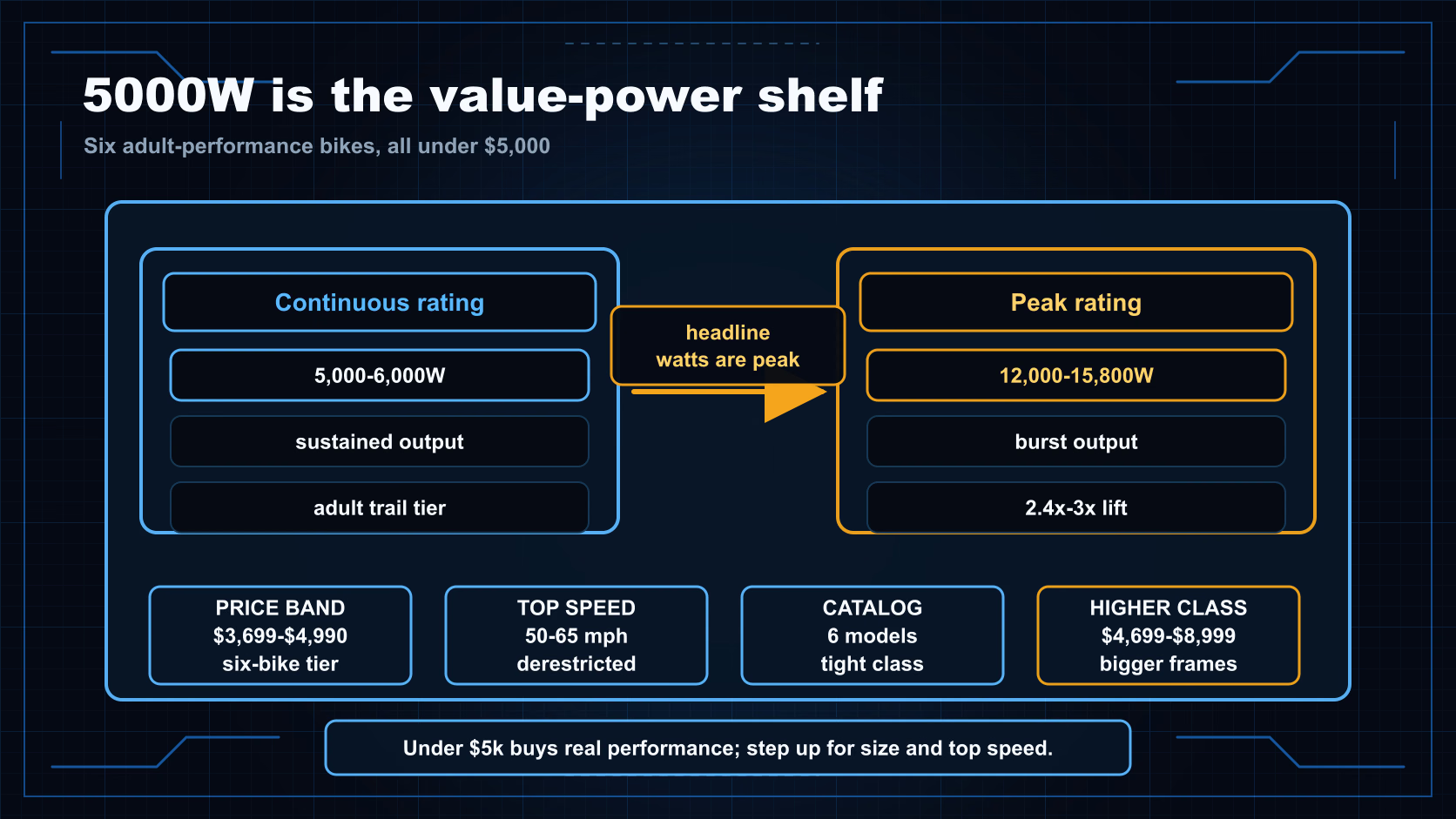
A "5000W electric dirt bike" is the value performance tier — the band where capability per dollar peaks. Continuous power runs 5,000–6,000W, peak power 12,500–15,800W, top speeds 50–65 mph, and prices $3,899 to $4,999. And the reason it matters:
These four score 89 to 92 — and the far pricier 8,000W-plus class above them tops out at 96. Four Score points is what as much as $4,000 more actually buys you.
| Bike | Score | Continuous | Peak | Top speed | Price |
|---|---|---|---|---|---|
| Apollo RFN Ares | 89 | 5,000W | 12,500W | 50 mph | $4,799 |
| E-Ride Pro SS 3.0 | 92 | 6,000W | 15,800W | 60 mph | $4,699 |
| Talaria MX5 Pro | 89 | 5,500W | 13,400W | 59 mph | $4,990 |
| Rawrr Mantis X Pro | 89 | 5,000W | 15,000W | 65 mph | $3,899 |
Why this is the value tier, in one table
Line this tier up against the high-power class above it and the value case is clear — the price ceiling nearly doubles while the Score ceiling moves four points:
| Tier | Continuous | Peak | VoltRipper Score | Typical price |
|---|---|---|---|---|
| The 5,000W value tier (these four) | 5,000–6,000W | 12,500–15,800W | 89–92 | $3,899–$4,999 |
| The 8,000W+ high-power class | 8,000–10,000W | 18,000–25,000W | 90–96 | $4,699–$8,999 |
Step up to the 8,000W-plus class and the Score ceiling does rise, but not in proportion to the price. That class tops out at 96 with the full-size Sur-Ron Storm Bee at $8,999 — four points above this tier's best, for $4,000 more. The Onyx RCR (94, $4,699) and Sur-Ron Ultra Bee (94, $6,499) sit in between, and the Altis Sigma actually scores 90 at $5,299 — below this tier's top three despite costing more. What the extra outlay reliably buys is top speed, battery size, and a bigger frame; the Score climbs, but slowly, and not at every price.
Still the peak-vs-continuous story — just bigger numbers
The same trap from the entry and Sur-Ron classes applies here, scaled up: the headline wattage is peak, and the multiple over continuous is large.
- Rawrr Mantis X Pro — 5,000W continuous, 15,000W peak (3.0×).
- E-Ride Pro SS 3.0 — 6,000W continuous, 15,800W peak (2.6×).
- Apollo RFN Ares — 5,000W continuous, 12,500W peak (2.5×).
- Talaria MX5 Pro — 5,500W continuous, 13,400W peak (2.4×).
A "15,000W" Mantis X Pro is a 5,000W-continuous bike — the peak figure is triple the sustained one. Read the pattern the same way across the tier, and lean on our specs guide when a listing shows only the big number.
Every bike in the tier, on its own terms
Apollo RFN Ares — $4,799, Score 89. Marketed as a "Sur-Ron killer," it earns an 89 — three points below the tier-leading E-Ride Pro SS 3.0 and level with the Talaria MX5 Pro. It pairs a big 3,132 Wh removable battery — the largest here — with 12,500W of "rocket-mode" peak, a headlight for kit-based street use, and adjustable suspension. Two honest caveats: top-speed claims for it vary widely (46–55 mph), and the 90-mile range figure is an eco number — plan for ~30–40 mi ridden hard.
E-Ride Pro SS 3.0 — $4,699, Score 92. The tier's highest Score, and the most muscular of the four on paper: 15,800W peak, a 3,600 Wh swappable pack, 60 mph, plus reverse, an app, and adjustable suspension. It is rated for expert riders, and after E-Ride's August 2026 price move it is now the second-cheapest of the four as well as the highest-scoring — behind only the Rawrr. E-Ride publishes 64 miles at 25 mph and does not publish a hard-riding figure, so we leave real-world range unscored rather than guess.
Talaria MX5 Pro — $4,990, Score 89. The 72V step up from Talaria's 60V Sting family — a real power-and-range jump on a Samsung-cell pack, with 13,400W peak, roughly 59 mph unlocked, and moto-spec hydraulic brakes. Like its Sting siblings it ships limited to 20 mph, so the high-speed numbers assume derestriction and the local-law risk that carries.
Rawrr Mantis X Pro — $3,899, Score 89. The value play and, at $3,899, the cheapest of the four — while also being the fastest, at 65 mph. It brings 15,000W peak, app-tunable Eco/Sport/Race modes, DOT hydraulic brakes, IP-rated sealing, and a genuine 1-year/1,000-mile power-system warranty. It scores a few points below the rest of the tier because it is a younger brand with a smaller aftermarket, and 65 mph is a lot of bike for a newer rider.
Who should shop the 5000W tier
- Most adult trail and play riders → this is the tier to shop first. Start with the tier's top scorers — the E-Ride Pro SS 3.0 or the Apollo RFN Ares.
- Value-first buyers → the Rawrr Mantis X Pro at $3,899 gives you the most speed per dollar in the tier.
- Riders who want a Talaria street-kit path → the MX5 Pro, accepting its 20 mph factory limit.
- Riders set on the biggest frame, top speed, or battery → look above this tier, and read our cost guide first, because the price jump is real and the Score gain is small.
The bottom line
"5000W" is the value power tier, and for most adult riders it is the smartest place to shop. Continuous power of 5,000–6,000W, peak of 12,500–15,800W, and VoltRipper Scores of 89–92 — all for under $5,000. The tier's top scorer is the E-Ride Pro SS 3.0 at $4,699 (Score 92), with the Apollo RFN Ares at $4,799 and Talaria MX5 Pro at $4,990 just behind at 91; the value and speed pick is the Rawrr Mantis X Pro at $3,899 (Score 89). Spend up to the 8,000W-plus class only if you specifically need the top speed, the bigger battery, or the full-size chassis — because that class tops out at a 96, and the step up costs as much as $4,000 more. And remember the headline watts are peak: a "15,000W" bike here makes 5,000W continuously.
The other power and voltage bands:
- 36V Electric Dirt Bikes: The Kids' Band, Decoded by Age and Fit
- 48V Electric Dirt Bikes: Every Model, and the $5,637 Question
- 60V Electric Dirt Bikes: Every Model, and Why the Step to 72V Is Real
- 72V Electric Dirt Bikes: Every Model, and Why the Number Tells You Less Than You Think
- 1000W Electric Dirt Bike: The Entry Class, Explained
- 3000W Electric Dirt Bike: The Sur-Ron Class
- 8000W Electric Dirt Bike
VoltRipper is independent — our guidance comes from verified specs and the transparent VoltRipper Score, not commissions. We are spec-verified and data-driven rather than hands-on. Affiliate disclosure is included on monetized pages.
FAQ
How fast is a 5000W electric dirt bike?
About 50 to 65 mph across this tier. The Rawrr Mantis X Pro reaches roughly 65 mph, the E-Ride Pro SS 3.0 about 60 mph, and the Talaria MX5 Pro around 59 mph once derestricted; the Apollo RFN Ares is the outlier, rated near 50 mph despite big peak power. Gearing and derestriction shape the top end here more than raw wattage does.
Is 5000W enough for an adult electric dirt bike?
For almost every adult rider, yes — this is arguably the sweet spot. A 5,000–6,000W-continuous bike peaks at 12,500–15,800W, hits 50–65 mph, and carries real trail capability. It tops out at a 92 where the far pricier 8,000W-plus class reaches 96 — four points, for as much as $4,000 more, which is exactly why we call it the value tier.
What is the best value electric dirt bike?
In this tier, the Rawrr Mantis X Pro (about $3,899, VoltRipper Score 89) is the cheapest and the fastest of the four, while the E-Ride Pro SS 3.0 earns the tier's highest Score at 92, with the Apollo RFN Ares and Talaria MX5 Pro just behind at 91. All four land at 89–92 for under $5,000, against 90–96 for the 8,000W-plus class that costs $4,699 to $8,999.
Is a 5000W bike better than a Sur-Ron Light Bee?
On paper, by the numbers, yes. The Sur-Ron Light Bee X makes 3,000W continuous and 10,000W peak and scores 89. Every bike in this 5,000W tier makes more continuous power and more peak power, and three of the four out-score it — the Rawrr Mantis X Pro matches it at 89. What the Light Bee still wins on is aftermarket depth and support — which is why it holds value despite the lower Score.
Sources
Specification sources
- Rawrr Mantis X ProRide Rawrr — Mantis X ProChecked
- Apollo (RFN) RFN Ares Rally ProRFN by Apollo — Rally ProChecked
- E-Ride Pro SS 3.0E-Ride Pro - Pro SS 3.0 official product pageChecked
- Talaria Sting MX5 ProTalaria Canada - Sting MX5 Pro specificationsChecked