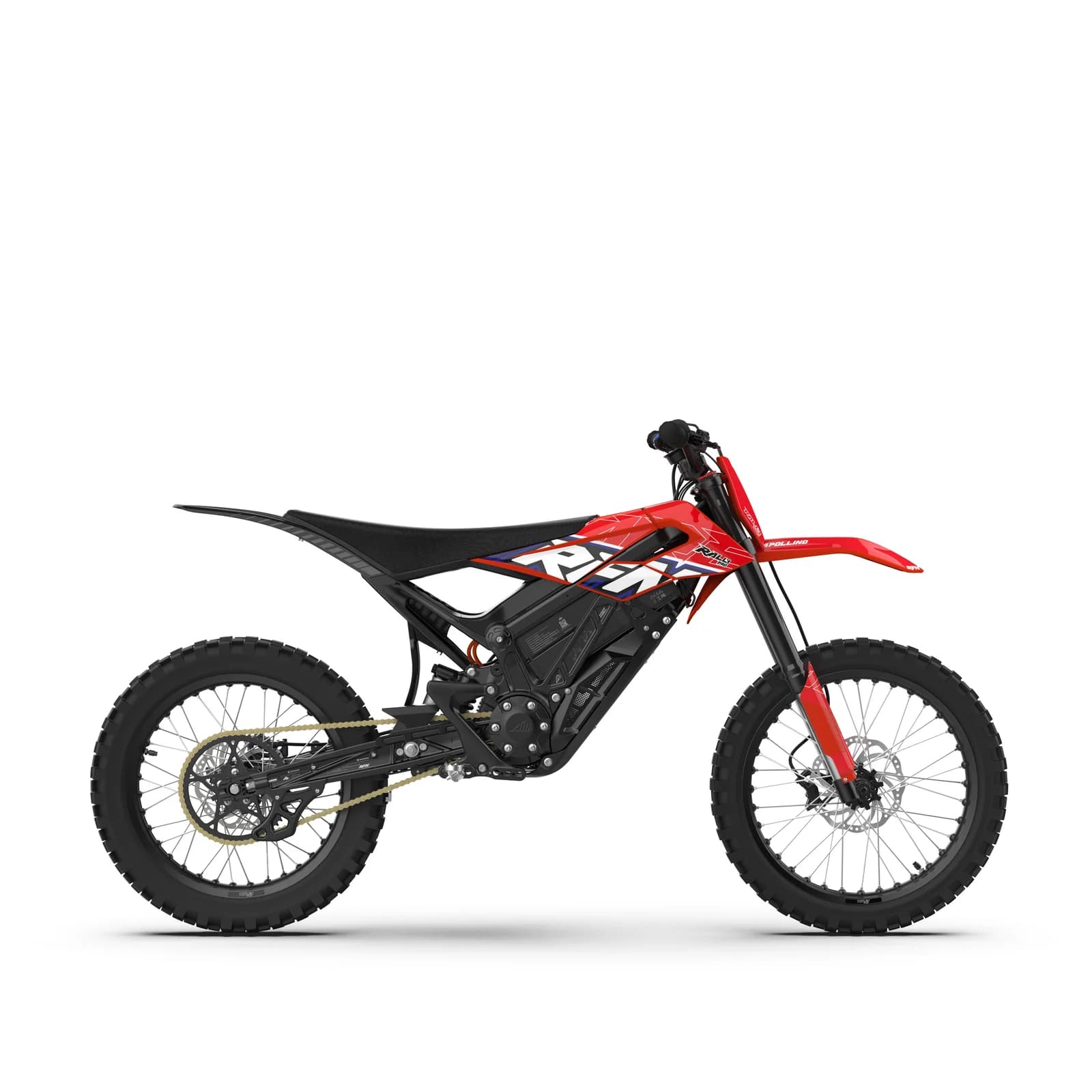
The verdict
The Apollo RFN Ares (sold as the Rally Pro) is marketed as a "Sur-Ron killer," and on the spec sheet it makes a real case — 12.5 kW of peak power, a large removable battery, adjustable suspension, and a factory headlight for about $4,799. It earns a VoltRipper Score of 89/100, which puts it near the top of the sub-$5,000 value-performance tier. It's a lot of bike for the money and one of the few in this price band with lights for a kit-based street conversion. The asterisk is the same one that applies to every challenger: it's a newer brand, so it gives up Sur-Ron's proven aftermarket and support.
Who it's for — and who should skip it
Buy it if you want maximum peak power for the money, value a large removable battery, or want a value bike that already has a headlight for a possible street-legal conversion.
Skip it if you want the deepest, most proven support ecosystem (that's still Sur-Ron) or you're wary of newer brands with smaller US aftermarkets.
What it actually is: big power, big-battery claim, real value
The Ares leads with power and components. It runs a 72V-class system with a 12.5 kW peak motor — a genuine "rocket mode" that's among the highest peak figures in the sub-$5,000 class — and a large removable battery pack. There is a spec conflict worth noting: RFN's current Rally Pro page lists a 3,132 Wh battery, REVRides lists 43Ah / 2,590 Wh with 72V nominal, and RFN Australia describes a 43Ah pack as 74V / 3,182 Wh. We score the current RFN manufacturer battery headline and keep this as a 72V-class bike because 3,132 Wh / 43Ah lands at about 72.8V, but you should still verify the exact pack on the unit you're buying through a dealer. Add adjustable suspension, tortoise/rabbit ride modes (dial the power down for new riders, up for experienced), fast charging, and a headlight, and it's a genuinely well-equipped bike for the money.
The honest caveats
- Newer brand. RFN/Apollo doesn't have Sur-Ron's years of proven reliability or aftermarket depth. The "Sur-Ron killer" tag is marketing; the support gap is real.
- Specs vary by listing. Top-speed claims range from ~46 to ~55 mph depending on the source and configuration — verify the exact model you're buying.
- Range is optimistic. The 90-mile city/low-speed claim is an easy-riding figure; plan for ~40 miles ridden hard (the usual gap — see our range guide).
Rider capacity: 265 lb, above the class norm
RFN publishes a max load of 120 kg — 265 lb for the Ares, which is 45 lb above the 220 lb that Sur-Ron and Talaria publish across their ranges. It is not the highest we track, but for a rider in the 220–265 lb band it widens the field meaningfully. We took the figure from RFN's own regional specification page rather than the dealer listing alone, because dealer capacity numbers contradict manufacturers often enough that we do not treat them as sufficient on their own.
Why it scores 89
- Power, battery & value (its strengths): 12.5 kW peak power, a large removable pack, adjustable suspension, and factory lighting for about $4,799 is a strong package.
- Support (the trade-off): a newer brand scores lower on the known-quantity/aftermarket factors than an established Sur-Ron or Talaria.
- Not street-legal as sold: it has lights but still ships off-road; road use needs a kit and a permitting state.
Apollo RFN Ares vs E-Ride Pro SS 2.0 — the value-performance duel
| Apollo RFN Ares | E-Ride Pro SS 2.0 | |
|---|---|---|
| VoltRipper Score | 89 | 88 |
| Price | $4,799 | $4,599 + $300 shipping |
| Peak power | 12.5 kW | 12 kW |
| Battery | 3,132 Wh manufacturer | 2,880 Wh (swappable) |
| Top speed | 50 mph | 60 mph |
| Factory headlight | Yes | No |
The bottom line
The Apollo RFN Ares is a strong value-performance bike — big peak power, a large removable battery, adjustable hardware, and a headlight, all for about $4,799, which is why it earns a 89 and a place among our best value picks. Just take the "Sur-Ron killer" marketing with a grain of salt: on paper it competes, but Sur-Ron's proven support is still the safer long-term bet. If specs-per-dollar and street-conversion optionality matter most, the Ares delivers. Not sure it fits your riding? Run the Find Your Ride configurator.
Compared with
Every head-to-head we have published on this bike:
- Apollo RFN Ares vs Sur-Ron Light Bee X
- Apollo RFN Ares vs Talaria Sting MX5 Pro
- E-Ride Pro SS 3.0 vs Apollo RFN Ares
Go deeper on the Apollo (RFN) RFN Ares Rally Pro:
VoltRipper is spec-verified and data-driven — we do not claim hands-on testing of this bike. Specs and prices are cross-checked against the sources listed above and re-verified regularly; real-world figures are our own estimates, clearly labeled.
FAQ
Is the Apollo RFN Ares worth it?
For maximum peak power for the money, yes — 12.5 kW, a large removable battery, adjustable suspension, and a factory headlight for about $4,799 make it a lot of bike (VoltRipper Score 89, near the top of the sub-$5,000 value tier). It's also one of the few in this price band with lights for a kit-based street conversion. The asterisk is the usual one for challengers: it's a newer brand with a smaller, less-proven US aftermarket than Sur-Ron.
Is the Apollo RFN Ares really a 'Sur-Ron killer'?
On the spec sheet it makes a real case — more peak power (12.5 kW) and a bigger removable battery than a Light Bee X for a similar or lower price. But 'killer' overstates it: the Sur-Ron still wins decisively on aftermarket depth, community, and resale — the things that matter years into ownership. The Apollo is a strong value alternative, not a replacement for the ecosystem. See our [RFN Ares vs Light Bee X comparison](/guides/apollo-rfn-ares-vs-sur-ron-light-bee-x).
Is the Apollo RFN Ares street legal?
Not as sold, but it's better positioned than most: it ships with a factory headlight, which makes a kit-based street-legal conversion more realistic than starting from a lights-free Sur-Ron. You'll still need the full DOT equipment, registration, insurance, and a license where your state allows conversion — check your state's rules first.
How much power does the Apollo RFN Ares have, and what's its range?
It makes about 12.5 kW of peak power — more than a Sur-Ron Light Bee X — and carries a large removable battery. Plan real range around a realistic figure rather than the optimistic claim (see our range guide). The removable pack makes carrying a charged spare an option for longer days.