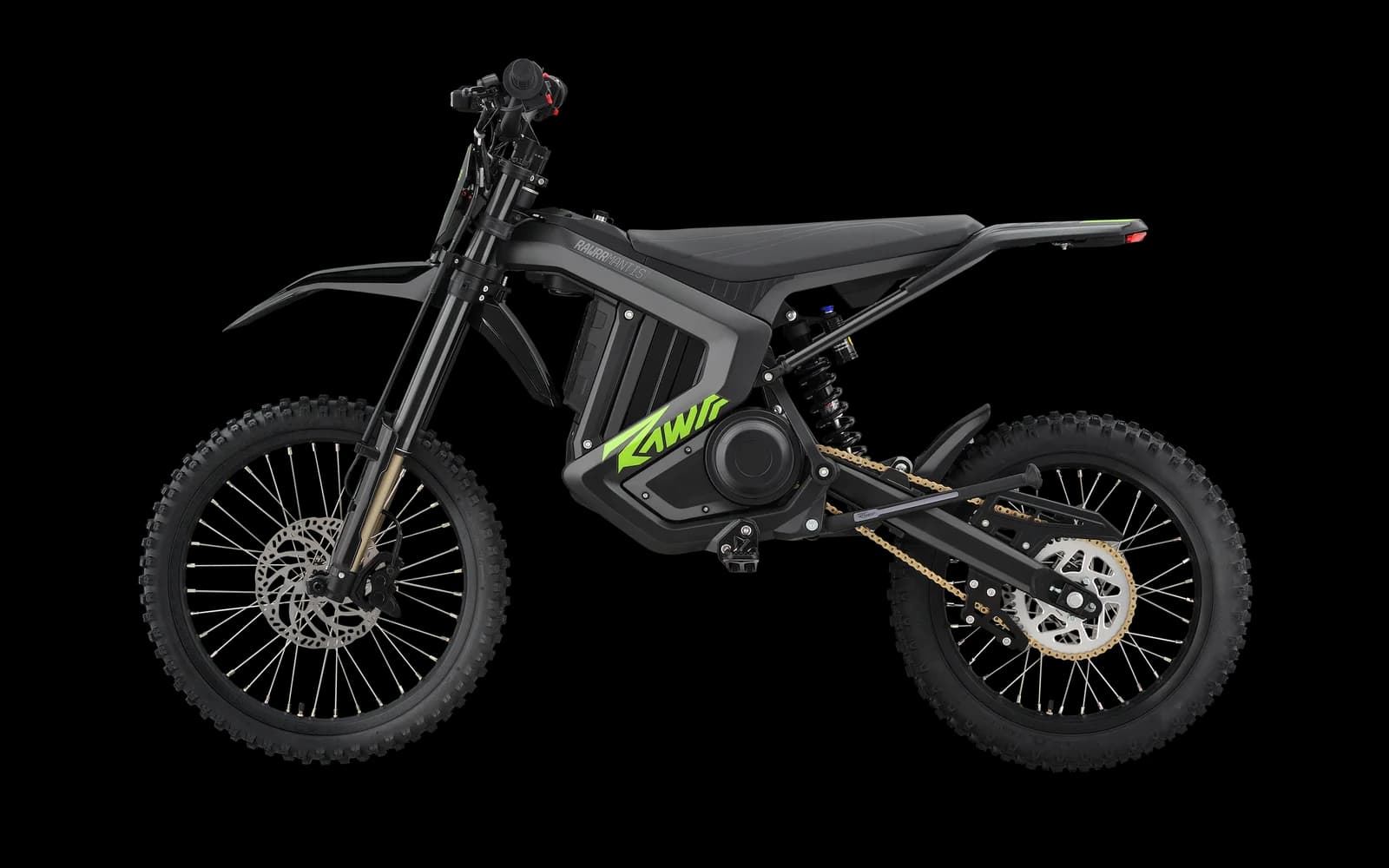
The verdict
The Rawrr Mantis X Pro is the power bargain of the class. It puts down ~15 kW peak and 65+ mph — power that lives closer to Sur-Ron's $6,500–$9,000 flagships — for $3,899, which is $600 less than a Sur-Ron Light Bee X. It earns a VoltRipper Score of 89/100 — level with the Light Bee X it undercuts. If your priority is maximum performance per dollar and you've got the experience to use it, this is one of the most bike-for-your-money options we track.
Who it's for — and who should skip it
Buy it if you want the most power and speed you can get for under $4,000, like app-tunable ride modes, and have the skill to handle a genuinely fast bike.
Skip it if you're a beginner — 15 kW and 65 mph is a lot of machine to learn on; if you want the deepest aftermarket and largest community (that's still Sur-Ron); or if you want the lightest, most flickable bike (the Mantis is heavier).
What you're getting: near-flagship power for entry money
This is the headline, and it's real. The Mantis X Pro runs a 72V system with ~15 kW peak and a stout 389 Nm at the wheel, good for 65+ mph — a big step above the base Mantis X (see the full base-vs-Pro comparison). It backs that with app-tunable Eco/Sport/Race modes, DOT hydraulic disc brakes, IP66/IP55 water sealing, a swappable 2,520 Wh (72V/35Ah) battery, and — notably for a value bike — a real 1-year / 1,000-mile power-system warranty. Feature-for-feature and watt-for-dollar, it undercuts the establishment hard.
Range: honest and swappable
Rawrr claims 62 miles; plan around a ~25–35 mile real-world band instead. Our catalog estimate uses ~35 miles for mixed trail riding, while Freshly Charged's hard-riding test burned 47% over 13 miles, implying roughly 26 miles when ridden aggressively. That spread is the honest answer: Eco cruising can go longer, but fast trail riding will sit near the lower end. Because the battery is swappable, carrying a charged spare can extend the day in seconds. (Why claimed and real diverge is in our range guide.)
Independent test notes we factored in
The strongest hands-on competing review is Freshly Charged's Mantis X Pro test. We are not claiming our own seat time, so we use it as a reality check alongside Rawrr and REVRides spec data.
The useful takeaways: the bike repeatedly showed the claimed 65 mph on its display, the reinforced rear linkage is a meaningful upgrade, and the added lighting/brake hardware makes the Pro feel more complete than the base Mantis X. The caveats are just as important: the stock off-road tires can be slick on smooth pavement until scrubbed in, the handlebar/display have turn-signal controls without actual turn signals, and the suspension is not the premium part of the package. That lines up with our Score: huge power/value, good chassis, but not a fully mature platform.
Rider capacity: 220 lb, and now actually published
The catch: the ecosystem
Here's the honest trade-off for all that spec-sheet value. Rawrr is a younger brand than Sur-Ron or Talaria, with a smaller aftermarket and community. That matters over years of ownership — fewer bolt-on upgrades, fewer local experts, thinner resale history. The bike itself is impressive; the platform around it isn't as deep. If you value a proven, endlessly-supported ecosystem over raw output, that's the reason to pay more for a slower Sur-Ron.
One practical wrinkle that follows from the smaller network: as of July 2026 the Pro is sold out at most major online retailers (REVRides, VORO, eMotoZone all show no stock), with availability concentrated at powersports dealers who tend to price above MSRP and add freight and assembly. A thinner distribution network means less price competition and more waiting — factor that into "cheaper on paper."
Where it costs you
- It's a lot of bike. 15 kW and 65 mph is not beginner-friendly; respect the power modes while you build skill.
- Weight. At ~158.5 lb it's heavier and less flickable than a 130 lb Light Bee X.
- Smaller aftermarket. Covered above — the main reason it scores 89 rather than higher.
- Street-use caveats. Independent testing flagged stock knobbies that can be slick on pavement, and the turn-signal controls are not actual street equipment.
- Not street-legal as sold; it's an off-road machine.
Mantis X Pro vs Sur-Ron Light Bee X
The Mantis makes 50% more power (15 vs 10 kW) and runs 15 mph faster for $800 less, on the same 2,520 Wh of battery — while giving up 28.5 lb of agility and Sur-Ron's unmatched ecosystem. The two land a point apart on our board — 89 against the Light Bee X's 89 — because the Light Bee X's support advantage offsets the Mantis's performance advantage almost exactly. Want flagship power and the Sur-Ron ecosystem? Step up to the Ultra Bee.
Full head-to-head: Rawrr Mantis X Pro vs Sur-Ron Light Bee X →
Compared with
Every head-to-head we have published on this bike:
- Rawrr Mantis X Pro vs E-Ride Pro SS 2.0
- Rawrr Mantis X Pro vs Sur-Ron Light Bee X
- Rawrr Mantis X Pro vs Talaria MX5 Pro
- Rawrr Mantis X vs Mantis X Pro
- Segway X260 vs Rawrr Mantis X Pro
Go deeper on the Rawrr Mantis X Pro:
Bottom line
The Rawrr Mantis X Pro is a legitimate performance bargain — near-flagship power and a genuinely modern feature set for the price of an entry Sur-Ron. Its 89-point Score reflects exactly that: excellent hardware, held back only by a younger brand's shallower support. For an experienced rider chasing the most speed per dollar, it's one of the smartest buys on the board — just go in knowing the aftermarket isn't Sur-Ron-deep yet.
VoltRipper is spec-verified and data-driven — we do not claim hands-on testing of this bike. Specs and prices are cross-checked against the bike record's source list, REVRides/Rawrr product data, and Freshly Charged's hands-on review; our real-world figures are clearly labeled estimates or third-party reality checks.
FAQ
Is the Rawrr Mantis X Pro worth it?
For maximum power-per-dollar, yes — it puts down ~15 kW peak and 65+ mph (power that lives closer to Sur-Ron's $6,500-$9,000 flagships) for $3,899, which is $600 less than a Light Bee X, plus app-tunable ride modes (VoltRipper Score 89, level with the Light Bee X). If your priority is performance-per-dollar and you have the experience to use it, it's one of the best bike-for-your-money options we track. Two caveats: it's sold out at most major online retailers as of July 2026, and dealer listings often run above Rawrr's $3,899 MSRP plus freight and assembly. Skip it if you're a beginner (15 kW and 65 mph is a lot), want the deepest aftermarket (Sur-Ron), or want the lightest, most flickable bike.
Rawrr Mantis X Pro vs Sur-Ron Light Bee X — which should you buy?
The Mantis X Pro is now $600 cheaper ($3,899 vs $4,499) and trails it by a single point (89 to 90), but they're opposite bikes. The Mantis X Pro is the power play — ~15 kW and 65+ mph with app-tunable modes, far more performance for the money. The Light Bee X is the ecosystem play — the deepest aftermarket, biggest community, the widest pool of used buyers, and a lighter, more beginner-friendly chassis. A matching Score doesn't mean the same bike. See our [Mantis X Pro vs Light Bee X comparison](/guides/rawrr-mantis-x-pro-vs-sur-ron-light-bee-x).
Is the Rawrr Mantis X Pro good for beginners?
Not really — at ~15 kW and 65+ mph it's a genuinely fast bike, more than a true beginner should learn on. Capable riders will love the performance-per-dollar, but a first-timer is better served by a lighter, less-powerful bike, or by starting the Mantis in a low app-tuned power mode and easing in.
How much power does the Rawrr Mantis X Pro have, and how fast is it?
About 15 kW of peak power and 65+ mph — flagship-level performance for mid-tier money. Its ride modes are app-tunable, so you can dial the power to your skill. It's an off-road machine, not street-legal as delivered; plan real range around a realistic figure (see our range guide).