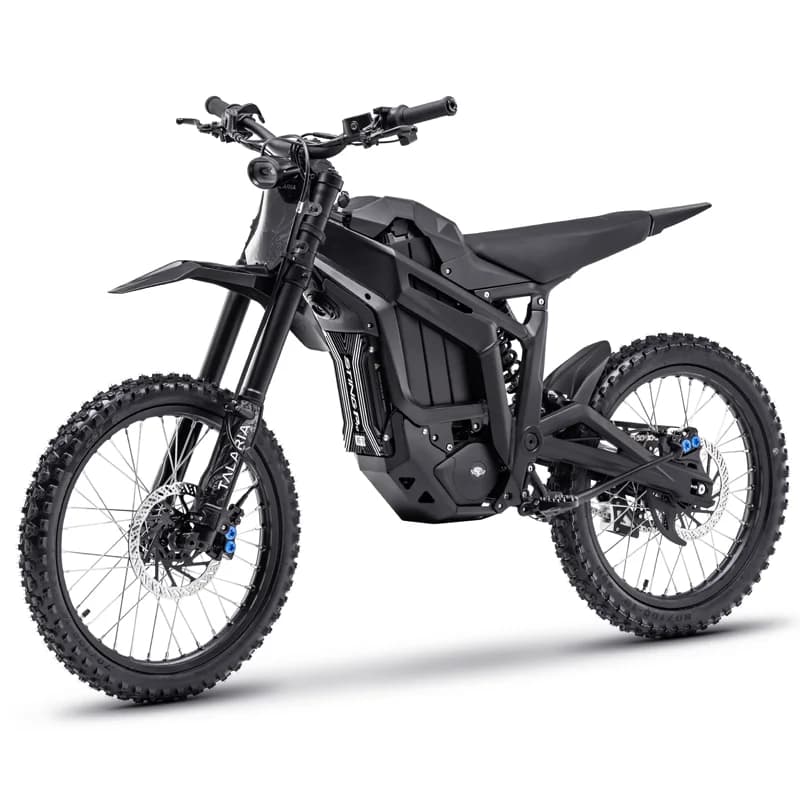
The verdict
The Talaria Sting MX5 Pro is the brand's newest 72V Sting — and the first Talaria that out-specs the Sur-Ron Light Bee X on paper. It earns a VoltRipper Score of 89/100 — a strong result for the money, though below the Sur-Ron Storm Bee at 92, the Apollo RFN Ares and Onyx RCR at 90, and well below the Stark Varg EX at 95 and the board-leading Sur-Ron Hyper Bee at 96. The reason is simple: for $4,990 you get more peak power (13.4 kW), a bigger battery (2.88 kWh, 72V, Samsung cells), and a higher unlocked top speed (~59 mph) than the Sur-Ron benchmark. The catch — and it's a real one — is that it ships factory-limited to 20 mph, and the MX5-specific aftermarket is still young. Buy it for 72V power-per-dollar from a dealer-supported brand; just go in clear-eyed about the limiter and the new-platform ecosystem.
Who it's for — and who should skip it
Buy it if you want Talaria's newest and most powerful 72V platform, you're stepping up from a 60V Sting or X3, you're cross-shopping the Light Bee X on power-per-dollar, and you're comfortable derestricting a bike to unlock its real speed.
Skip it if you want full performance straight out of the crate (it ships throttled to 20 mph), need a street-legal machine as delivered, want the single deepest parts-and-community ecosystem (that's still the Light Bee X), or you value a proven resale and aftermarket track record over the newest hardware.
The defining quirk: it ships limited to 20 mph
This is the one thing to understand before buying. Like its Sting siblings, the MX5 Pro is capable of roughly 59 mph, but Talaria delivers it factory-limited to 20 mph for compliance. Owners routinely derestrict it to reach that full potential — our reality-check panel logs both numbers honestly. Derestriction is common and well-documented, but be clear-eyed: it's on you, it can affect warranty coverage, and it does not change the bike's legal status (it remains an off-road machine). If "unbox it and rip" is your expectation, plan for the derestriction step first.
What you're actually buying: the jump to 72V
The headline is the move to 72V. Where the Sting R MX4 and X3 are 60V bikes, the MX5 Pro runs a 2,880 Wh (72V, 40 Ah, Samsung-cell) pack feeding a motor rated to 13.4 kW peak and 500 N·m of torque — a genuine power-and-range step up over the 60V family. It's proper high-end Sting hardware: dual hydraulic brakes, full adjustable suspension (220 mm front travel), 19-inch knobby tires, an on-board display, and a trim 165 lb curb weight. For riders stepping up from a 60V Sting or an e-bike, the extra voltage translates to a more planted, more motorcycle-like ride — and it undercuts the Light Bee X on price while out-gunning it on paper.
The number nobody advertises: real-world range
Talaria rates the MX5 Pro at ~62 miles. In mixed, real-world riding, plan for ~35 miles — Luna Cycle frames it as roughly a 40-mile bike at a steady 25 mph, and hard trail use pulls that into the mid-30s. That's the same claimed-vs-real gap that runs across this entire category, and the reason we publish both figures. The 72V/40 Ah pack is large for the class and helps the MX5 Pro hold its own, but range still falls sharply once you've derestricted and are riding in the top power mode. We break down the whole dynamic in our range guide.
Where it wins, where it costs you
Wins: the 72V platform (more power and range than the 60V Sting/X3 siblings), 13.4 kW peak output, moto-spec dual hydraulic brakes and adjustable suspension, and Talaria's dealer network and sibling-platform familiarity behind it. On raw power-per-dollar, it's one of the strongest bikes in the class.
Costs you: the 20 mph factory limit and the derestriction it forces; a young MX5-specific aftermarket and resale history compared with the proven Sting R MX4 and Light Bee X; it's off-road as sold; and there's no companion app. None are dealbreakers — but the still-maturing ecosystem is the honest reason it scores an 89 rather than pushing into Storm/Ultra Bee territory.
Living with it: the gearbox and real maintenance
The MX5 Pro's maintenance story is the mirror image of a Sur-Ron's. Where the Light Bee runs a belt primary drive, the Talaria Sting runs a sealed gearbox in an oil bath, feeding a chain final drive — more robust against primary-belt failures, at the cost of one scheduled job the belt-primary bikes skip: periodic gear-oil changes. Plan the first around 185 miles (300 km) to flush break-in debris, then roughly every 3,100 miles (5,000 km) after that. It's a quick small-volume gear-oil job, but it's a real maintenance item to know before you buy. The chain to the rear wheel is standard dirt-bike upkeep (clean and lube it regularly). Weighing that belt-versus-gearbox tradeoff against a Sur-Ron? We break down the mechanical root of why the two brands feel different in Sur-Ron vs Talaria.
Street-legal reality
The MX5 Pro is marked kit-legal — meaning a conversion path exists, not that it arrives road-ready. It ships without factory DOT lighting, so any pavement use means adding a proper street-legal kit and living in a state that will register the result — a narrow, paperwork-heavy path. Check our street-legal guide and your state's rules before planning any road time; treat this as an off-road bike first.
MX5 Pro vs Light Bee X
This is the cross-shop most MX5 Pro buyers are actually making. The MX5 Pro wins on hardware — more peak power, a bigger battery, a higher unlocked top speed — and takes the Score 89 to 89. It is also $590 dearer, not cheaper. And note how each arrives: the Light Bee X ships ready to run at 50 mph, while the MX5 Pro is throttled to 20 mph until you derestrict it, on a younger aftermarket than Sur-Ron's.
Full head-to-head: Sur-Ron Light Bee X vs Talaria MX5 Pro →
Compared with
Every head-to-head we have published on this bike:
- Altis Sigma vs Talaria Sting MX5 Pro
- Apollo RFN Ares vs Talaria Sting MX5 Pro
- Arctic Leopard XF Pro vs Talaria MX5 Pro
- E-Ride Pro SS 3.0 vs Talaria Sting MX5 Pro
- Onyx RCR vs Talaria Sting MX5 Pro
- Rawrr Mantis X Pro vs Talaria MX5 Pro
- Stark Varg vs Talaria MX5 Pro
- Sur-Ron Light Bee X vs Talaria MX5 Pro
- Sur-Ron Ultra Bee vs Talaria Sting MX5 Pro
- Talaria MX5 Pro vs Segway Xaber 300
- Talaria MX5 Pro vs Talaria Komodo
- Talaria Sting R MX4 vs Sting MX5 Pro
Go deeper on the Talaria Sting MX5 Pro:
Bottom line
The Talaria Sting MX5 Pro is the brand's most capable Sting yet and the first Talaria to out-spec the Sur-Ron Light Bee X on paper — the pick for riders who want maximum 72V power-per-dollar from a dealer-backed brand and are willing to derestrict. Its 89 Score reflects genuinely strong Sting-line hardware, tempered by a still-young ecosystem and the factory speed limiter rather than any lack of capability. If those trade-offs don't bother you, it's one of the best hardware values in the class.
VoltRipper is spec-verified and data-driven — we do not claim hands-on testing of this bike. Specs and prices are cross-checked against the sources listed above and re-verified regularly; real-world figures are our own estimates, clearly labeled.
FAQ
Is the Talaria Sting MX5 Pro worth it?
For 72V power-per-dollar, yes — at $4,990 it out-specs the Sur-Ron Light Bee X (13.4 kW peak, a 2.88 kWh Samsung pack, ~59 mph unlocked) from a dealer-supported brand, earning a VoltRipper Score of 89. The catches: it ships factory-limited to 20 mph (you'll want to derestrict it), and the MX5-specific aftermarket is still young. Skip it if you want full speed straight out of the box, the single deepest parts-and-community ecosystem (still the Light Bee X), or a street-legal machine as delivered.
Why does the Talaria MX5 Pro only go 20 mph, and how do I make it faster?
It ships factory-limited to 20 mph for compliance, but it's capable of roughly 59 mph. Owners routinely derestrict it to unlock the full speed — the process is common and well-documented. Be clear-eyed, though: it's on you, it can affect warranty coverage, and it does not change the bike's legal status (it's still an off-road machine). If your expectation is 'unbox it and rip,' plan for the derestriction step first.
Talaria MX5 Pro vs Sur-Ron Light Bee X — which should you buy?
On paper the MX5 Pro out-specs the Light Bee X — more peak power (13.4 vs 10 kW), a bigger battery, and a higher top speed — but it no longer undercuts it: after July 2026 pricing the MX5 Pro is about $491 more ($4,990 vs $4,499). The Light Bee X counters with the deepest aftermarket, the biggest community, and the widest pool of used buyers in the class. Buy the MX5 Pro for 72V power-per-dollar; buy the Light Bee X for the proven ecosystem. See our full [Light Bee X vs MX5 Pro comparison](/guides/sur-ron-light-bee-x-vs-talaria-mx5-pro).
How fast is the Talaria MX5 Pro and what's its real range?
It's capable of about 59 mph once derestricted (it ships limited to 20 mph). Real-world trail range is roughly 35 miles from its 2.88 kWh, 72V battery — more in eco, less ridden hard. It is not street-legal as delivered.
How much maintenance does a Talaria Sting MX5 Pro need?
Its signature item is the gearbox. Unlike the belt-primary Sur-Ron, the MX5 Pro runs a sealed gearbox in an oil bath into a chain final drive — more robust against primary-belt failures, but it needs periodic gear-oil changes: the first around 185 miles (300 km) to flush break-in debris, then roughly every 3,100 miles (5,000 km). It's a quick small-volume oil job, but it's a scheduled task the belt-primary bikes don't have. The chain final drive is normal upkeep (clean and lube it regularly), and — like every Talaria Sting — it ships limited to 20 mph, so budget the derestriction as a first setup step.