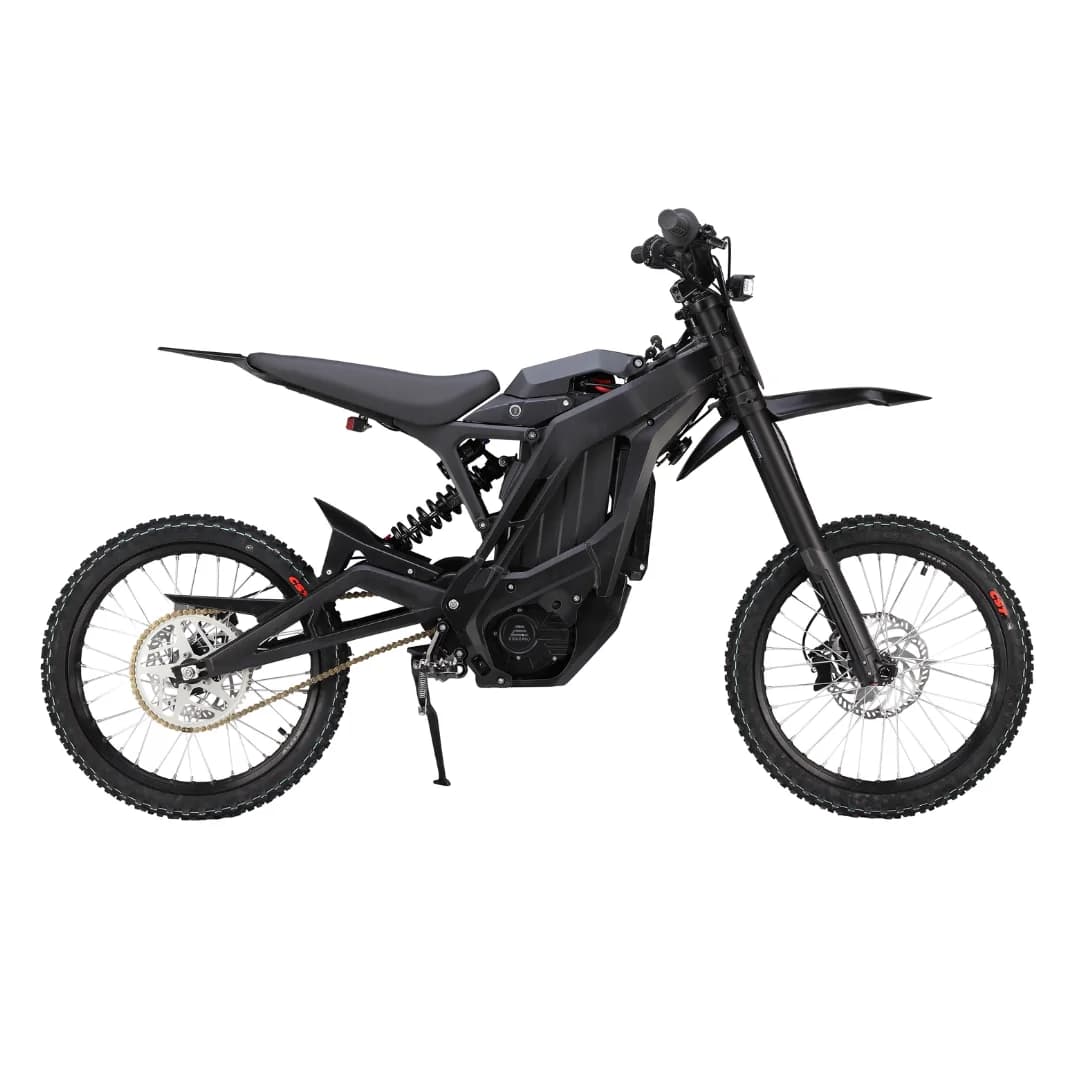
The verdict
The E-Ride Pro SS 2.0 is a genuinely strong machine whose value case just took a hit. The hardware is unchanged - 12 kW of peak power, a 60 mph top speed, and a swappable Samsung battery, good for a VoltRipper Score of 88/100. What changed is the price.
The catch is the ecosystem: E-Ride's aftermarket and support aren't as deep as Sur-Ron's or Talaria's. There is also a rider-limit source conflict: E-Ride's current official SS 2.0 page lists 120 kg / 265 lb, while current dealer pages still cite 300 lb. VoltRipper uses the conservative official figure in the catalog until E-Ride clarifies it. If raw performance-per-dollar is your priority and you fit the official rating, the SS 2.0 is still a standout.
Model note (2026): E-Ride now sells the Pro SS 3.0 (~16 kW peak, a bigger 72V/50Ah ~3,600 Wh battery, app support, reverse, around $4,699) as the current performance model. This review covers the SS 2.0 - still a strong value where it's available, and the lower-cost of the two. If you're buying new, confirm which version you're getting: the 3.0 is more powerful and pricier; the 2.0 is the budget performance play. Deciding between them? See our SS 2.0 vs SS 3.0 breakdown — the surprise is that the upgrade is battery and features, not top speed.
Who it's for - and who should skip it
Buy it if you want 12 kW / 60 mph performance in the lightest chassis E-Ride offers (139 lb, intermediate-rated), you value a swappable battery, or you want more rider-rating headroom than the common 220 lb Sur-Ron/Talaria ceiling and fit under E-Ride's official 265 lb spec.
Skip it if you want the deepest parts-and-community ecosystem, a long-term upgrade path, or a higher official rider rating than 265 lb - a Sur-Ron Light Bee X gives up power but adds more support, while the GT73 and VALTINSU EM-5 Pro publish higher rider limits.
What it actually is: big power on a budget
The SS 2.0 punches well above its price. It runs a 72V system with a 12 kW peak motor - matching bikes like the Rawrr Mantis X Pro on power - and hits a genuine 60 mph. That's flagship-adjacent performance for value-tier money. At 139 lb it's a mid-weight bike: heavier than a Light Bee X, lighter than an Ultra Bee, and stable at speed rather than flickable-first.
The standout features
- A swappable Samsung pack. The 72V/40Ah (2.88 kWh) battery is removable and hot-swappable, with a roughly 2-hour fast charge - carry a spare and you can keep riding instead of waiting.
- A 265 lb official rider limit, with a caveat. E-Ride's current official page lists 120 kg / 265 lb for the SS 2.0. VORO and other dealer pages still cite 300 lb, so we use the lower manufacturer number in the scored catalog. Even at 265 lb, it still gives more headroom than the common 220 lb Sur-Ron/Talaria rating.
Range reality
E-Ride quotes around 50 miles; our real-world estimate is ~35 miles ridden hard - the usual low-speed-vs-trail gap that affects every bike in this class. The swappable pack is the practical answer for longer days. (More in our range guide.)
Why it scores 88
- Power (its strength): 12 kW and 60 mph is real performance, and the Score of 88 reflects genuinely good hardware. The value half of that argument weakened when the price moved to $4,599 + $300 shipping.
- Support (the trade-off): E-Ride's aftermarket and dealer/community network are smaller than Sur-Ron's or Talaria's. That gap is what keeps its Score level with — rather than ahead of — the lighter-hardware Light Bee X, even though the SS 2.0 out-specs it.
- Not street-legal: off-road only, with no street kit as sold.
SS 2.0 vs Sur-Ron Light Bee X
The SS 2.0 is more powerful (12 vs 10 kW), faster (60 vs 50 mph) and carries a bigger, swappable pack — but it is now $100 cheaper than the Light Bee X on sticker — though its stated $300 shipping turns that into a $200 premium delivered. Its rider rating is also unsettled: E-Ride's own page says 265 lb where dealer pages still show 300 lb. The Light Bee X counters with the deepest aftermarket in electric dirt, which is why the two draw level on the Score at 88 apiece, while it gives up performance.
Full head-to-head: Sur-Ron Light Bee X vs E-Ride Pro SS 2.0 →
The bottom line
The E-Ride Pro SS 2.0 is a good bike at an awkward price. The hardware earns its 90 - 12 kW, 60 mph, and a swappable Samsung pack - but at $4,599 plus $300 shipping it no longer qualifies for our under-$4,000 rankings, and it lands within roughly $100 of the higher-scoring SS 3.0. Our honest read: buy it for the lighter 139 lb chassis and intermediate rating, which are real advantages over the 167 lb, expert-rated SS 3.0 - not for value, which is no longer its argument. Go in knowing you're choosing E-Ride's smaller support network over Sur-Ron's, and use the current official 265 lb rider rating unless E-Ride resolves the 300 lb dealer-page conflict. Not sure it fits your size and riding? Run the Find Your Ride configurator.
Compared with
Every head-to-head we have published on this bike:
- E-Ride Pro SS 2.0 vs SS 3.0
- Rawrr Mantis X Pro vs E-Ride Pro SS 2.0
- Sur-Ron Light Bee X vs E-Ride Pro SS 2.0
Go deeper on the E-Ride Pro SS 2.0:
VoltRipper is spec-verified and data-driven - we do not claim hands-on testing of this bike. Specs and prices are cross-checked against the sources listed above and re-verified regularly; real-world figures are our own estimates, clearly labeled.
FAQ
Is the E-Ride Pro SS 2.0 worth it?
Less than it was. E-Ride's official store now lists it at $4,599 plus a stated $300 shipping charge — about $4,899 delivered — where we previously had it at $3,999. The hardware is unchanged and still good (12 kW, 60 mph, a swappable Samsung pack, VoltRipper Score 88), but at that delivered price it sits within roughly $100 of the higher-scoring SS 3.0 (92), which is the better bike. Buy the SS 2.0 if you specifically want the lighter 139 lb chassis and intermediate rating; otherwise compare the SS 3.0 and the Rawrr Mantis X Pro ($3,899, Score 89) first. Also note the ecosystem caveat — E-Ride's aftermarket isn't as deep as Sur-Ron's — and a rider-limit source conflict (see below).
E-Ride Pro SS 2.0 vs SS 3.0 — which should you buy?
The SS 2.0 is the lighter previous generation (12 kW, 139 lb, $4,599 + $300 shipping); the SS 3.0 is the performance upgrade (~15.8 kW peak, a bigger 72V/50Ah battery, app support and reverse, ~$4,699, 167 lb). They used to be $1,000 apart, which made the SS 2.0 the clear value pick; after the SS 2.0's July 2026 price move they are about $100 apart delivered, so the higher-scoring SS 3.0 is the better buy for most riders and the SS 2.0's case is its lighter chassis. Both use a conservative 265 lb official rider rating in the catalog, though dealer pages may cite higher numbers. See our [SS 3.0 review](/bikes/e-ride-pro-ss-3) and the [head-to-head](/guides/e-ride-pro-ss-2-vs-ss-3).
What's the E-Ride Pro SS 2.0's rider weight limit — 265 or 300 lb?
There's a source conflict: E-Ride's current official SS 2.0 page lists 120 kg / 265 lb, while some dealer pages still cite 300 lb. VoltRipper uses the conservative official 265 lb figure until E-Ride clarifies it. If your geared-up weight is near or above that, treat 265 lb as the number to plan around.
How much power does the E-Ride Pro SS 2.0 have, and how fast is it?
About 12 kW of peak power and a 60 mph top speed — close to Sur-Ron Ultra Bee performance for far less money. Its Samsung battery is swappable, so you can carry a charged spare for longer days. It's off-road only, not street-legal as delivered; plan real range around a realistic figure (see our range guide).