Tracked price checks
Bikes in this guide
Talaria
Sting MX5 Pro
72V/2.88 kWh Samsung-cell platform is a real power and range step up from the 60V Sting and X3 family
Trade-off: Ships limited to 20 mph, so the high-speed numbers assume derestriction and local-law risk
We may earn a commission if you buy through this link, at no extra cost to you.
Check price at Luna CycleTalaria
Komodo
32 kW peak output, 65 mph capability, and a 97.2V/45Ah pack make it Talaria's step above the Sting MX5 Pro
Trade-off: Current US dealer listing is off-road only; the L3e street trim should not be assumed for US buyers
We may earn a commission if you buy through this link, at no extra cost to you.
Check price at Ronster RidesTalaria
Dragon
28 kW peak output, 10 kW nominal power, and a 5.2 kWh pack make it Talaria's premium big-battery full-size entry
Trade-off: Current credible source material does not confirm a US ship date, so real owner range and support history are not established
We may earn a commission if you buy through this link, at no extra cost to you.
Check price at Talaria CanadaTalaria
Sting R MX4
Bigger 2,700 Wh (60V/45Ah) LG-cell pack than a stock Sur-Ron — more usable range
Trade-off: Ships factory-limited to 20 mph — needs derestriction to reach its ~40+ mph potential
We may earn a commission if you buy through this link, at no extra cost to you.
Check price at Luna CycleSur-Ron
Light Bee X
Enormous aftermarket and parts ecosystem — the most-supported e-dirt-bike platform
Trade-off: Advertised range collapses at speed — plan for real-world miles well under the claim
We may earn a commission if you buy through this link, at no extra cost to you.
Check price at ATV Wholesale OutletThe short answer
Talaria is Sur-Ron's benchmark rival — the brand that usually out-specs it on paper for less money. The trade is real: Talaria gives you more hardware per dollar and the newest platforms, while its aftermarket and resale are younger than Sur-Ron's deep ecosystem. For a spec-and-value shopper, it's the first place to look.
The 2026 lineup splits cleanly into two families:
The compact Sting line — light, ~125–130 lb, the Sur-Ron Light Bee class:
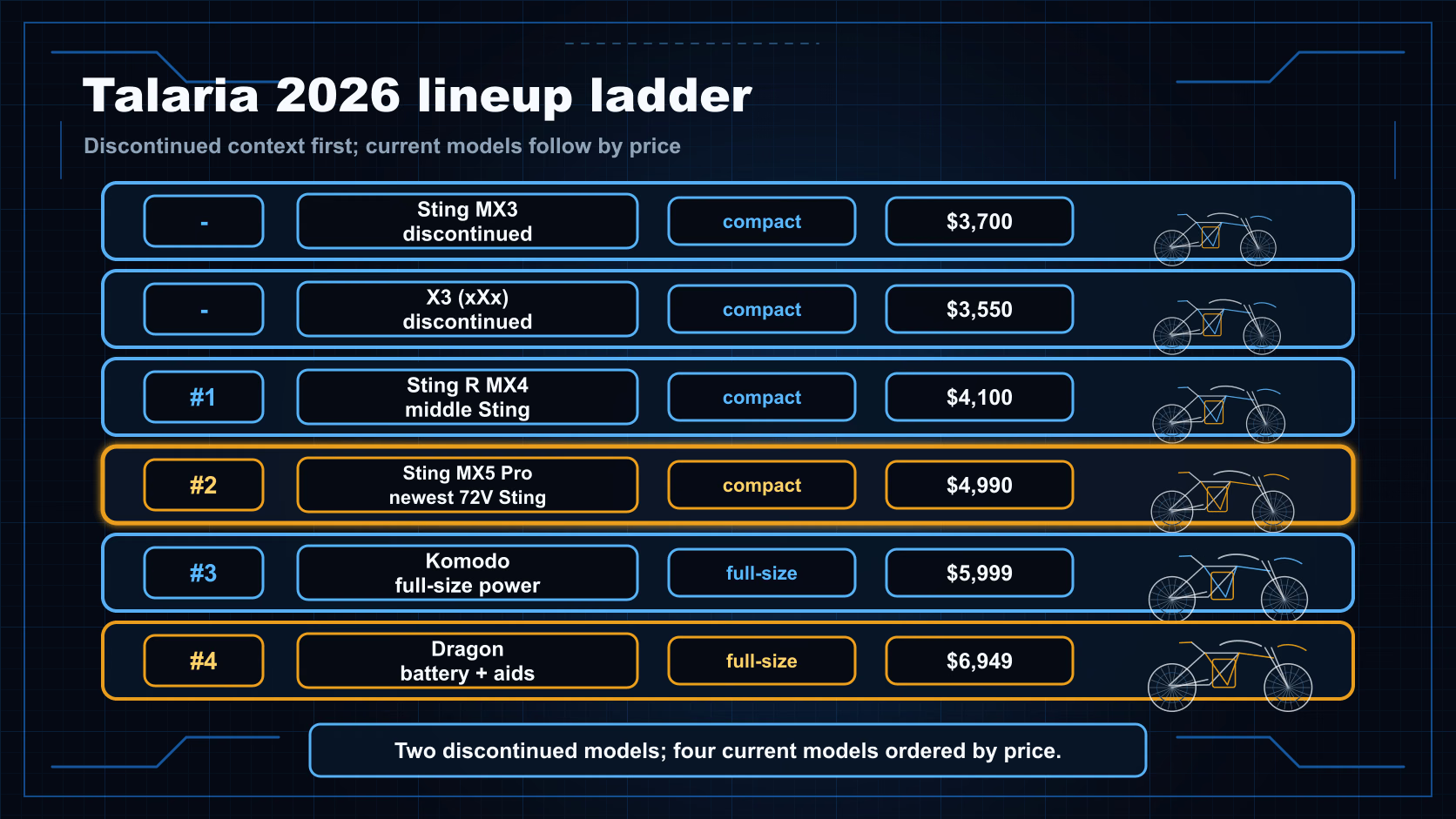
| Model | VoltRipper Score | Price | The take |
|---|---|---|---|
| Talaria Sting MX3 | 86 | $3,700 | Discontinued; the value entry into a genuine Talaria |
| Talaria X3 (xXx) | 88 | $3,550 | Discontinued; compact, low-seat, strong value Score |
| Talaria Sting R MX4 | 87 | $4,100 | The mid Sting |
| Talaria Sting MX5 Pro | 89 | $4,990 | The newest 72V Sting — the compact-line leader |
The full-size line — motorcycle-scale, 21/18 wheels:
| Model | VoltRipper Score | Price | The take |
|---|---|---|---|
| Talaria Komodo | 91 | $5,999 | Value full-size — the most peak power per dollar |
| Talaria Dragon | 90 | $6,949 | Big battery + rider aids (pre-order caveat) |
The Sting MX5 Pro and the Komodo share the top of the brand at Score 91, with the Dragon a point back at 90 — three top-tier Talarias for three different reasons.
The Sting line, explained
The Sting family is Talaria's compact, Light-Bee-class range, and it's where the value lives:
Talaria Sting MX3 — $3,700, Score 86, discontinued. It was the value door into a genuine, supported light e-dirt-bike — a 60V bike with four-piston hydraulic brakes and a gearbox drive for a fraction of the bigger Stings. It ships factory-limited to 20 mph. (Full review →)
Talaria X3 (xXx) — $3,550, Score 88, discontinued. Luna Cycle, Talaria's only listed US dealer, has replaced it with the XXX Pro, which is not in our catalog. It was the strongest-scoring value Sting — a compact ~125 lb chassis with a genuine street-kit path and one of the lowest seats in the class. Also ships limited to 20 mph. (Full review →)
Talaria Sting R MX4 — $4,100, Score 87. The mid Sting — more bike than the MX3, but at a price where the newer MX5 Pro's 72V hardware makes a stronger case. (Full review →)
Talaria Sting MX5 Pro — $4,990, Score 89. The newest 72V Sting and the leader of the compact line: 13.4 kW peak, a larger Samsung-cell pack, and hardware that out-specs the Light Bee X on paper. The honest caveat is a young aftermarket — it's a brand-new platform — which is the main thing keeping it from the very top of the board. (Full review →)
The full-size Talarias
Talaria's motorcycle-scale bikes go head to head with the Sur-Ron Ultra Bee and Storm Bee:
Talaria Komodo — $5,999, Score 91. The value full-size: 32 kW peak and 21/18 wheels for $5,999, the most peak power per dollar of any Talaria and a real undercut on the Ultra Bee's price. Heavier and newer-platform, but a lot of hardware for the money. (Full review → · vs the Ultra Bee →)
Talaria Dragon — $6,949, Score 90. The feature flagship: a 28 kW bike with a big 5.2 kWh pack, ABS, traction control, and a Bluetooth TFT. It scores the same 91 as the Komodo for different reasons — battery and rider aids rather than raw power-per-dollar — and carries a pre-order caveat. (Full review → · vs the Komodo →)
The quick answer, by need
- Tightest budget into a real bike → the Sting R MX4 ($4,100), the cheapest Talaria still in production. It is sold out at both US sellers we track, as of 2026-09-14. The Sting MX3 and X3 cost less, but both are discontinued.
- Newest compact 72V Sting → Sting MX5 Pro ($4,990).
- Most full-size power per dollar → Komodo ($5,999).
- Biggest battery + rider aids → Dragon ($6,949), a prototype on pre-order with no release date yet.
The full pick-by-need logic is in our which Talaria should you buy guide.
Talaria vs Sur-Ron: the eternal question
This is the decision most buyers in this class are really making. Talaria typically wins the spec sheet and the price; Sur-Ron wins the ecosystem. A Talaria often gives you more power, more battery, or newer hardware for less — but Sur-Ron's parts network, dealer support, and resale are deeper, so a Sur-Ron is easier to own and sell over years. If you optimize for spec-per-dollar and the newest hardware, Talaria; if you optimize for a platform you can fix, upgrade, and resell, Sur-Ron. The full head-to-head is in Sur-Ron vs Talaria, and Talaria stacks up against Segway in Talaria vs Segway.
Owning a Talaria: what to know
- The 20 mph factory limit. The X3, Sting MX3, and Sting R MX4 ship speed-limited and need derestriction to reach their rated top speed — real capability, but a local-law consideration. Confirm limited and unlocked speeds before buying on a number.
- A younger aftermarket. Talaria's parts and resale ecosystem is real and growing but newer than Sur-Ron's — a factor for long-term ownership, and part of what keeps the newest platforms just shy of the very top of the board.
- Street-legal. Like the whole class, Talarias are off-road as sold; road use is a kit-plus-registration project that depends on your state.
Not sure Talaria's the one? The alternatives
The strongest cross-shops — the Sur-Ron Light Bee X and Ultra Bee, the value Rawrr and E-Ride bikes, and the full-size Arctic Leopard XE Pro R — are laid out with the honest trade-offs in Talaria alternatives.
The bottom line
Talaria is the value-and-spec benchmark — more hardware per dollar and the newest platforms, with an aftermarket that's younger than Sur-Ron's. The three bikes to know are the Sting MX5 Pro ($4,990, Score 89) for the newest compact hardware, the Komodo ($5,999, Score 91) for full-size power per dollar, and the Dragon ($6,949, Score 90) for battery and rider aids — with the Sting MX3 ($3,700, discontinued) as the value entry. Confirm the factory speed limit and the exact model before you buy, and match one to your size and riding with the Find Your Ride configurator.
VoltRipper is independent — our rankings come from verified specs and the transparent VoltRipper Score, not commissions. We are spec-verified and data-driven rather than hands-on. Affiliate disclosure is included on monetized pages.
FAQ
How many Talaria models are there in 2026?
Six we track, in two families. The compact Sting line: the Sting MX3 (~$3,700), the X3 / xXx (~$3,550), the Sting R MX4 (~$4,100), and the 72V Sting MX5 Pro (~$4,990). The Sting MX3 and X3 are now discontinued. And the full-size line: the Komodo (~$5,999) and the big-battery Dragon (~$6,949). The Sting bikes are the light, compact class; the Komodo and Dragon are motorcycle-scale.
Which Talaria is the best?
The 72V Sting MX5 Pro ($4,990) and the full-size Komodo ($5,999) share the top of the range at VoltRipper Score 91, with the big-battery Dragon ($6,949) a point back at 90. The right one depends on what you want — the MX5 Pro for the newest compact Sting hardware, the Komodo for the most peak power per dollar in a full-size, the Dragon for the biggest battery and rider aids. Our which-Talaria guide sorts it by need.
Talaria vs Sur-Ron — which is better?
Talaria often out-specs Sur-Ron on paper for less money, while Sur-Ron has the deeper parts network, wider dealer support, and stronger resale. So it's a values decision: Talaria for spec-per-dollar and the newest hardware, Sur-Ron for the ecosystem you can fix, upgrade, and resell for years. Neither is 'wrong' — see our full Sur-Ron vs Talaria breakdown.
Why is my Talaria limited to 20 mph?
Several Talarias — the X3, Sting MX3, and Sting R MX4 — ship factory-limited to about 20 mph and need derestriction to reach their rated top speed (roughly 45–53 mph depending on model). It's a shipping/compliance setting, not the bike's real capability, but derestricting carries local-law risk. Confirm the model's limited and unlocked speeds before you buy on a speed number.
Is a Talaria street legal?
Not as sold — Talarias ship as off-road equipment. Making one road-legal takes a conversion kit and a state that allows it, like the rest of the class. Check your state's rules and our street-legal guide before planning to commute on one.
Sources
Specification sources
- Talaria Sting MX5 ProTalaria Canada - Sting MX5 Pro specificationsChecked
- Talaria KomodoRonster Rides - Talaria Komodo dealer listingChecked
- Talaria DragonTalaria Canada - Dragon prototype specificationsChecked
- Talaria Sting R MX4Talaria Canada - Sting R MX4 specificationsChecked
- Sur-Ron Light Bee XATV Wholesale Outlet - 2026 Sur-Ron Light Bee X (72V/35Ah, 10 kW), $4,699 from $4,999Checked