Tracked price checks
Bikes in this guide
Onyx
RCR
Moped-style comfort with a seat, lights, and a street kit — the most commuter-friendly bike here
Trade-off: Heavy (~155 lb) and moped-shaped — less capable in technical off-road than a true dirt bike
We may earn a commission if you buy through this link, at no extra cost to you.
Check price at Onyx Motors (official)Talaria
Sting MX5 Pro
72V/2.88 kWh Samsung-cell platform is a real power and range step up from the 60V Sting and X3 family
Trade-off: Ships limited to 20 mph, so the high-speed numbers assume derestriction and local-law risk
We may earn a commission if you buy through this link, at no extra cost to you.
Check price at Luna CycleShort answer: in almost every U.S. state, no. An electric dirt bike like the Sur-Ron, Talaria, or Segway is classified as an off-highway or motor vehicle — not an electric bicycle — because it has a multi-thousand-watt motor, no pedals, and does 45+ mph. That means it's legal on private land and designated OHV areas, but riding it on public roads, bike lanes, or sidewalks is illegal in most states (and a criminal offense in some). Here's exactly why, and the narrow paths to legal street use.
The one distinction that decides everything
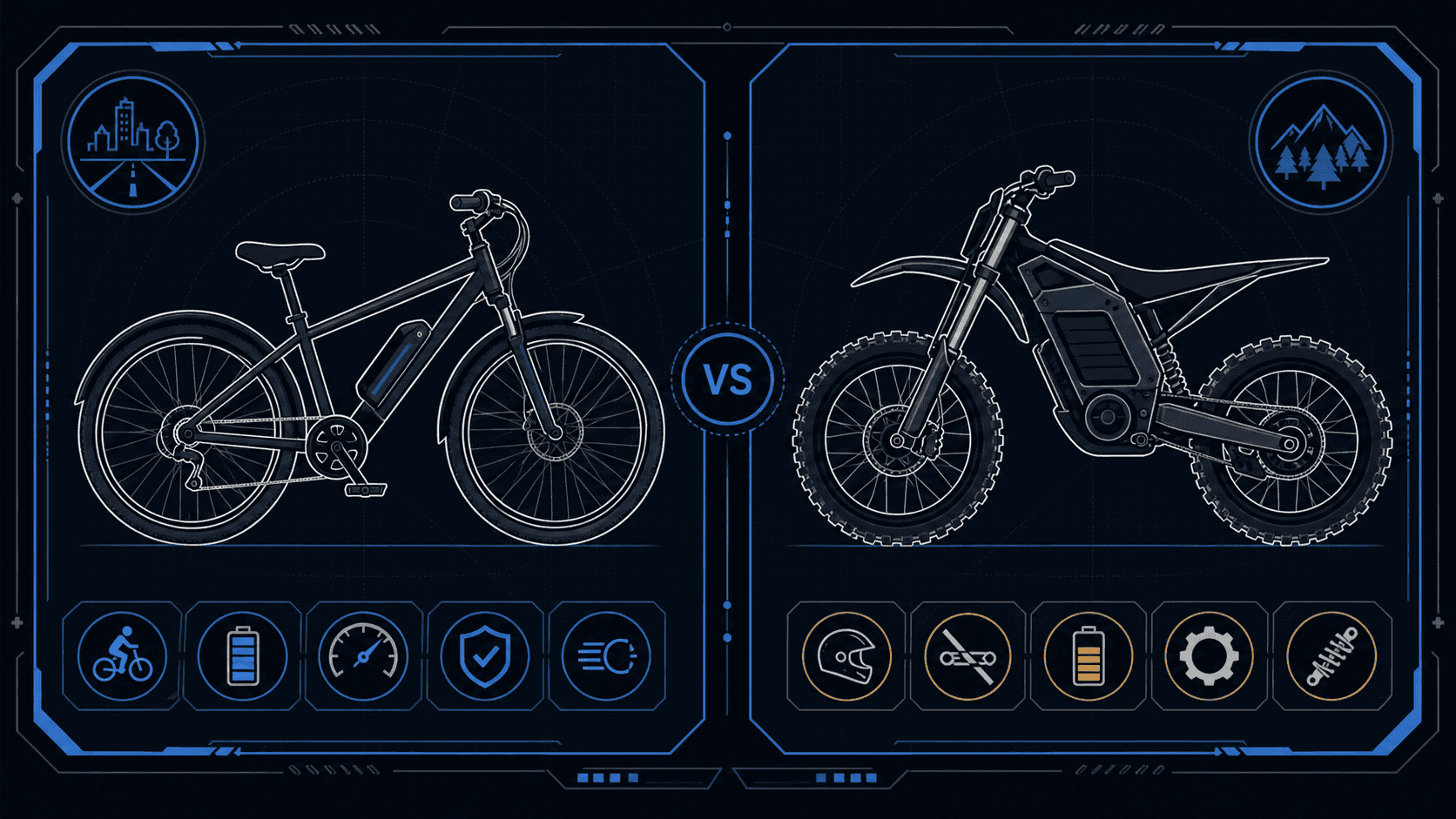
The law splits electric two-wheelers into two very different buckets:
- Electric bicycles — capped at 750W (1 hp), with functional pedals and an assisted top speed around 20–28 mph (the three-class system most states use). These are street-legal like bicycles.
- Electric dirt bikes / e-motos — multi-kilowatt motors, no pedals, 45+ mph. These exceed the e-bike definition, so the law treats them as motor vehicles or off-highway vehicles.
A Sur-Ron Light Bee X (~10 kW peak, ~50 mph, no pedals) is nowhere near the e-bike line — which is why "but it's electric" doesn't make it road-legal. (More on that distinction: electric dirt bike vs e-bike.)
What "street legal" actually requires
To legally register any motorcycle-class vehicle for the road, you typically need:
- DOT-approved equipment: headlight, tail/brake light, turn signals, mirror(s), horn, DOT tires.
- A VIN and a title, plus registration and insurance.
- A motorcycle license (e.g., a Class M endorsement).
Most electric dirt bikes ship with none of the equipment and no VIN/title path — which is why they can't simply be plated.
The simplest path: buy a street-legal bike
Before you commit to converting an off-road bike, know the easier option: some bikes are built to be street-legal in the first place. Rather than fight a title/registration system that often doesn't want an off-road machine, you can buy a model designed for the road:
- Dedicated street-legal e-motos — the Stark Varg EX, Onyx RCR, and Delfast Top 3 are road-oriented or road-capable models, but exact registration still depends on paperwork and state law.
- Factory road-legal trims and street motorcycles — some off-road models are offered in road-legal versions in certain markets, and full street electric motorcycles (Ryvid, Zero) are always an option if pavement is the real goal.
If riding legally on the road is your priority, buying street-legal is almost always simpler and cheaper than converting an off-road bike — see our best street-legal picks.
The three ways states handle it
Every state lands in one of three buckets. We maintain a full per-state breakdown, each page listing the sources behind it; the pattern:
- Off-road only, no registration — ride private land / OHV areas; no street path.
- Off-road + OHV registration required — you must register for off-highway use (a decal or sticker) to ride public OHV land.
- Conversion path exists — you can make it street-legal by adding equipment + titling + registering.
Real examples from our state data:
- California — As of SB-586 (effective Jan 1, 2026), a Sur-Ron-class bike is an off-highway motorcycle requiring a DMV Green Sticker, and it cannot be registered or converted for street use. Ride OHV areas or private land only; helmet required. → California details
- Texas — Not street-legal as sold; a $16/yr TPWD OHV decal is required for public lands, and a full conversion + Class M license is the only road path. → Texas details
- Florida — Treated as a motor vehicle; riding one on a public road is a criminal offense with possible fines and impoundment. Private land and OHV trails only. → Florida details
Electric dirt bike laws, state by state
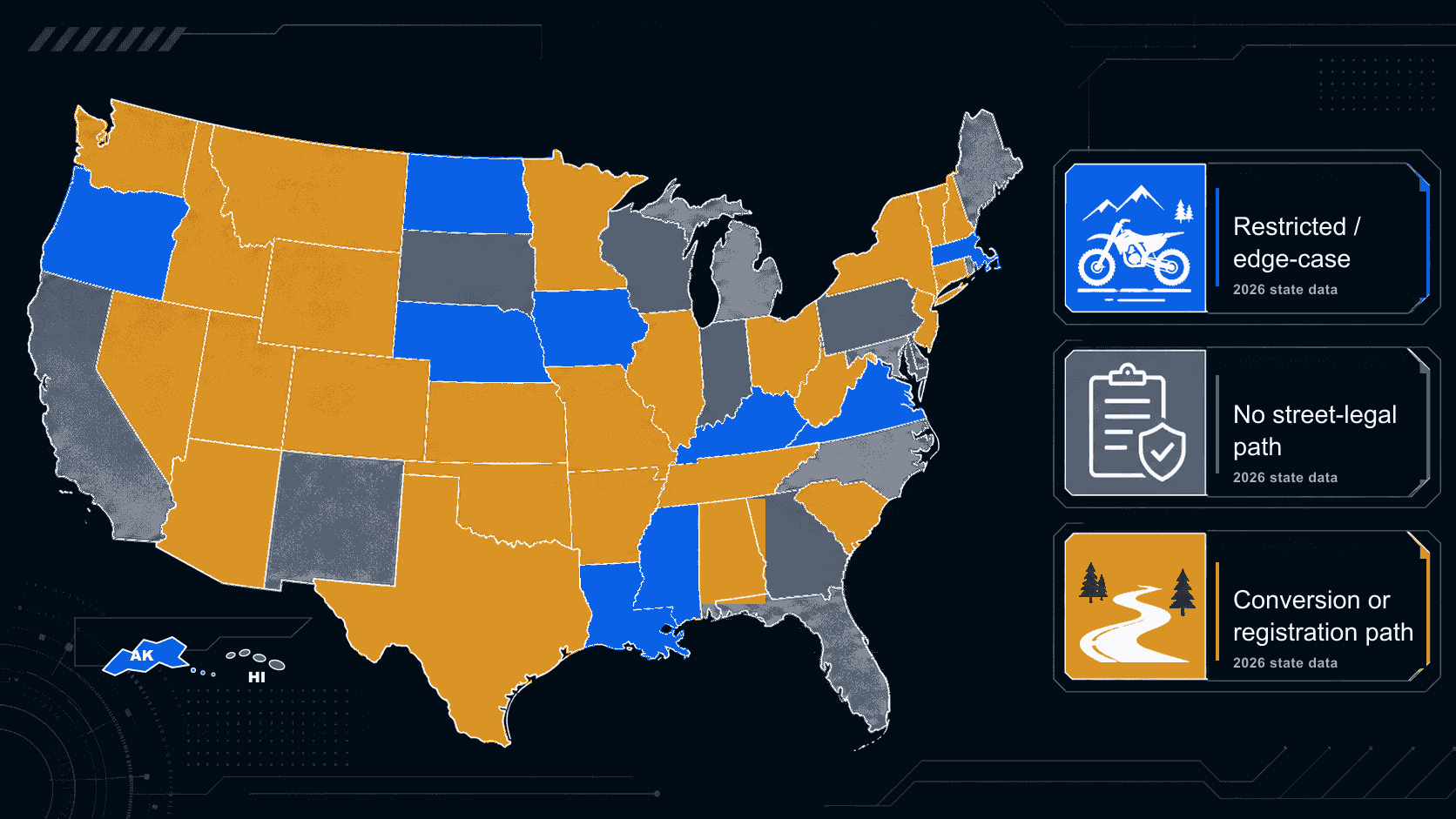
We maintain in-depth legality pages for all 50 states, grouped the way our state data is — by how realistic a street-legal path actually is. Four tiers:
A clear statutory path exists: the legislature wrote the route into the code deliberately. Arizona's A.R.S. § 28-1177(C) provides that once you hold an OHV user indicia and the machine meets the state's equipment requirements, on a signed affidavit the department shall register it for highway use — a mandate, not a discretion, and one written specifically for machines that were not road-legal as produced.
A conversion or registration path exists — difficulty varies: you can, with effort (DOT equipment, a VIN and title, registration, insurance, a motorcycle license), get there.
Restricted — limited road access without a full conversion: no clean street-plate path, but each offers something a flat "no" state does not — a local-road or shoulder allowance, an OHV-friendly registered-road regime, or a distinct titling route.
No street-legal path — off-road use only: treated as an off-highway machine with no route to a plate, whether as sold or converted.
Four of these tiers changed in August 2026 after we re-verified the ten largest states against primary statute rather than secondary sources, and several moved. Two more moved on 2026-08-22, and they moved in opposite directions — which is the honest shape of this subject. Maine was listed as no-road-access and is not: Title 12 section 13001 defines an ATV to include "a motorcycle or related 2-wheel... vehicle", and section 13157-A lets a registered ATV cross a public way for up to 500 yards and ride the extreme right of any way a municipality has designated and signed as an ATV-access route. Michigan kept its tier but lost a claim: we had told readers these bikes "cannot be titled or registered for general street use", and MCL 257.217i in fact requires the Secretary of State to title an assembled vehicle expressly including "an off-road vehicle, regardless of whether the original manufacturer's certificate of origin specifies that the vehicle is an off-road vehicle". New York, New Jersey and Illinois had been listed as conversion states and are not: New York's VTL § 122-b fixes a machine's certified top speed "regardless of any modification made to such vehicle after such certification," Illinois' 625 ILCS 5/3-401(c-1) restricts registration to vehicles originally manufactured for highway use, and New Jersey defines a dirt bike by its federal-safety-standard non-compliance at the point of manufacture. In each case the barrier is fixed at the factory, so no amount of equipment moves it. Arizona moved the other way, from "conversion" to a clear statutory path. Full reasoning is on each state's page.
Even inside a tier the details vary enormously. Tennessee rewrote its rules in April 2025 and now permits these bikes on county roads and on state highways posted at 45 mph or less — while apparently leaving no registration class a two-wheeler can actually hold, which is a door opened without a key. Meanwhile California's SB-586 bars street conversion outright, Oregon explicitly says off-road motorcycles cannot be converted to street legal, and Nevada and Utah (under a new 2026 e-motorcycle law) are actively cracking down on illegal street riding. Find yours in the full legality index, each with its own sourced breakdown and status graphic. The national rule holds everywhere — as sold, these are off-road machines, not street-legal.
Where you can legally ride
- Private property, with the owner's permission.
- Designated OHV parks and trails — often with an OHV registration/decal.
- Check the specific area: some trails are non-motorized, and rules differ by land manager (state park vs. national forest vs. private venue).
For the full breakdown — the four kinds of legal riding land and how to find open trails near you — see where you can legally ride an electric dirt bike.
Penalties are real
This isn't theoretical. Depending on the state, riding an unregistered electric dirt bike on the street can mean citations, fines, and — in Florida — a criminal charge, impoundment, and a mandatory court appearance. Enforcement has ramped up as these bikes flood neighborhoods. Ride where it's legal.
And 2026 is the year states got serious. Hawaii just enacted Act 259 (signed July 15, 2026, effective immediately): anything over 750W or 28 mph is now a "high-speed electric device" banned from every public area statewide — roads, bike lanes, paths, sidewalks. Utah's HB 381 (effective May 6, 2026) wrote e-motos into the motorcycle definition outright, and New Jersey's new registration regime hit its compliance deadline July 19, 2026 with the MVC's systems now live. The direction of travel is one way: more definition, more registration, more enforcement. Check your state's page — each one shows when we last verified it, and against what.
The narrow street-legal options
If road-legality matters to you, you have three realistic moves:
- Buy a bike that ships street-capable — e.g., the Stark Varg EX (road-legal performance enduro), the Onyx RCR (moped-style with lights and a street kit), or the Delfast Top 3.0, which ships as a street-legal Class-2 e-bike and unlocks full power off-road — though it is discontinued with no purchasable path we can find, so treat that one as used-market only.
- Convert it where your state allows (equipment + VIN/title + registration + insurance).
- Keep it off-road and enjoy it where it's designed to be ridden — the simplest, cheapest, and most common choice.
Not sure which bike fits your legal situation? The Find Your Ride configurator lets you filter by "must be street-legal" so you only see bikes that can actually get you there.
Bottom line
Electric dirt bikes are off-road machines, full stop. Treat "street legal" as the exception, not the rule: confirm your state on our legality pages, register for OHV use if your state requires it, and if you need pavement, start with a dual-sport. Ride legal, ride where you're welcome, and the whole sport stays open.
This guide is general information, not legal advice — laws change and vary by locality. Verify current rules with your state DMV and land manager before riding. VoltRipper is reader-supported; we may earn a commission on purchases through our links, at no extra cost to you, and it never affects our rankings. See our disclosure.
FAQ
Can I ride a Sur-Ron on the road?
In almost every state, no. A Sur-Ron and similar electric dirt bikes are classified as off-highway or motor vehicles, not e-bikes, so riding on public roads, bike lanes, or sidewalks is illegal without a formal street-legal conversion (and in most states, not even then). In Florida it's a criminal offense. Legal riding is private land and designated OHV areas.
Why isn't an electric dirt bike a street-legal e-bike?
Federal and state e-bike rules cap a street-legal electric bicycle at 750W (1 hp) with functional pedals and an assisted top speed around 20-28 mph. A Sur-Ron-class bike has a multi-thousand-watt motor, no pedals, and does 45+ mph, so it falls outside the e-bike definition and is treated as a motor vehicle.
How do I make my electric dirt bike street legal?
Where it's allowed at all, you generally need DOT-approved equipment (headlight, tail/brake light, turn signals, mirror, horn), a VIN/title, registration and insurance, and a motorcycle license. Some states (like Texas) have a conversion path; others (like California) explicitly bar registering these bikes for the street. A dual-sport model that ships street-legal is the simpler route.
Where can I legally ride an electric dirt bike?
On private property (with permission) and at designated OHV (off-highway vehicle) parks and trails. Several states require an OHV registration or decal for public-land riding — California's Green Sticker, Texas's $16 TPWD decal. Always check the specific area's rules and your state page.
Do kids need a license to ride an electric dirt bike?
Not for off-highway riding on private land or OHV areas, though age and helmet rules vary by state and venue. No electric dirt bike (kids' or adult) is street-legal for on-road use without registration, so keep young riders on private property or designated trails.
Sources
Editorial sources
- Hawaii Legislature — HB2021 CD1, enacted as Act 259 and signed 2026-07-15, creating the high-speed electric device classChecked
- Utah Legislature — HB 381 Electric Mobility Device Amendments, enrolled text (effective 2026-05-06)Checked
- Utah Highway Safety Office — HB 381 rider requirements, including the DOT FMVSS 218 helmet standard for e-motorcyclesChecked
- California Legislature — SB-1167 status, in the Assembly floor process and unsigned; SB-586 remains the governing lawChecked
- New Jersey MVC — dirt bikes and ATVs are for off-road use only; 39:3C registration is not a plateChecked
- Michigan Legislature — MCL 257.217i, requiring the Secretary of State to title an assembled vehicle including one whose certificate of origin says off-roadChecked
- Maine Legislature — Title 12 section 13001, defining an ATV to include a motorcycle or related 2-wheel vehicleChecked
- Maine Legislature — Title 12 section 13157-A, ATV crossings and municipally designated ATV-access routes on public waysChecked
Specification sources
- Onyx RCROnyx Motors — RCR 80V 45AhChecked
- Talaria Sting MX5 ProTalaria Canada - Sting MX5 Pro specificationsChecked