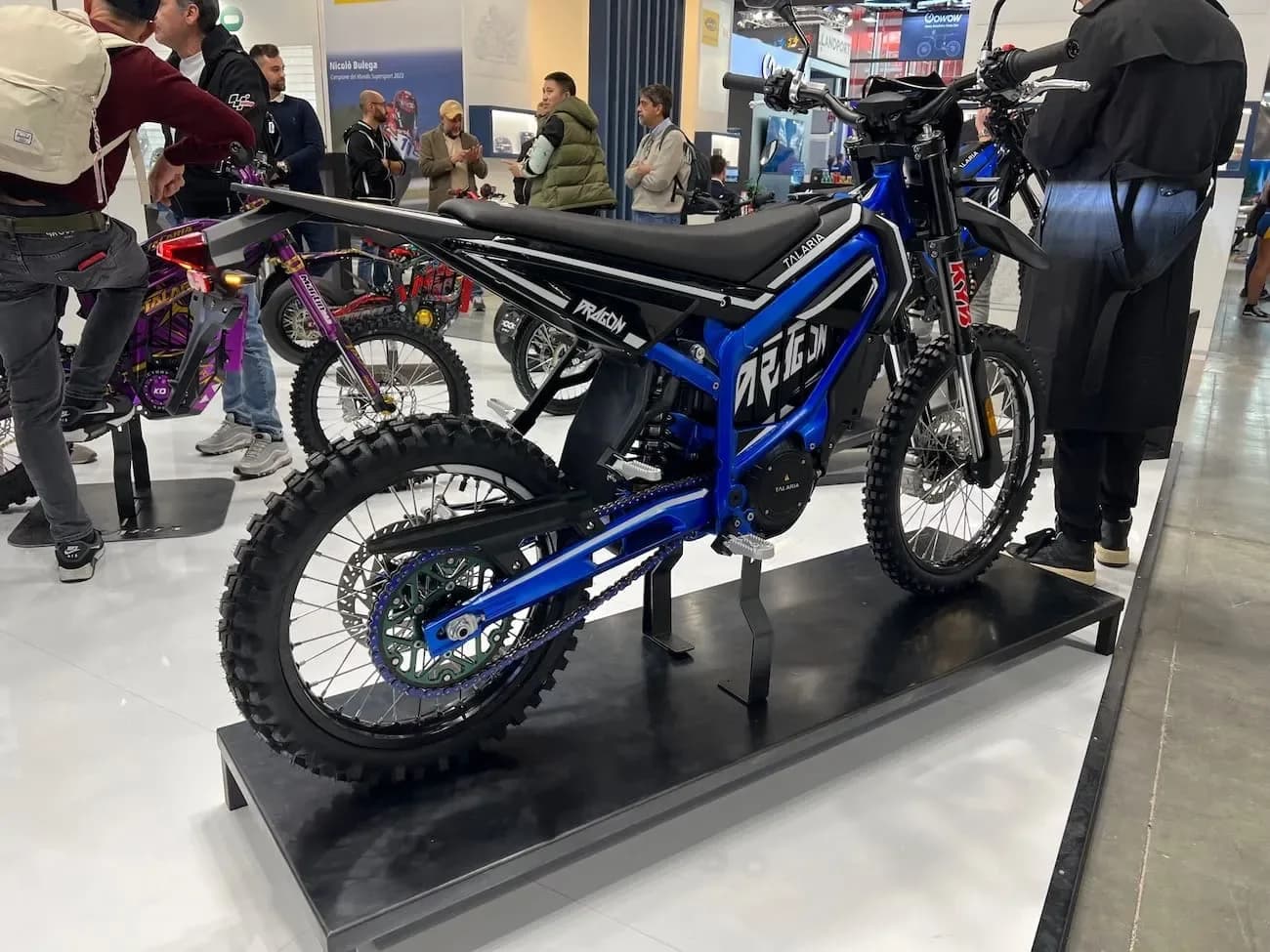
The verdict
The Talaria Dragon is Talaria's big-battery, tech-forward flagship — the one that adds a large 88.8V / 5.2 kWh pack, a 70 mph top-speed claim, and genuine rider aids (ABS, traction control, and a 4.3-inch Bluetooth TFT dash) on top of a full-size 21/18 enduro chassis, for a $6,949 pre-order price. It earns a VoltRipper Score of 90/100. But the most useful thing we can tell you is the honest one: its own cheaper sibling, the $5,999 Talaria Komodo, makes more peak power (32 vs 28 kW) and more torque (754 vs 630 N·m) for $950 less. So the Dragon is not the power play — it's the battery, electronics, and top-speed play. Buy it if those are what you want, you're an experienced rider, and you're comfortable ordering an unproven pre-order bike with no confirmed US ship date.
Who it's for — and who should skip it
Buy it if you want the largest battery and the most features in the Talaria line — ABS, traction control, and a smart TFT dash — a higher 70 mph top-speed claim, and full-size 21/18 geometry, and you're an experienced rider who can wait out a pre-order.
Skip it if you want the most power or the best value (the Komodo beats it on both), you need a proven platform with owner history and deep parts support today, you want the lightest, most flickable bike, you need a confirmed street-legal machine as delivered, you're a beginner (this is expert-rated), or you're uncomfortable buying a bike whose online footprint is dominated by reseller storefronts.
What it actually is: Talaria's big-battery, tech-forward flagship
For years Talaria's lineup topped out at the Sting family and, more recently, the Komodo — the brand's 32 kW, top-peak-power value enduro. The Dragon slots in above the Komodo on price and beside it on our board, but it gets there a different way. Instead of chasing peak power, the Dragon leans into battery capacity and electronics: a large 88.8V, 58.5Ah (≈5.2 kWh) pack, a 28 kW peak / 10 kW nominal mid-drive motor, 630 N·m of wheel torque, and — the real differentiators — ABS, traction control, and a 4.3-inch Bluetooth TFT display, plus an adjustable air fork and full-size 21-inch front / 18-inch rear motocross wheels. At a claimed 220 lb (100 kg), it's a full-size, motorcycle-scale machine, not a compact play bike.
That feature set is genuinely unusual in this class. ABS and traction control on a sub-$7k electric dirt bike are rare — most rivals, including the Komodo and the Sur-Ron Ultra Bee, ship without either. They point at a bike designed for mixed street-and-trail use rather than pure closed-course racing. That's a real selling point for a commuter-leaning or newer-to-full-size rider — but note the flip side: hardcore off-road riders often want ABS off to slide and lock the rear, so those aids matter most if you value control on pavement and loose-but-fast terrain, and less if you're racing tight woods.
The spec story: battery and electronics over raw power
The Dragon's headline numbers are strong, but read them for what they are. The 5.2 kWh battery is one of the larger packs in the class — bigger than the Komodo's ~4.4 kWh and the Ultra Bee's 4.44 kWh, though still well short of the Storm Bee's 5.72 kWh. The 70 mph top-speed claim is the highest in Talaria's lineup. And the ABS/TC/TFT package is a legitimate step up in refinement.
Where the Dragon doesn't lead is power. Its 28 kW peak trails the Komodo's 32 kW; its 630 N·m of torque trails the Komodo's 754 N·m; and its 88.8V system is lower-voltage than the Komodo's 97.2V. In other words, the cheaper Talaria is the harder-pulling one. The Dragon buys you battery, top speed, and electronics — not grunt. That's not a knock; it's just the honest shape of the trade, and it's why the two bikes land within a point of each other from opposite directions.
Dragon vs Komodo
The Komodo wins power, torque, voltage, weight and price. The Dragon wins battery size, top-speed claim, range claim, and the rider aids — ABS, traction control and a TFT dash. They finish a point apart, Komodo 91 to the Dragon's 90, because our Score weighs "more power for less money" and "more battery plus real rider aids" as roughly even.
Full head-to-head: Talaria Dragon vs Talaria Komodo → · Weighing the whole line? Which Talaria to buy
Range reality
Talaria quotes 93 miles, but that's a low-speed/eco claim, not a number to plan a hard trail loop around. The 5.2 kWh pack is genuinely large — an advantage over most of the class — but a 28 kW bike ridden for performance drains it quickly. Rather than guess a real-world figure, we leave it unverified until owner or instrumented data exists, consistent with how we treat every low-speed range claim in the class. The honest planning takeaway: it's a big battery, so real range should be strong for the segment — but treat 93 miles as a best-case ceiling, not a promise, and expect a realistic hard-riding figure well below it.
Street-legal reality
We score the US-market Dragon as off-road only. The picture is genuinely mixed: some market listings describe street-legal Dragon trims with turn signals and a horn, and the bike's ABS and full lighting hint at street intent — but a US DOT-homologated version is not confirmed in our sources, so we don't assume road use. Treat the Dragon as a trail and private-land machine until a dealer confirms the exact US trim, and check our street-legal guide and your state's rules before counting on any road riding.
The two real risks: a pre-order, and where you shop
Two honest cautions matter more on the Dragon than on almost any bike we cover.
It's a pre-order with a rocky launch history. As of July 2026, the Dragon has no credible, confirmed US ship date. It's an announced pre-order, but the only delivery timelines we can find come from the unreliable reseller sites — and they conflict — while some coverage has described it as a long-delayed, near-prototype model that may never have reached production. Treat any specific "ship date" you're quoted with suspicion. That means no meaningful owner history, no proven long-term parts support, and unverified real-world performance. Score it, and shop it, as a promising but unproven pre-order — not a known quantity.
Its online footprint is a minefield. Almost every Dragon listing we found lives on `*.us.com`-style reseller sites — the exact pattern behind Talaria's well-documented fake-and-unauthorized-storefront problem — and quoted prices swing wildly, from roughly $4,900 to $7,600. Our $6,949 figure reflects a current, credible listing, but verify it. Buy only from a legitimate, established dealer, confirm the out-the-door price and exact trim in writing, and treat any too-good-to-be-true Dragon deal as the warning sign it usually is. (How to spot a fake lookalike site →)
Where it wins, where it costs you
Wins: the largest battery in the Talaria lineup (~5.2 kWh); the highest Talaria top-speed claim (70 mph); genuine rider aids the class rarely offers (ABS, traction control, Bluetooth TFT); full-size 21/18 enduro geometry with an adjustable air fork; and a feature-forward, more street-friendly character.
Costs you: it's outgunned on power and torque by its own cheaper sibling (the Komodo makes 32 kW / 754 N·m for $950 less); it's heavy at ~220 lb and expert-rated; its real-world range is unverified behind a low-speed claim; its US street-legal status is unconfirmed; and — as an unconfirmed pre-order sold largely through reseller storefronts — it carries the thinnest track record and the highest buy-safely burden of any full-size bike we score. Those are the honest reasons a well-equipped bike lands at 90 rather than higher.
How it stacks up
| Bike | VoltRipper Score | Price | Peak power | Battery | Top speed | Weight |
|---|---|---|---|---|---|---|
| Sur-Ron Ultra Bee | 94 | $6,499 | 24.5 kW | 4,440 Wh | 59 mph | 195 lb |
| Talaria Dragon | 90 | $6,949 | 28 kW | 5,200 Wh | 70 mph | 220 lb |
| Talaria Komodo | 91 | $5,999 | 32 kW | 4,374 Wh | 65 mph | 216 lb |
| Arctic Leopard XE Pro R | 91 | $5,699 | 26.5 kW | 4,440 Wh | 72 mph | 175 lb |
The Dragon out-specs the class benchmark on battery, power, and top speed — yet it only ties the Sur-Ron Ultra Bee on our board (91 each) because Sur-Ron's decade-deep aftermarket, dealer network, proven resale, and lighter chassis offset a spec-sheet lead over years of ownership — the same reason the Komodo lands below it. And the Arctic Leopard XE Pro R undercuts the Dragon on price and weight with similar hardware, minus the big battery and the rider aids. The Dragon's distinct case in this group is simple: it's the one with the biggest battery and real electronics — you pay for those with a higher price, more weight, and pre-order risk.
Compared with
Every head-to-head we have published on this bike:
Go deeper on the Talaria Dragon:
Bottom line
The Talaria Dragon is the big-battery, tech-forward Talaria — a large 5.2 kWh pack, a 70 mph claim, and ABS/traction-control/TFT refinement the rest of the class rarely offers, on a full-size 21/18 chassis for $6,949. Its 90 Score reflects exactly that balance: real strengths in battery and features, weighed against an honest reality — the cheaper Komodo out-powers it, its range and street status are unverified, and it's an unconfirmed pre-order sold largely through reseller storefronts. If you specifically want the biggest battery, the highest top speed, and the rider aids in the Talaria line, and you'll buy carefully from a real dealer, the Dragon delivers something no other Talaria does. If you mostly want power and value, its own showroom sibling is the smarter, cheaper buy. Order it for what it verifiably is — and from someone you can trust.
VoltRipper is spec-verified and data-driven — we do not claim hands-on testing of this bike. Specs and prices are cross-checked against manufacturer and dealer sources and re-verified regularly; real-world figures we can't verify (real range, exact US street trim, warranty term, seat height) are left unstated rather than guessed. Affiliate disclosure is included on monetized pages.
FAQ
Is the Talaria Dragon worth it?
It's worth it for the right buyer: the Dragon is the big-battery, feature-rich Talaria — a 88.8V / 5.2 kWh pack, a 70 mph top-speed claim, and rider aids (ABS, traction control, a Bluetooth TFT dash) that no other Talaria offers — for $6,949 (VoltRipper Score 90). The honest catch is that its own cheaper sibling, the $5,999 Talaria Komodo, actually makes more peak power (32 vs 28 kW) and more torque (754 vs 630 N·m). So buy the Dragon for the battery, the electronics, and the higher top speed — not for raw grunt. And treat it as a mid-2026 pre-order with an unproven production and support record, not a bike you can judge on owner history yet.
Talaria Dragon vs Talaria Komodo — which should you buy?
The Komodo edges it on our board, 91 to 90, so it largely comes down to what you value. The Komodo ($5,999) is the value-and-power pick: $950 less, 32 kW peak (vs 28), 754 N·m (vs 630), and higher 97.2V. The Dragon ($6,949) is the battery-and-features pick: a larger 5.2 kWh pack (vs ~4.4), a 70 mph claim (vs 65), a 93-mile range claim (vs 71.5), and ABS + traction control + a TFT dash the Komodo lacks. Buy the Komodo if you want the most power for the least money; buy the Dragon if you want the biggest battery, the rider aids, and the higher top speed and you'll pay $950 for them.
Is the Talaria Dragon street legal?
We score the US-market Dragon as off-road only. Some markets list street-legal Dragon trims with turn signals and a horn, and the bike's ABS and lighting point at mixed street/trail intent — but a US DOT-homologated version is not confirmed, so we don't assume road use. Treat it as a trail and private-land machine until a dealer confirms the exact trim and your state's rules allow it. Check our street-legal guide first.
What's the real range of the Talaria Dragon?
Talaria's 93-mile figure is a low-speed/eco claim, not a hard-trail number. The 5.2 kWh pack is genuinely one of the larger batteries in the class, but a 28 kW bike ridden for performance spends energy fast. We leave the real-world range unverified until owner or instrumented data exists rather than guessing — plan around a realistic figure and treat 93 miles as a best-case ceiling.
When does the Talaria Dragon ship, and is it safe to order?
As of July 2026 the Dragon still has no credible, confirmed US ship date — it's an announced pre-order with a rocky launch history (some coverage described it as a long-delayed, near-prototype model), and the only 'delivery dates' we can find come from the unreliable *.us.com reseller sites, which contradict one another. Just as important: almost every Dragon listing online lives on *.us.com-style reseller sites, the exact pattern behind Talaria's known fake-storefront problem, and quoted prices swing from roughly $4,900 to $7,600. Buy only from a legitimate, established dealer, confirm the out-the-door price and exact trim in writing, and be skeptical of any too-good-to-be-true listing.