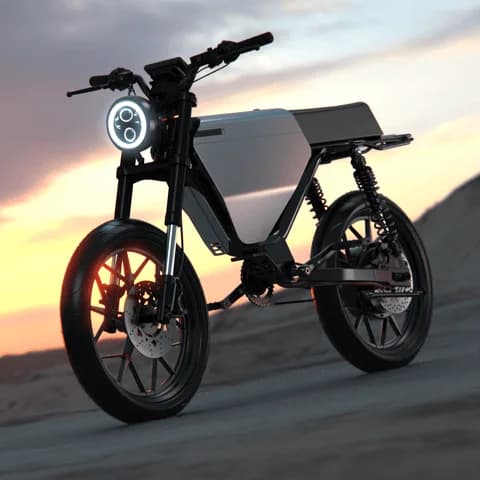
The verdict
The Onyx RCR is the odd one out on our board — and that's exactly why it's worth knowing. It isn't really a dirt bike; it's a moped-style dual-sport with a real seat, lights, a chainless hub motor, and one of the longest real-world ranges in our catalog. The current 80V model earns a VoltRipper Score of 94/100 — level with the Sur-Ron Ultra Bee and two behind the Storm Bee — but it earns it as a commuter-and-light-trails machine, not a hardcore off-road tool. If you want one electric bike that can actually run errands and still hit a fire road, this is the one.
Who it's for — and who should skip it
Buy it if you want to commute and ride light trails on the same bike, value comfort (a seat, an upright moped stance), want long range and low maintenance, and like the idea of lights and a more road-friendly machine.
Skip it if you want a genuine dirt bike for technical off-road — at ~150 lb and moped-shaped, it's out of its depth in the rough; if you want the deepest aftermarket (that's Sur-Ron); or if you need a swappable battery for all-day range.
What makes it different: it's a moped, not a dirt bike
Most of our board is a dirt bike first. The RCR is built the other way around. It has a comfortable seat, factory lights (`road_legal_lights: yes`), and an 80V, 15 kW boost hub motor — meaning no chain to maintain — good for a conservative scored top speed of 65+ mph. Onyx also lists a 21 kW max-peak figure and a Hyper mode at 75 mph for off-road use, but we score the less speculative 15 kW / Sport-mode basis. Think "fast electric moped that can handle dirt roads," not "Sur-Ron with extras." That framing is the key to whether it's right for you: it's still one of the most road-and-commute-friendly bikes we track.
Range: the best-evidenced real number in the class
Onyx rates the 80V RCR at 130 miles in Eco, 75 miles in Normal, and 55 miles in Sport; in real mixed riding, plan for ~45 miles — among the highest real-world ranges on our board — thanks to a big 3,600 Wh (80V/45Ah) pack, an efficient hub drive, and a gentler moped riding style. For a commuter, that's genuinely useful range, not a spec-sheet fantasy. (Why claimed and real diverge across the class is in our range guide.)
The hub-motor trade-off
The chainless hub motor is a double-edged sword, and it's central to the RCR's character:
- Upside: almost no drivetrain maintenance — no chain to clean, tension, or replace. For a bike you'll ride to work, that's a real perk.
- Downside: a hub motor adds unsprung weight, is less composed over rough terrain, and is harder to upgrade than the mid-drive platforms on the Sur-Ron and Talaria. It's the right choice for pavement and light trail, the wrong one for jumps and technical dirt. (See it against a purpose-built trail bike in Onyx RCR vs Talaria MX5 Pro.)
Street-legal: closer than most, but still check your state
Unlike the Sur-Rons, the RCR ships with lights, so the street-legal path is more realistic here than on a bike you'd have to light from scratch. But it is still kit-legal only — whether you can actually register and plate it depends on your state's rules. Read our street-legal guide and check locally before you count on road use.
Where it costs you
- Weight and shape. ~155 lb and moped-styled — comfortable, but not agile in real dirt.
- Ships speed-limited. It's delivered restricted; full 65+ mph performance needs unlocking and appropriate off-road use.
- Fixed battery. The pack isn't swappable, so you can't carry a spare to double your range.
- Smaller aftermarket. Parts and community support are decent but not Sur-Ron-deep.
Onyx RCR vs Sur-Ron Light Bee X
Choose the RCR if your riding is commuting plus the occasional trail, and you value range (~45 real miles against 25–35), comfort, factory lights and a chainless hub drive. Choose the Light Bee X if you want a real dirt bike, the biggest aftermarket, and lighter, more capable off-road handling. The RCR takes the Score 94 to 89 on range, power and road-friendly versatility; the Light Bee is still the better dirt platform.
Full head-to-head: Sur-Ron Light Bee X vs Onyx RCR →
Compared with
Every head-to-head we have published on this bike:
- Onyx RCR vs Delfast Top 3.0
- Onyx RCR vs Segway Xaber 300
- Onyx RCR vs Sur-Ron Ultra Bee
- Onyx RCR vs Talaria Sting MX5 Pro
- Sur-Ron Light Bee X vs Onyx RCR
Go deeper on the Onyx RCR:
Bottom line
The Onyx RCR is the most road-and-commute-friendly electric bike on our board, with one of the best real-world ranges and the low-maintenance appeal of a chainless drive. Just be clear about what it is: a do-it-all moped-style dual-sport, not a dirt bike. If you want one bike for the street and light trails, the RCR is a genuinely strong 94-point pick; if you want to actually ride dirt, get a Sur-Ron.
VoltRipper is spec-verified and data-driven — we do not claim hands-on testing of this bike. Specs and prices are cross-checked against the sources listed above and re-verified regularly; real-world figures are our own estimates, clearly labeled.
FAQ
Is the Onyx RCR worth it?
If you want one electric bike that can commute and ride light trails, yes — it's the most road-ready and most comfortable pick in our catalog, and ties for the longest real-world range we publish (VoltRipper Score 94), with a chainless hub drive that needs almost no maintenance. Skip it if you want a genuine off-road dirt bike (it's moped-shaped and out of its depth in technical terrain), the deepest aftermarket (that's Sur-Ron), or a swappable battery for all-day range.
Is the Onyx RCR street legal?
Not out of the box. It's the closest thing to road-ready in the class — moped-style, with lights and a street-speed mode — but it still needs a DOT light/signal kit, registration (often as a moped, depending on your state), a license, and insurance to ride legally on public roads. That's far less work than converting a Sur-Ron, but it's a kit-and-register bike, not turnkey. Check your state's rules first.
Onyx RCR vs Sur-Ron — which should you buy?
Different tools. The Onyx is a moped-style commuter with lights, a real seat, a chainless hub drive, and long range — the better bike for roads, errands, and light trails. The Sur-Ron is a genuine light dirt bike with the deepest aftermarket — the better bike for technical off-road and modding. Buy the Onyx to commute; buy the Sur-Ron to rip trails.
How far does the Onyx RCR go, and how fast is it?
It has one of the longest real-world ranges in our catalog — about 45 miles per charge — and tops out around 65 mph. Its chainless hub motor needs almost no maintenance, which suits daily commuting. For the full range picture, see our range guide.