The verdict
When riders ask "what's the step up from a Sur-Ron Light Bee?", the Ultra Bee is the answer. It posts a top-tier VoltRipper Score of 94/100 — and it earns that with a genuinely bigger everything: a 4.4 kWh battery, roughly 24.5 kW of peak power in HP listings, a 59 mph top end, and 2026 wheelie control, all riding on the deepest support network in the segment. At ~$6,499 it is not a value pick, and it's more bike than a beginner should start on — but for a rider ready to move up, it's the class benchmark.
Who it's for — and who should skip it
Buy it if you have outgrown a Light Bee (or know you will), want the most capable Sur-Ron short of the Storm Bee, and have the experience to use ~24.5 kW responsibly.
Skip it if you're a beginner — 195 lb and this much power is a lot of bike to learn on; on a budget — the Light Bee X or a Talaria Sting delivers most of the fun for around $2,000 less; or you need a street-legal machine out of the box (this one doesn't).
What you're stepping up to
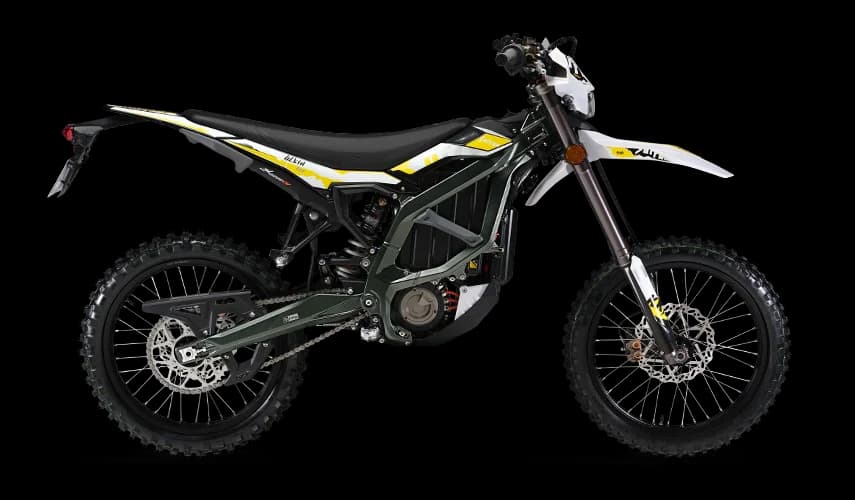
The Ultra Bee HP runs a 74V system with ~24.5 kW peak in current retailer listings (versus the Light Bee X's 10 kW), a 4.4 kWh pack (74V, 60 Ah) — about 76% larger than the Light Bee X's 2,520 Wh — and a 59 mph top speed. It adds full hydraulic discs, DNM suspension, and, new for 2026, wheelie control. At 195 lb it's a moto-class machine, not a trail toy. This is where Sur-Ron stops being "a fast bicycle" and starts being a proper electric dirt bike.
Range: the honest answer
Current Ultra Bee HP listings quote long low-speed range claims, but we won't treat those as trail range. What we can say from the hardware: the 4.4 kWh pack is roughly 76% larger than the Light Bee X's, so real-world range should be meaningfully better than the Light Bee's honest ~25–35 miles. As always, budget your ride off real-world riding, not a spec sheet — see our range guide for why the two diverge.
The ecosystem still applies
Stepping up doesn't cost you Sur-Ron's biggest advantage. The Ultra Bee sits on the strongest parts availability, dealer network, and 5/5 rider community in the segment — the same moat that makes the Light Bee X our top value pick. It's upgradable, serviceable, and holds resale. A more powerful rival you can't get parts for is the worse buy.
By the numbers: what the step-up buys
Our standard computed metrics from the verified spec set:
| Metric | Ultra Bee | How it reads |
|---|---|---|
| Battery per dollar | 0.68 Wh/$ | Better than the Light Bee X (0.57) — the bigger bike is also the better battery buy |
| Power to weight | 126 W/lb | The class-leading figure among mid-size bikes — this is what $6,499 is actually buying |
| Price per real-world mile | not published | No defensible third-party measured range yet — we won't invent one |
The surprise in the math: the Ultra Bee out-values its own little brother on watt-hours per dollar while nearly doubling watts per pound. The step-up premium buys hardware, not just badge — which is exactly why it posts a top-tier Score of 94. The missing range row stays honest until real measured data exists.
Where it costs you
- Weight. At 195 lb it's a lot of bike to pick up, loft, or correct — the opposite of the flickable Light Bee.
- Price. ~$6,500 puts it above every trail-class value pick.
- Not street-legal as sold. It ships off-road; road use needs a lighting/registration kit and a state that allows it. Read our street-legal guide first.
Ultra Bee vs Light Bee X
This is the choice most Sur-Ron buyers actually face. You pay $2,099 more and carry 65 more pounds for roughly 2.5× the peak power, 76% more battery, and 9 mph more top speed — and the Ultra Bee takes the Score 94 to 89. If you will genuinely use that performance, it is worth it. If you are mostly trail cruising or still building skills, the Light Bee X is lighter, cheaper, and gives up surprisingly little day to day.
Full head-to-head: Sur-Ron Ultra Bee vs Light Bee X →
Compared with
Every head-to-head we have published on this bike:
- Altis Sigma vs Sur-Ron Ultra Bee
- Arctic Leopard XE Pro R vs Sur-Ron Ultra Bee
- Onyx RCR vs Sur-Ron Ultra Bee
- Segway Xaber 300 vs Sur-Ron Ultra Bee
- Sur-Ron Ultra Bee vs E-Ride Pro SS 3.0
- Sur-Ron Ultra Bee vs Light Bee X
- Sur-Ron Ultra Bee vs Storm Bee
- Sur-Ron Ultra Bee vs Talaria Sting MX5 Pro
- Talaria Komodo vs Sur-Ron Ultra Bee
Go deeper on the Sur-Ron Ultra Bee:
Bottom line
The Sur-Ron Ultra Bee is the most capable, best-supported electric dirt bike for a rider who's ready to step up — the class benchmark, with a top-tier VoltRipper Score of 94/100. It isn't a beginner bike and it isn't a value play. But if you've outgrown the entry tier and want more of everything without leaving the ecosystem that makes Sur-Ron worth owning, this is the one.
VoltRipper is spec-verified and data-driven — we do not claim hands-on testing of this bike. Specs and prices are cross-checked against the sources listed above and re-verified regularly; where listing figures are trim-specific, conflicting, or condition-dependent, we label them instead of turning them into trail claims.
FAQ
Is the Sur-Ron Ultra Bee worth it?
If you've outgrown a Light Bee and want the most capable Sur-Ron short of the Storm Bee, yes — it posts a top-tier VoltRipper Score of 94 with ~24.5 kW peak power, a 4.4 kWh battery, and a 59 mph top end, all on the deepest support network in the class. But at ~$6,499 it's not a value pick, and its 195 lb and power make it too much bike for a true beginner. Skip it if you're on a budget (a Light Bee X or Talaria Sting delivers most of the fun for ~$2,000 less) or new to the class.
Sur-Ron Ultra Bee vs Light Bee X — which should you buy?
The Ultra Bee is the step-up: roughly 2.5x the peak power (24.5 vs 10 kW), a much bigger battery, and a higher top speed — for about $2,000 more ($6,499 vs $4,499) and 65 lb more weight. Buy the Ultra Bee if you want more power and range and can handle the extra weight; buy the Light Bee X if you want the lighter, cheaper, more beginner-friendly bike — it gives up surprisingly little for the riding most people actually do. See our full [Ultra Bee vs Light Bee X comparison](/guides/sur-ron-ultra-bee-vs-light-bee).
Is the Sur-Ron Ultra Bee good for beginners?
Not really — at 195 lb with ~24.5 kW of peak power, it's a lot of bike to learn on. Capable riders will love it, but a true beginner is better served by the lighter, less-powerful Light Bee X, or by starting the Ultra Bee in a low power mode and easing in. It's a step-up bike, not a first bike.
How fast is the Sur-Ron Ultra Bee and what's its real range?
About 59 mph top speed. On range, we won't give you a single number, because nobody has measured this bike ridden hard. Sur-Ron's 71-mile claim is a constant-speed figure, and the one instrumented independent test we've found — Cycle News, GPS-tracking every ride — got up to 60 miles on trails at an intermediate pace on the same 74V/60Ah pack. Ride it hard and you should expect well under that. It's an off-road machine, not street-legal as delivered.