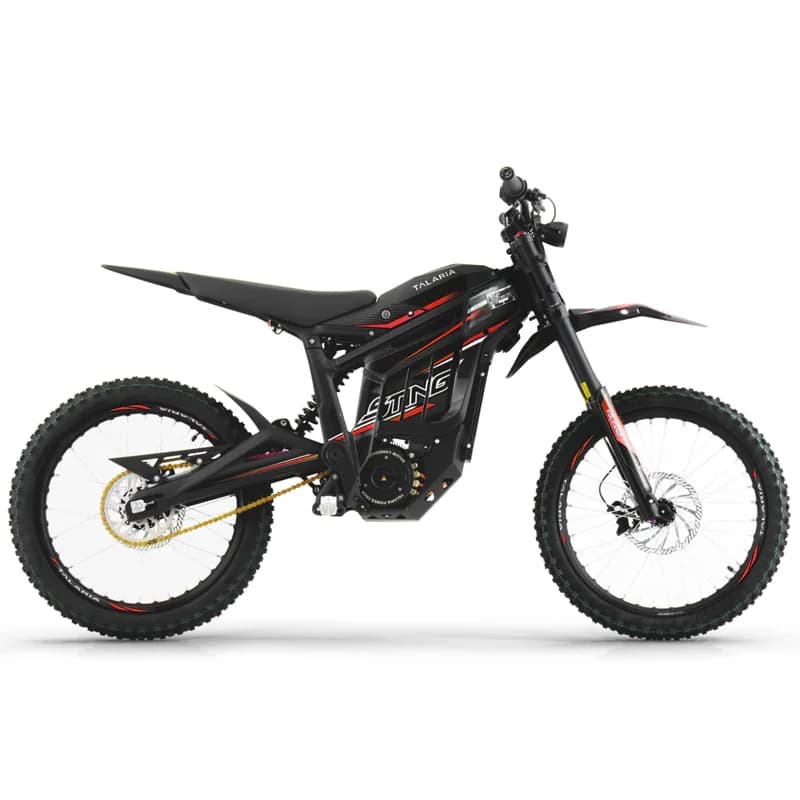
The verdict
> Discontinued (August 2026). Talaria has ended the Sting MX3 and Luna Cycle — the dealer we link — names the Sting R MX4 as its successor. Remaining stock is still sellable, but note the direction of travel: last-stock pricing has gone up, to about $3,700 from the $3,099 this bike sold for before. If you want a new Talaria at this size, the MX4 is the one still in production.
The Talaria Sting MX3 was the value entry point to the light electric-dirt-bike class, and for most of 2026 it was the cheapest way into a genuine one. Talaria has now discontinued it. Final stock runs about $3,700, up from the $3,099 it sold for, so it is now roughly $700 cheaper than the Sur-Ron Light Bee X and about $400 cheaper than Talaria's own Sting R MX4 — both gaps about a third of what they were. It earns a VoltRipper Score of 86/100, and the value argument that once put it above the pricier Sting R MX4 has reversed with those prices: the MX4 now scores 87. For a budget-minded buyer who can still find one, this remains a lot of bike for the money - but you are buying a platform Talaria has stopped making, at a price that has gone up rather than down.
Who it's for — and who should skip it
Buy one from remaining dealer stock if this is your first serious e-dirt-bike, you're watching your budget, or you want into the Talaria ecosystem without paying the premium — and you're happy with a lighter, more approachable bike.
Skip it if you want maximum power (a Sur-Ron or the Sting R MX4 makes more), the biggest battery and range, or app connectivity — none of which are the MX3's job.
The value story: the cheapest way into a real one
This is the whole point of the MX3. For about $3,099 you get a genuine 60V light e-dirt-bike — 6 kW peak, 284 Nm, hydraulic disc brakes, full suspension, and a proper 47 mph top end — for well under what the establishment charges. It scores 86, now below the Sting R MX4, which scores 87 at $4,100 after both bikes' prices moved in opposite directions, because our VoltRipper Score weighs value, and the MX3 gives up only modest power and battery for a big price cut. That's the textbook definition of a value pick: not the most bike, but the most bike per dollar.
By the numbers: the value claim, quantified
The same computed metrics we run on every bike (derived from the verified spec set) — and here the math is the argument:
| Metric | Sting MX3 | How it reads |
|---|---|---|
| Battery per dollar | 0.74 Wh/$ | The best figure among the class's big names — beats the Light Bee X (0.57) by ~30% |
| Power to weight | 49 W/lb | The honest trade: modest punch — this is the beginner-tune, not a rocket |
| Price per real-world mile | ~$111/mi | The cheapest real trail miles in the premium-brand tier (Light Bee X: ~$147) |
That's the MX3's whole case in three rows: you give up power-to-weight (deliberately — it's the approachable tune) and in exchange you get the most watt-hours and the cheapest real-world miles per dollar of any establishment-brand bike we track. If the computed value math decides your purchase, this is where it points.
Beginner-friendly by design
Talaria built the MX3 as an approachable bike. It's rated for beginners, ships factory-limited to 20 mph in many dealer configurations, and offers four power modes to dial the delivery down while you build skill. That limiter does not make a 123 lb e-moto "safe" by itself — it just makes the first rides more manageable. Unlocking the full ~47 mph off-road mode is common, but it is at the rider's risk and can change the legal/warranty picture.
Independent/dealer reality checks
Luna Cycle's current MX3 listing frames it well: the bike is the original Sting, re-released with an updated controller and factory fork, and it is more docile and manageable than the MX4 while keeping a gearbox, smooth throttle, larger rear tire, and upgrade-friendly platform. GritShift's MX3/MX4/E Ride comparison adds the important caveat: the MX3 is a proven 6 kW machine with strong aftermarket support, but some shops are moving attention toward newer models, so availability can be uneven.
That matters for buyers. The MX3 is not the newest or highest-ceiling Talaria; it was the easier-entry Sting, and the cheaper X3 is discontinued too. Buy remaining stock only if the price/parts/platform equation still works for you, not because it is secretly the best Talaria at every job.
The Talaria ecosystem — a real edge for a budget bike
Here's what separates the MX3 from cheap no-name imports at similar prices: parts availability is strong. It rides on Talaria's established platform, so upgrades, replacement parts, and support are genuinely available. A budget bike you can actually maintain and improve is worth far more than a cheaper one you can't.
Range: claimed 44, real ~28
Talaria rates it at 44 miles; plan for ~28 in real mixed riding. The 2,280 Wh pack is smaller than the pricier bikes', but it's appropriate for the price and for the typical beginner ride. (More on why claimed and real diverge in our range guide.)
Where it costs you
- Less power. 6 kW peak trails the Sting R MX4 (8 kW) and the Sur-Rons (10 kW+).
- Smaller battery. 2,280 Wh is the least among the mid-tier bikes here.
- Factory speed limit. Like other Talarias, many dealer configs ship throttled to 20 mph; full-speed unlocking is an off-road/risk decision.
- No app, non-swappable battery. Basic on the tech and convenience front.
- Street legality is trim/state-specific. The off-road MX trim is not street-legal as sold; L1E/kit paths only matter where the paperwork, equipment, and state law line up.
The value ladder: MX3, R MX4 and the Light Bee X
The ladder has reordered, and it is worth being blunt about why. The MX3 was the value sweet spot when the two bikes sat about $1,400 apart — a wide gap for modestly less bike, which is exactly the trade the Score rewards. Both prices moved in August 2026: Talaria cut the R MX4 and discontinued this bike, pushing its remaining stock up rather than down. The gap is now about $400, and at that distance the R MX4's bigger battery and extra power win — it now scores 87 to the MX3's 86. Above both sits the Light Bee X (89) for the deepest ecosystem. There is no wrong rung, just the one that matches your budget.
Full head-to-head: Sur-Ron Light Bee X vs Talaria Sting MX3 →
Compared with
Every head-to-head we have published on this bike:
- 79Bike Falcon Pro vs Talaria Sting MX3
- Rawrr Mantis X vs Talaria Sting MX3
- Sur-Ron Light Bee X vs Talaria Sting MX3
- Talaria X3 vs Sting MX3
Go deeper on the Talaria Sting MX3:
Bottom line
The Talaria Sting MX3 was the best-value entry into the light electric-dirt-bike class until Talaria discontinued it in August 2026 — a genuine, well-supported bike, with an 86-point Score that reflects how much bike it gives per dollar. If you find remaining dealer stock near $3,700 and it's your first e-dirt-bike or budget is the priority, it is still a smart buy. For a new bike, Luna names the Sting R MX4 as the successor. The MX4 is sold out at both US sellers we track, as of 2026-09-14. Talaria's X3 is discontinued too. Move up to a Sur-Ron only if you specifically want more power, range, or the largest aftermarket.
VoltRipper is spec-verified and data-driven — we do not claim hands-on testing of this bike. Specs and prices are cross-checked against the bike record's source list, Talaria/dealer product data, and current retailer comparisons; real-world figures are clearly labeled estimates or third-party/dealer reality checks.
FAQ
Is the Talaria Sting MX3 worth it?
For a first serious e-dirt-bike or a budget-minded buyer, it's one of the smartest entries on the board — it was for most of 2026 the cheapest way into a genuine light electric dirt bike. Talaria has now discontinued it, and final stock sells for about $3,700 rather than the $3,099 it launched at, so it is now only modestly cheaper than the Sur-Ron Light Bee X and Talaria's own Sting R MX4. Both gaps used to be far wider, and the Score relationship has reversed with them: this bike now scores 86 where the Sting R MX4 scores 87, because the MX4's price fell while this one's final-stock price rose. Skip it if you want maximum power, the biggest battery, or app connectivity.
The Sting MX3 used to out-score the Sting R MX4. Why doesn't it now?
Because the VoltRipper Score weighs value, not just capability. The Sting R MX4 has more battery and a more motorcycle-like ride, but it costs ~$400 more and ships factory-limited to 20 mph. The MX3 delivers so much of the core light-e-dirt-bike experience for ~$3,700 that its value-per-dollar once earned it a Score above the R MX4's. That has since reversed: with the MX3 discontinued and its final stock at ~$3,700, and the R MX4 cut to $4,100, the Sting R MX4 now scores 87 against this bike's 86. It remains a clean example of why a higher price doesn't mean a higher Score.
Talaria Sting MX3 vs Sur-Ron Light Bee X — which should you buy?
The MX3 was the cheaper, lighter and more approachable entry, and the Light Bee X is the benchmark with the deepest aftermarket, biggest community, and the widest pool of used buyers. The MX3 is discontinued, so buy one only if you find remaining dealer stock near $3,700. For a new bike, Luna names the Sting R MX4 as the successor, at $4,100. The MX4 is sold out at both US sellers we track, as of 2026-09-14. Talaria's X3 is discontinued too. Buy the Light Bee X ($4,499) for the proven ecosystem if you can spend more. See our [Light Bee X vs Sting MX3 comparison](/guides/sur-ron-light-bee-x-vs-talaria-sting-mx3).
Is the Talaria Sting MX3 good for beginners?
Yes, if you find remaining dealer stock — it was one of the better first-serious-bike choices, lighter and more approachable than a Sur-Ron. For a new bike, Luna names the Sting R MX4 as the successor. The MX4 is sold out at both US sellers we track, as of 2026-09-14. Start it in a low power mode and ease in. It's off-road only (not street-legal as delivered), so it's a trail first bike rather than a road commuter.