Tracked price checks
Bikes in this guide
Altis
Sigma
Highest top-speed claim in the catalog: 97.2V, 25 kW peak, 80+ mph claimed for the fastest gearing (real-world ~70+ mph)
Trade-off: Newer brand, so parts depth, resale, and owner history are far behind Sur-Ron or Talaria
We may earn a commission if you buy through this link, at no extra cost to you.
Check price at REVRidesApollo (RFN)
RFN Ares Rally Pro
Marketed as a 'Sur-Ron killer' — 12.5 kW peak 'rocket mode' is big power for the money
Trade-off: Newer brand with a smaller aftermarket than Sur-Ron/Talaria
We may earn a commission if you buy through this link, at no extra cost to you.
Check price at REVRidesE-Ride Pro
SS 3.0
15.8 kW peak output and 62 mph top speed put it above the SS 2.0 and Light Bee class
Trade-off: Real trail range still needs verified owner or test data; claimed range is a low-speed figure
We may earn a commission if you buy through this link, at no extra cost to you.
Check price at VoroMotorsThe short answer
These are three electric dirt bikes separated by three VoltRipper Score points — and three points is narrower than the difference between the riders they suit. So this isn't really a "which is best" question; it's a "which fits you" one:
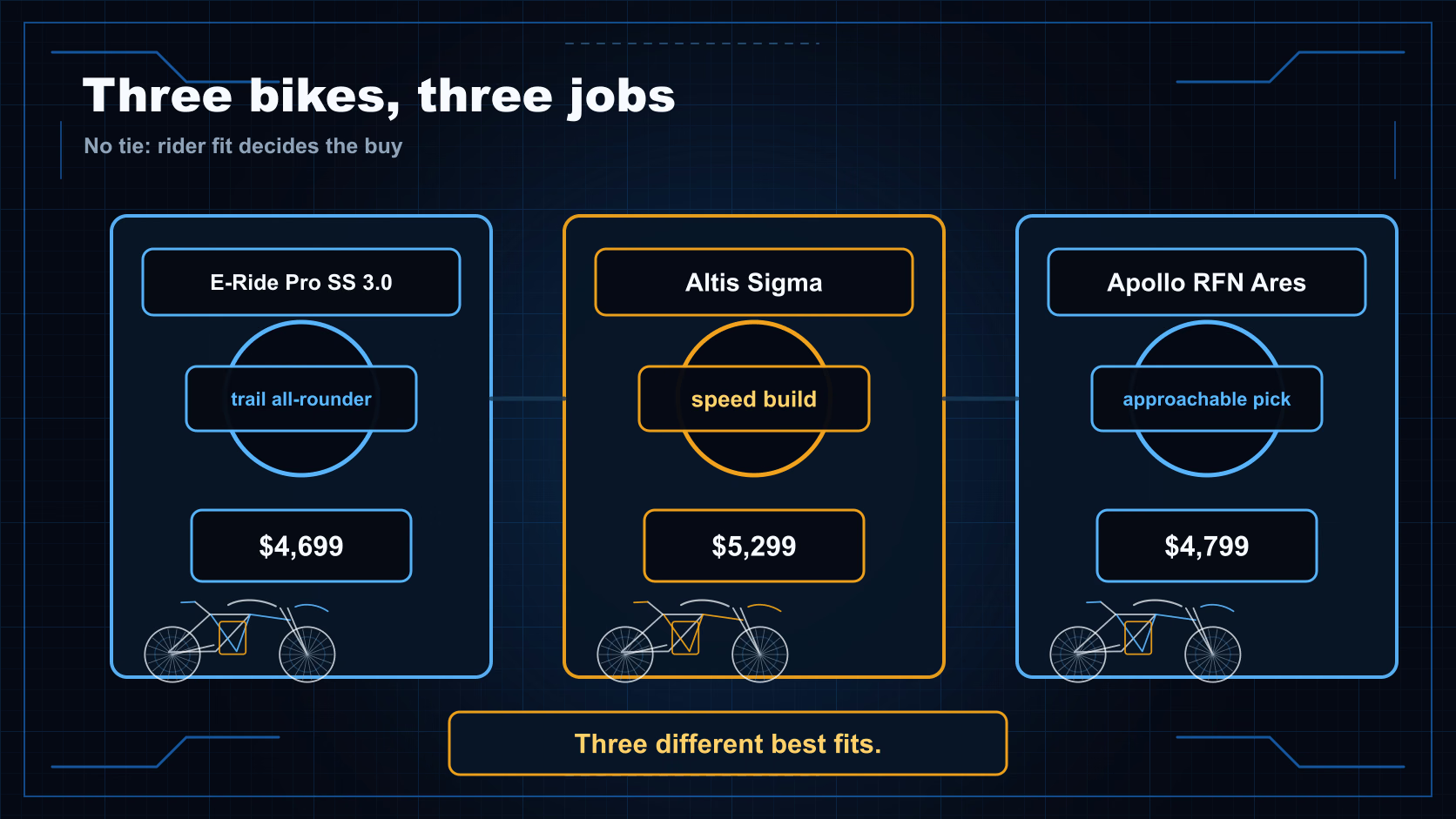
- E-Ride Pro SS 3.0 ($4,699, Score 92) — the best-balanced pick and the highest scorer here: mid-pack speed and power, the lowest seat of the three, and the only swappable battery, with reverse and app support.
- Apollo RFN Ares ($4,799, Score 89) — the approachable, street-kit-ready pick: less power but the friendliest to ride, the only one with a headlight and a real street path, the longest warranty, and the lightest of the three.
- Altis Sigma ($5,299, Score 90) — the speed-and-power pick: 25 kW and an 80 mph claim (the biggest top-speed number of the three), for the expert rider who wants outright pace.
The ordering is worth reading carefully, because it inverts the spec sheet. The Altis has the most power, the highest top speed and the most torque of the three, and it scores lowest — because the VoltRipper Score rates fitness for purpose, and a 25 kW / 80 mph machine that ships factory-limited, carries no stated warranty and asks the most money does not convert those numbers into the best bike for most people. A two-point spread is not a verdict. Treat the Score as the tiebreaker of last resort here, and your riding as the first one.
Why these three
All three sit in the 90s on our board, and two of them sit under $5,000 (see the whole tier). That's what makes this the decision worth having: you're not choosing between a good bike and a compromise — you're choosing between three genuinely strong bikes built for different riders. Get the match right and you've bought the best bike in the class for you; get it wrong and you've bought a great bike that fights how you ride.
The three-way matchup
| Altis Sigma | Apollo RFN Ares | E-Ride Pro SS 3.0 | |
|---|---|---|---|
| VoltRipper Score | 90 | 89 | 92 |
| Price | $5,299 | $4,799 | $4,699 |
| Peak power | 25 kW | 12.5 kW | 15.8 kW |
| Top speed | 80 claimed / ~70+ real | 50 mph | 60 mph |
| Torque | 601 Nm | 364 Nm | 520 Nm |
| Battery | 3,402 Wh (97.2V) | 3,132 Wh (72V) | 3,600 Wh (72V) |
| Weight | 185 lb | ~149 lb | 167 lb |
| Seat height | 35 in | 33.9 in | 32.7 in |
| Swappable pack | No | No | Yes |
| Street path | Off-road only | Kit + headlight | Off-road only |
| Warranty | Unstated | 24-month | Unstated |
| Skill level | Expert | Intermediate | Expert |
Head-to-head, factor by factor
Speed & power → Altis Sigma. It's not close on the headline: 25 kW and an 80 mph claim versus the E-Ride's 62 and the Apollo's 50. The Altis has the highest top-speed number in the entire catalog. Two honest asterisks: that 80 is a best-case claim (real-world accounts put it around ~70+ mph, and no one's published an instrumented run), and it ships factory-limited to 20 mph, so you must derestrict it. If raw pace is the point, though, the Altis owns this trio.
Approachability → Apollo RFN Ares. This is the flip side of the Altis's power. The Apollo is the only one of the three we rate intermediate rather than expert; its 12.5 kW / 50 mph is the least intimidating; and it's the friendliest to learn on. If you're still building skill, the Apollo is the sane entry to this tier — the other two are expert machines that reward experience and punish mistakes.
Weight → Apollo, which reverses what we used to say here. We previously called this for the E-Ride at 167 lb, because the Apollo's weight was unpublished and we would not guess. RFN's own spec sheet puts the Apollo's complete-bike net weight at 68 kg — about 149 lb — and a US dealer lists 149 lb net against 154 lb curb. On either figure the Apollo is the lightest of the three, by roughly 13-18 lb over the E-Ride and 31-36 lb over the Altis (185 lb). One caveat we would rather state than hide: manufacturers are inconsistent about whether a published weight is dry or curb, so treat a 10 lb gap between any two of these as noise. The Apollo's lead over the Altis is not noise. Lighter means more flickable on tight trails and easier to pick up and load — though the E-Ride still has the lowest seat here at 32.7 in, which matters just as much for manageability. (Why weight matters more than the spec sheet admits: our weight guide.)
Battery & range → close, with an E-Ride edge on flexibility. The packs are within ~15% of each other on energy — E-Ride 3,600 Wh, Altis 3,402 Wh, Apollo 3,132 Wh — so none has a decisive size advantage. The difference is the E-Ride's swappable pack: only it lets you carry a charged spare to extend range trailside. All three quote optimistic low-speed range claims (Apollo's 90 mi, E-Ride's 64, Altis's 50) that we treat as best-case, not trail numbers — claimed vs real explained. On raw battery, call it a draw; on range flexibility, the E-Ride wins.
Street-readiness → Apollo RFN Ares. The Apollo is the only one with a factory headlight and a kit-based street path, so it's the closest of the three to a bike you could eventually register and plate where your state allows. The Altis and E-Ride are off-road only as sold. If any road use is in your future, the Apollo is the only realistic starting point here — though it still needs a full kit, registration, and your state's blessing. (Check street-legal rules first.)
Warranty → Apollo RFN Ares. The Apollo is the only one of the three with a stated warranty — 24 months, the longest in this comparison. The Altis and E-Ride warranties are unstated in our data, which is a real ownership consideration on bikes from newer brands. Confirm terms with the dealer, but on paper the Apollo gives you the most coverage.
Features → E-Ride Pro SS 3.0. The E-Ride adds reverse, app support, and adjustable suspension on top of its swappable pack — the most complete feature set here. The Apollo also has adjustable suspension and ride modes; the Altis leans on raw output rather than gadgets. For a rider who values refinement and tuning, the E-Ride is the richest package.
Price → the E-Ride, and it changed hands in August 2026. The E-Ride is now the cheapest at $4,699, the Apollo is $4,799, and the Altis is the most expensive at $5,299 — a $600 spread. The Apollo held this slot until E-Ride's own store dropped the SS 3.0 by $300; we carried $4,999 until 2026-08-18. The Altis carried a $4,799 figure here until July 2026; that was the 2025 model's price sitting under the 2026 model's specs, and the bike we describe on this page costs $5,299. One further wrinkle: E-Ride publishes a stated $300 shipping, which lands the SS 3.0 at $4,999 delivered — still under the Altis's sticker. Neither Altis's nor Apollo's seller publishes a shipping figure, so we won't rank these three on delivered cost. Price is a real input here, and on the sticker it now points at the E-Ride.
The honest caveats
- The Altis's 80 mph is a claim, not a clocked run — and it ships limited to 20 mph. Buy it for capability, not a guaranteed number.
- The Apollo is the least powerful by a wide margin (12.5 kW / 50 mph). Don't cross-shop it expecting Altis or E-Ride pace — its case is approachability, warranty, street path, and range, not speed.
- All three headline range claims are low-speed figures. Plan conservatively, especially because the E-Ride's real trail range is still not verified enough for a catalog estimate.
- The Apollo's weight isn't published, so we can't compare it on that axis — we leave it blank rather than guess.
- Two of the three are expert-level (Altis, E-Ride); only the Apollo is intermediate-friendly.
Which should you buy?
- Outright speed and power, and you're an experienced rider: Altis Sigma — the highest top-speed claim of the three, with real-world accounts still pointing to a genuinely fast 70+ mph bike. (Full review → · vs the Talaria MX5 Pro →)
- Approachability, a street-kit path, and the longest warranty — especially if you're newer: Apollo RFN Ares — the friendliest and most road-flexible of the three. (Full review →)
- The best all-round balance — swappable battery, lowest seat, most features: E-Ride Pro SS 3.0 — the sensible do-it-all pick, though the Apollo is now the lighter bike of the two. (Full review → · vs the Light Bee X →)
Still torn? Run the Find Your Ride configurator — with three bikes inside three Score points, matching the machine to your skill and terrain is the whole game.
The bottom line
The E-Ride Pro SS 3.0 (92), Apollo RFN Ares (89), and Altis Sigma (90) finish within three points of each other — two of them under $5,000, with the Altis just above that line — and how narrow that spread is is the point: each bike earns its number differently, so each is the right bike for a different rider. Want the best balance and a swappable pack? E-Ride. Want approachability, a street path, and warranty? Apollo. Want outright speed, and accept that the Score rates it lowest of the three for it? Altis. Don't let three points flatten a real decision — the best sub-$5k bike is the one built for how you ride.
VoltRipper is independent — we don't sell any of these bikes, and our Score is based on verified specs, not commissions. Affiliate disclosure is included on monetized pages, and we're spec-verified/data-driven rather than hands-on until first-hand testing exists.
FAQ
What's the best electric dirt bike under $5,000?
All three land inside three Score points — E-Ride Pro SS 3.0 at 92, Altis Sigma at 90, Apollo RFN Ares at 89 — which is close enough that fit should decide it, not the ranking. The E-Ride Pro SS 3.0 is the best-balanced pick and the highest scorer (60 mph, the only swappable battery, the lowest seat at 32.7 in). The Apollo RFN Ares is the most approachable and the only street-kit-ready one (50 mph, a headlight, a 24-month warranty), and it is the lightest at roughly 149 lb to the E-Ride's 167 lb. The Altis Sigma is the speed-and-power pick (80 mph claimed, 25 kW), and despite the biggest numbers it scores two points below the E-Ride, because outright pace is only one input. Match the bike to how you'll ride.
Which of the three is fastest — Altis, Apollo, or E-Ride?
The Altis Sigma, clearly, on its 80 mph claim (a real-world ~70+ mph) versus the E-Ride Pro SS 3.0's 60 mph and the Apollo RFN Ares's 50 mph. Two caveats: no one has published an instrumented run on the Altis, so treat 80 as a best-case claim; and it ships factory-limited to 20 mph, so you have to derestrict it to reach that speed. If outright pace is the goal, it's the Altis — but the E-Ride is the more manageable fast bike.
Which is best for a newer or lighter rider?
The Apollo RFN Ares. It's the only one of the three we rate at intermediate rather than expert skill, its 12.5 kW / 50 mph output is the least intimidating, and it adds a headlight, a class-longest 24-month warranty, and a kit-based street path. The Altis Sigma and E-Ride Pro SS 3.0 are both expert-level machines — quicker and more demanding. For someone still building skill, the Apollo is the friendliest way into this tier.
Which of the three has a swappable battery?
Only the E-Ride Pro SS 3.0 — its 72V/50Ah pack is designed to be swapped, so you can carry a charged spare to effectively extend range with no downtime. The Altis Sigma and Apollo RFN Ares both have removable packs you can take out to charge, but they aren't built for quick trailside swaps. If carrying a spare battery matters to you, the E-Ride is the one.
Sources
Specification sources
- Altis SigmaAltis Powersports - Sigma product pageChecked
- Apollo (RFN) RFN Ares Rally ProRFN by Apollo — Rally ProChecked
- E-Ride Pro SS 3.0E-Ride Pro - Pro SS 3.0 official product pageChecked