Tracked price checks
Bikes in this guide
Sur-Ron
Light Bee X
Enormous aftermarket and parts ecosystem — the most-supported e-dirt-bike platform
Trade-off: Advertised range collapses at speed — plan for real-world miles well under the claim
We may earn a commission if you buy through this link, at no extra cost to you.
Check price at ATV Wholesale OutletSur-Ron
Ultra Bee
Big 4.4 kWh (74V/60Ah) pack, ~24.5 kW HP listings, and a 59 mph top end — a real step up from the Light Bee
Trade-off: Heavier (~195 lb) and more bike than a beginner needs
We may earn a commission if you buy through this link, at no extra cost to you.
Check price at Boca ScootersSur-Ron
Storm Bee
Full-size motorcycle performance — ~75 mph and a huge 5.7 kWh (104V/55Ah) pack
Trade-off: Heavy (~280 lb) and fast — an expert bike, not a beginner's
We may earn a commission if you buy through this link, at no extra cost to you.
View official page79Bike
Falcon Pro
300 lb rated carrying capacity - the highest published in its price class and rare at any price
Trade-off: $250 shipping is disclosed only in the policy page - the real delivered cost is about $3,849
We may earn a commission if you buy through this link, at no extra cost to you. As an Amazon Associate I earn from qualifying purchases.
Check Amazon priceThe short answer
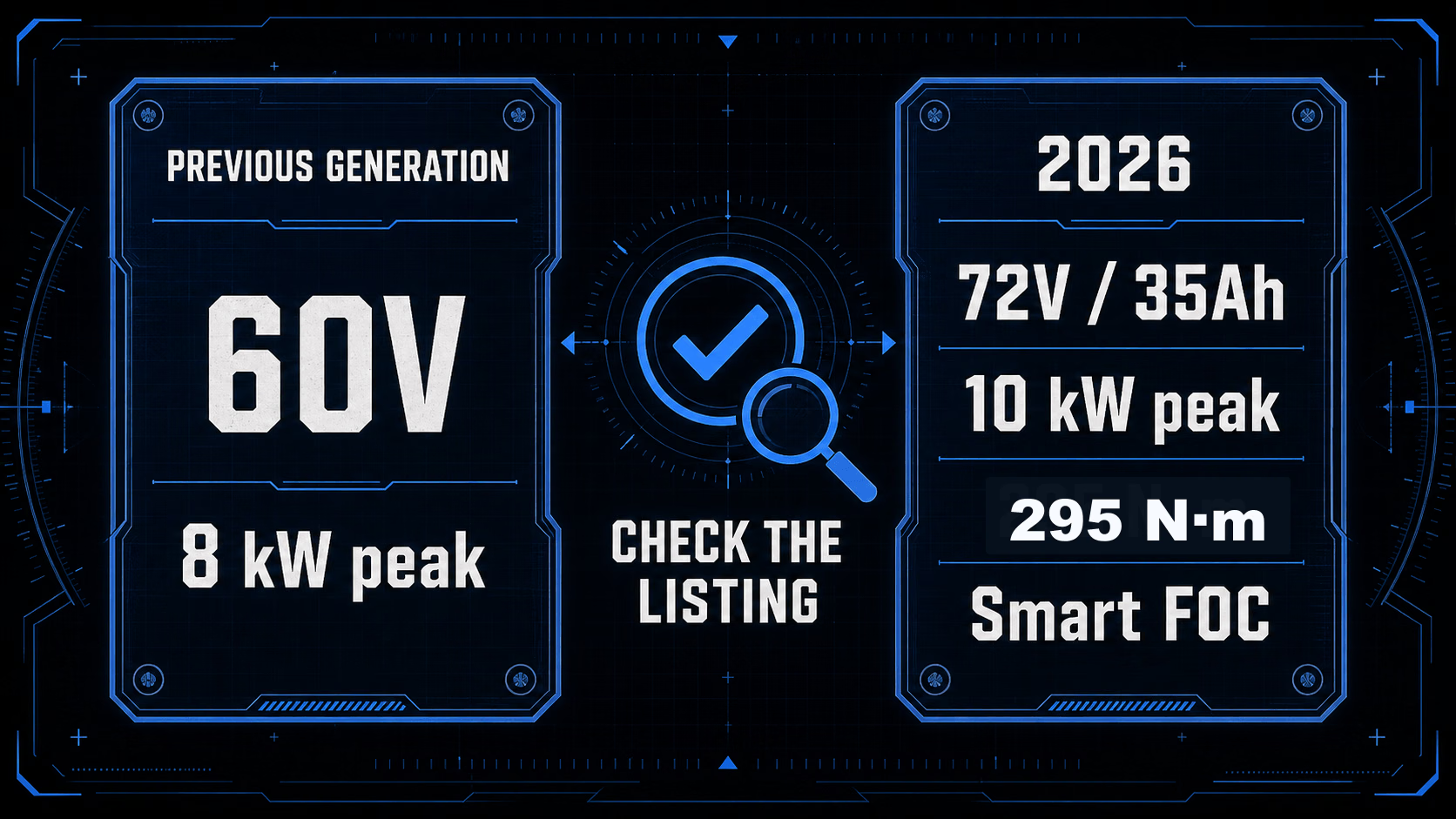
The 2026 Light Bee X is not last year's bike with new stickers. Sur-Ron moved it off the 60V platform it had run for years:
| Previous generation | 2026 Light Bee X | |
|---|---|---|
| Battery | 60V (commonly 32–38 Ah) | 72V / 35 Ah |
| Peak power | ~8 kW | 10 kW |
| Wheel torque | — | 295 N·m |
| Controller | Standard | Smart FOC |
Both bikes are sold under the name "Light Bee X." Both are on the market right now. Some listings state the model year and some do not — while price-checking dealers for our catalog we found a major retailer selling a 60V 34 Ah Light Bee X on the same day others listed the 72V 2026 bike.
So the practical advice is short: read the voltage line before you read the price. 72V and 10 kW is the 2026 bike. 60V and ~8 kW is the previous one. Everything else on this page follows from that.
Why we wrote this
We are a ranking site, so we re-verify prices against real sellers rather than carrying whatever a manufacturer said at launch. Doing that across the Sur-Ron lineup in July 2026 turned up something more useful than a price correction: the listings themselves are the hazard. Four distinct traps, all of which cost real money, none of which are the bike's fault.
Trap 1: the same name on two different bikes
This is the big one, and it is not limited to the Light Bee X.
Light Bee X. 60V / ~8 kW previous generation versus 72V / 35 Ah / 10 kW for 2026. The 2026 bike also gains the Smart FOC controller, which addresses the abrupt low-speed power delivery the older bikes were known for — a real ride-quality change, not just a number.
And the confusion starts at the top. As of 2026-07-20, Sur-Ron's own US site documents the Light Bee X at 60V/40Ah, 8,000 W and 46.6 mph — the previous generation — on the page its navigation points to. If the manufacturer's own storefront is still describing the older bike under the current name, a dealer listing that does the same is not being deceptive; it is repeating what it was given. That is exactly why the spec, not the badge, has to be the thing you check.
Hyper Bee. Sur-Ron's small-wheel bike launched in 2024 with a 5 kW motor on a 50.4V pack, quoted around 34 mph. The 2026 version steps to 8 kW on a 58V pack, quoted around 40 mph, and adds SAWC anti-wheelie control. Sur-Ron's own marketing describes roughly a 60% power increase over the previous generation — which tells you these are meaningfully different machines wearing one name. Listings quoting 31 miles of range or 5 kW are describing the earlier bike, whatever year appears in the title.
The tell in both cases is the same: specs identify the generation, model names do not.
Trap 2: "in stock" is doing a lot of work
When we priced the 2026 Light Bee X across sellers, the spread was over $800 — and the reason was not competition. It was that the listings were selling different experiences:
- ~$3,899 — factory-direct, four to six weeks, shipped from overseas.
- ~$4,699 — US dealer, listed as a pre-order with stock "arriving soon."
Neither was confirmed on a floor the day we looked. A cheap price attached to a six-week overseas lead time is a genuinely different offer from a bike you can collect this weekend, and it should be compared as one. We saw the identical pattern on the Hyper Bee, where the lowest advertised figure carried a five-to-six week factory-direct wait while in-stock sellers sat a couple of hundred dollars higher.
None of this is dishonest — the lead times were disclosed. It is just that price-comparison shopping silently rewards the longest wait, and you have to correct for that yourself.
Trap 3: gray imports and the warranty you think you have
Sur-Ron's US popularity has produced a robust unauthorized-import channel. One established dealer states plainly on its own product pages that the market is "currently flooded with illegally imported bikes."
The bike may be genuine. What is often missing is everything around it: a valid factory warranty, a dealer obligated to honor it, and a parts pipeline. On a machine whose greatest strength is its aftermarket and support network, that is most of what you were buying.
Ask one question before paying: who honors the warranty, and can I read the terms before I buy? A seller who cannot answer that concretely is selling you a bike, not an ownership.
Trap 4: sites that look official and are not
Searching any of these model names surfaces a dense field of sites using manufacturer branding that are not the manufacturer. During research for our catalog we logged a dozen such domains across the Sur-Ron, Talaria, and Stark names — enough that we maintain a blocklist so they can never be cited as a price source on this site. One was advertising a flagship motocross bike thousands of dollars below its launch MSRP.
We are not going to accuse specific sites of anything. We will give you the pattern we use, because it is easy to apply:
- Hyphenated brand-plus-country domains. Manufacturers generally own the clean version of their own name. Compare what you are on against the maker's real site — the difference can be a single hyphen.
- Flagship pricing far below MSRP. A several-thousand-dollar discount on a current halo model is a claim, not a bargain.
- Direct checkout on a five-figure vehicle with no dealer, no delivery detail, and no warranty terms.
- No physical address, no phone, no named dealer network.
The reliable move is to start from the manufacturer's own dealer locator and work outward, rather than starting from a search result and working backward.
What changed elsewhere in the lineup
Ultra Bee — remains the step-up: roughly 24.5 kW peak, a ~4,440 Wh pack, and 59 mph in a 195 lb chassis at about $6,499. Dealer listings distinguish model years at different prices, so the same voltage-and-power check applies. (Full review)
Storm Bee — worth knowing before you shop it. The full-size 68.3 mph flagship is thinning in the US. As of July 2026 we could not find an in-stock listing at an authorized US dealer: one major seller lists it sold out in both colorways, a factory-authorized dealer sells the rest of the line with live pricing but has no Storm Bee product page at all, and another dealer's 2025–2026 Sur-Ron lineup omits it entirely. We have not seen Sur-Ron confirm a discontinuation, so we are not declaring one — but treat availability as remaining inventory and confirm stock and price before you commit. (Full review)
Light Bee X — the generation change above, and still the platform we recommend to most riders. (Full review · which Sur-Ron fits you)
This is not a Sur-Ron problem
We led with Sur-Ron because it is the platform most people shop, but the pattern is category-wide, and the version at 79Bike is worth knowing because it works differently — and is harder to spot.
Sur-Ron's trap is one name covering two generations. 79Bike's is the opposite: the names do differ, and that lulls you.
The Falcon M was 79Bike's Sur-Ron-class bike — 8 kW, ~50 mph, on a 72V/35Ah pack. The Falcon Pro replaced it: 10 kW and 56 mph, on the same 72V/35Ah pack, in the same 130 lb chassis, for $3,599 against the M's last street price of $3,699. Two different bikes, a hundred dollars apart, that look strongly alike.
Here is the part that catches people. 79Bike never announced the discontinuation — it quietly repointed the URL, then removed it. In July 2026 the Falcon M's product address served the Falcon Pro page instead, with no notice that the model it describes is a different bike. As of September 2026 that original address returns a 404, while a shorter one still redirects to the Pro. Either way it is bad for a shopper: an old link to the Falcon M lands you on the Pro, at the Pro's price, or on an error page, with nothing saying what happened. Remaining M stock is still moving through dealers, and a listing has no obligation to tell you the manufacturer has moved on.
So the failure mode is not "you bought the older generation by accident." It is "you bought a bike whose maker has already erased it" — and with it your realistic path to warranty support and fitment answers, from a brand whose own parts store does not state which models its parts fit.
The check is the same one as everywhere else on this page: read the specs, not the badge. A listing quoting 8 kW or 50 mph is a Falcon M whatever the title says. And note that 79Bike honours its 12-month warranty only for bikes bought directly from 79Bike — a dealer purchase at an identical price is a materially worse deal, which is a second reason to know exactly which bike, from exactly which seller, you are buying.
The broader lesson, across both brands: a model name is marketing, and marketing is not a spec. The number of bikes in this category being sold under a name that no longer describes them is the single most expensive thing we found this month.
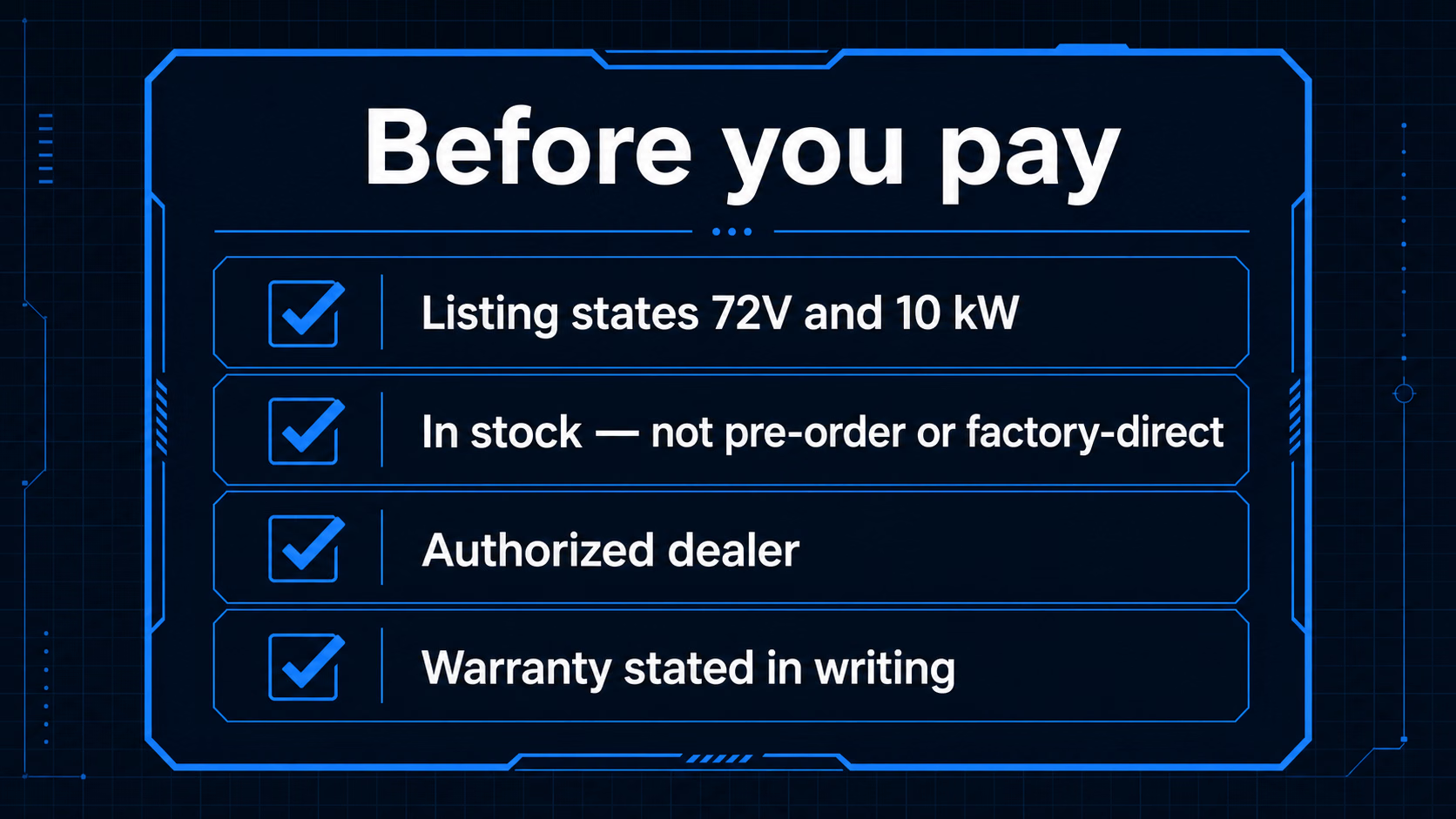
The four things to confirm before you pay
- The listing states 72V and 10 kW (Light Bee X), or 8 kW and SAWC (Hyper Bee). Specs, not the model name.
- Stock status is real — in stock beats pre-order beats factory-direct-with-a-lead-time, and the price should reflect which one you are getting.
- The seller is an authorized dealer, ideally one you reached from the manufacturer's own dealer locator.
- The warranty is stated in writing, with a named party who honors it.
If all four check out, the price is the price and you can shop it hard. If any one of them is vague, the cheapest listing on the page is usually cheap for a reason.
The honest bottom line
None of this makes the 2026 Sur-Ron lineup a bad buy — the Light Bee X's move to 72V and 10 kW is a real improvement to the most important bike in the category, and the platform's aftermarket advantage is undiminished. The problem is that a genuine generation change happened quietly, under an unchanged model name, in a market that already had a gray-import problem and an unusually convincing set of impostor storefronts.
So buy the 2026 bike on purpose rather than by accident. Confirm the voltage, confirm the stock, confirm who owes you a warranty — and if a previous-generation 60V bike turns up at a genuine discount, that is still a lot of motorcycle for the money. Just make sure the discount is real and the bike is the one you meant to buy.
VoltRipper is independent — we don't sell Sur-Ron or any bike, and our Score is based on verified specs, not commissions. Prices and availability in this guide were checked against seller listings on 2026-07-19 and move quickly; verify before you buy. We are spec-verified and data-driven rather than hands-on until first-hand testing exists.
FAQ
What changed on the 2026 Sur-Ron Light Bee X?
It moved off the long-running 60V platform. The 2026 Light Bee X runs a 72V / 35Ah battery and a 10 kW peak motor rated at 295 N·m of wheel torque, with a Smart FOC controller that smooths the abrupt low-speed delivery older Light Bees were known for. The previous generation was 60V with roughly 8 kW peak. That is a genuine platform change rather than a graphics update, and it is why confirming the voltage on a listing matters more this year than usual.
How do I tell a 2026 Sur-Ron Light Bee X from an older one?
Read the battery spec, not the model name — both are called 'Light Bee X'. The 2026 bike states 72V and 35Ah with a 10 kW peak motor. A previous-generation bike states 60V, typically with a 32Ah to 38Ah pack and around 8 kW. We found a major retailer still selling a 60V 34Ah Light Bee X while other sellers listed the 72V 2026 bike, so the voltage line is the fastest reliable tell.
Is a previous-generation 60V Sur-Ron still worth buying?
Yes, at the right price. The 60V Light Bee X is the bike that built the platform's reputation, and its aftermarket is the deepest in the class. The problem is not the bike, it is paying 2026 money for it. If a 60V bike is discounted well below the 72V bike's price, it can be a smart buy. If it is priced the same, you are buying less motor and less battery for identical money.
Why do Sur-Ron prices vary by more than a thousand dollars between sellers?
Mostly because the listings are not selling the same thing. Price-checking the 2026 model across sellers in July 2026, the cheapest listing was factory-direct with a four-to-six week lead time from overseas; the dealer listing above it was a pre-order with stock still arriving. The two were more than $800 apart, and neither was confirmed on a floor the day we checked. Those are different products in practice — one is a wait and an import, the other is domestic stock — so compare the lead time alongside the number. A low price attached to a long wait is not the same offer as a bike you can collect this weekend.
What is SAWC on the 2026 Sur-Ron Hyper Bee?
SAWC is Sur-Ron's anti-wheelie control, new for the 2026 Hyper Bee. Sur-Ron's own description is that it helps younger riders keep the front wheel down under hard acceleration — which is a fair signal of how much torque the bike makes for its intended rider. Its presence is also a quick way to identify a 2026 Hyper Bee against the 2024-2025 version, which does not have it.
Does this only happen with Sur-Ron?
No — it is category-wide, and the 79Bike version is harder to spot. There the model names do differ: the Falcon M was 8 kW and about 50 mph, and the Falcon Pro that replaced it is 10 kW and 56 mph on the same 72V/35Ah pack, $100 apart and visually similar. The catch is that 79Bike never announced the M's discontinuation. For a while its product URL quietly served the Falcon Pro page instead; today the original address returns a 404 and a shorter one still redirects to the Pro, so an old link lands you on the new bike or on nothing, with nothing saying why. Remaining stock still moves through dealers. Read the specs rather than the badge: a listing quoting 8 kW or 50 mph is a Falcon M whatever the title says.
Sources
Specification sources
- Sur-Ron Light Bee XATV Wholesale Outlet - 2026 Sur-Ron Light Bee X (72V/35Ah, 10 kW), $4,699 from $4,999Checked
- Sur-Ron Ultra BeeVoro Motors — Surron Ultra Bee HP SW 24.5kW 74V 60AhChecked
- Sur-Ron Storm BeeSur-Ron USA - Storm BeeChecked
- 79Bike Falcon Pro79Bike - Falcon Pro product pageChecked