Tracked price checks
Bikes in this guide
Segway
Dirt eBike X260
Swappable battery you can hot-swap in seconds for extended range
Trade-off: Advertised 74.6 mi range is a low-speed number — real trail range is a fraction of it
We may earn a commission if you buy through this link, at no extra cost to you.
View official pageE-Ride Pro
SS 2.0
12 kW peak and a 60 mph top speed — big power for $4,599
Trade-off: Claimed range only holds at low steady speed; expect ~35 mi ridden hard
We may earn a commission if you buy through this link, at no extra cost to you.
Check price at E-Ride Pro (official)Cake
Kalk OR
Premium Swedish design and a custom Öhlins air fork with 204 mm of travel
Trade-off: Cake went bankrupt in Feb 2024 and relaunched under new Norwegian ownership (Brages, Mar 2024) — the brand is back and Stockholm operations reopened, but as of mid-2026 the US dealer/parts network is still rebuilding (some US dealers are closing out stock); verify parts and warranty coverage for YOUR market before buying
We may earn a commission if you buy through this link, at no extra cost to you.
Check price at CAKEThe short answer
Discontinued electric dirt bikes are either the best value in the sport or a parts-orphan mistake, and the difference is knowable before you pay. Start by discarding the assumption that discontinued means cheaper — as of August 2026 the clearest example in our catalogue is the Talaria Sting MX3, whose last stock sells for about $601 more than it did in production.
The market has real examples of every case:
- Segway X260 — end-of-line (Segway moved to the Xaber 300), but the brand is healthy and stock near $3,999 is a genuine value. A fair closeout — at the right price.
- E-Ride Pro SS 2.0 — last-gen after the SS 3.0, but no longer a discount: E-Ride's official store moved it to $4,599 plus $300 shipping in July 2026, roughly $100 under the current SS 3.0 delivered. A cautionary example that last-gen does not automatically mean cheaper.
- Cake Kalk OR — US dealers are closing out stock while the relaunched brand (new ownership since 2024) rebuilds its US parts and dealer network. The deepest discounts and the most risk on this list.
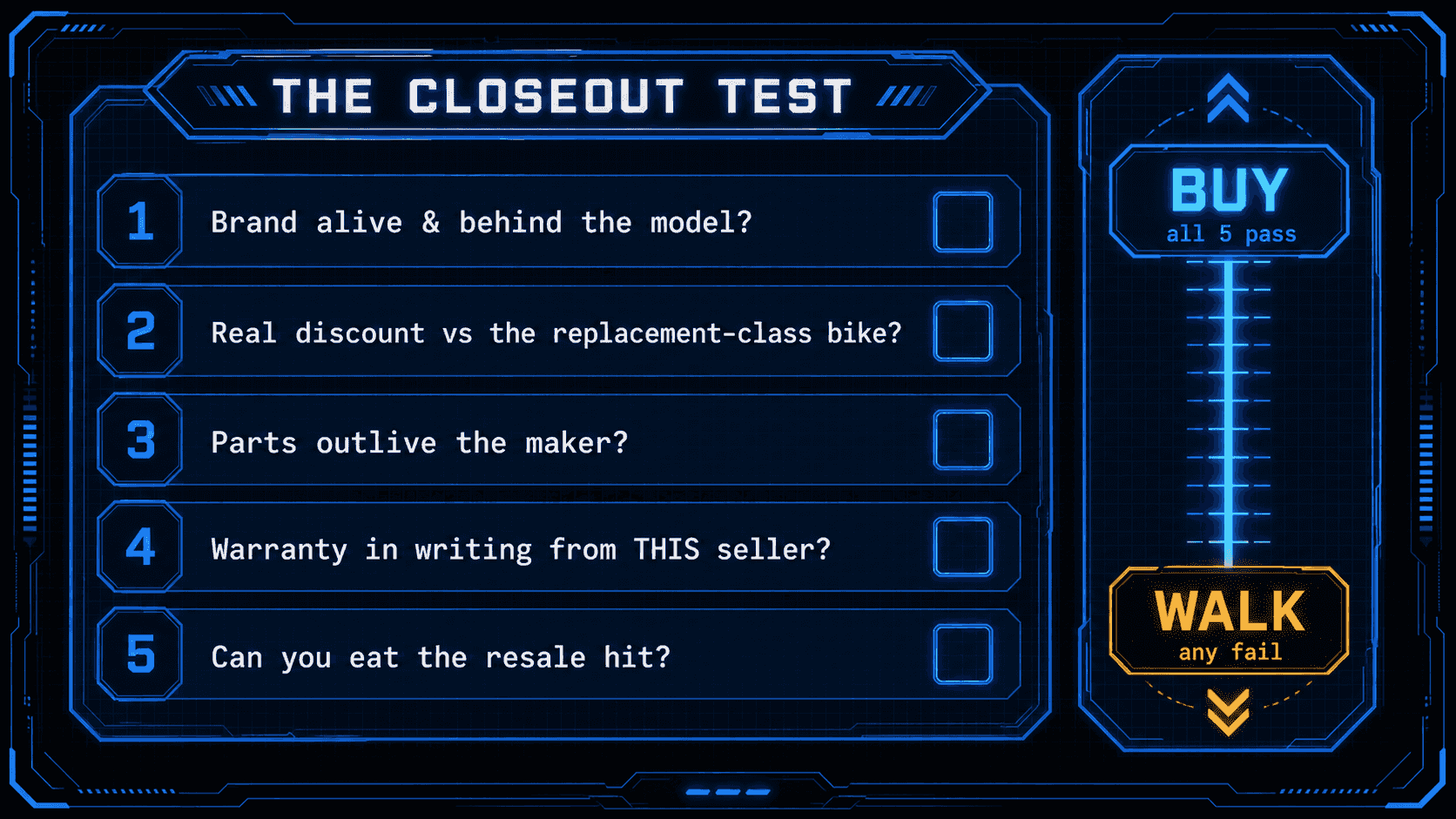
Run every closeout through the five questions below. If it passes all five, a discontinued bike can beat anything else at its price. If it fails even one, buy current.
Why brands discontinue bikes (and why that's not automatically bad)
This class moves fast — model cycles run two to three years, and brands replace bikes to chase power and battery specs, not because the old bike broke. A discontinued bike is usually the same bike it was the day before the announcement; what changes is its price trajectory, its parts window, and its resale curve. Your job isn't to avoid discontinued bikes — it's to make the market pay you fairly for those three changes.
The five questions
1. Is the brand alive — and still behind this model? A healthy brand keeps stocking consumables for a discontinued model for years (Segway isn't abandoning X260 owners; it wants them buying Xabers next). A brand in restructuring is a different bet: Cake is genuinely back under new ownership, but its US dealer and parts network is still rebuilding — which is exactly why its closeout discounts run deepest. Brand-dead orphans with no successor company are a hard no at almost any price.
2. Is the discount real? Price the closeout against its replacement-class bike, not its own old MSRP. An X260 near $3,999 vs the $5,299 Xaber 300 is a real gap; the $4,999 leftover listings floating around are not a deal — that's old-MSRP stock wearing a closeout costume. Our working rule: 15–25% under the replacement-class price makes the risk worth discussing; under ~10%, buy current.
3. Does the platform outlive the manufacturer? Aftermarket depth is the real parts insurance. Sur-Ron-pattern bikes stay serviceable nearly forever because the ecosystem is enormous. Check the boring bits: are the pads, tires, sprockets, and controller standard or proprietary? A bike whose consumables are commodity parts ages gracefully; a proprietary one is on a countdown.
4. What does the warranty actually say — from this seller? New-with-warranty from an authorized dealer is the standard to hold out for, discontinued or not (what voids coverage →). Liquidator and grey-market closeout stock often carries no warranty at all — priced accordingly or not at all. And where a brand changed hands, confirm in writing who honors claims.
5. Can you live with the resale hit? Discontinued bikes depreciate faster and sell slower — the next buyer applies the same skepticism you're applying now. If you ride bikes into the ground, this barely matters. If you trade every 18 months, it's the hidden cost that erases the discount.
The current market, scored by this framework
We re-verified every one of these against the manufacturer and its sellers on 2026-08-21, and the market has moved a long way since this page was first written. Six bikes we track are now discontinued outright, and several more are sold out at every seller we cite. Availability has quietly become a first-class buying consideration in this category.
The discontinued
| Bike | Price now | Brand health | Real discount? | Parts outlook | Our read |
|---|---|---|---|---|---|
| Talaria Sting MX3 | ~$3,700 last stock | Healthy — the Sting R MX4 ships in its place | No — it went up $601 | Good; large shared Talaria ecosystem | Buy only for the beginner-rated chassis, knowing you pay a scarcity premium |
| 79Bike Falcon M | ~$3,699 (list was $3,999) | Alive — Lite, Pro and GT still sold | Yes, modest | OK; siblings share parts | The safest true discontinuation here |
| Arctic Leopard XF | ~$3,699, dealer sold out | Thin — their catalogue is now one complete bike, the XE Pro R | Unknowable; no live listing to discount from | Risky | Walk, unless a dealer offers one cheap and stocks parts |
| Volcon Grunt EVO | ~$5,999 | Changed hands — Volcon is now part of Venom EV and its lineup is four-wheelers | No | Riskiest here | Enthusiasts only, and price the risk honestly |
| Delfast Top 3.0i | ~$6,999 nominal | No purchasable path — Delfast's own sites are down and the one seller we track is backordered | Not applicable | Unsupported | Not a buy at any price today |
| Torp Bike | ~$7,900 nominal | Pivoted — Torp now sells controllers and motors, not complete bikes | Used market only | Better than it looks; they still build the powertrain | Used only — and the parts story is the good news |
| Cake Kalk OR | Deep closeout, varies | Relaunched, rebuilding US | Deepest of the group | US network still forming | Enthusiasts only, priced for the risk |
Still made, just closing out
| Bike | Price | Brand health | Real discount? | Our read |
|---|---|---|---|---|
| Segway X260 | ~$3,999 (thinning) | Healthy | Yes, against the $5,299 Xaber | Buy at $3,999, walk at $4,999 |
| E-Ride Pro SS 2.0 | $4,599 + $300 shipping | Healthy | No — about $100 under the SS 3.0 delivered | Buy for the lighter chassis, not the price |
The counterintuitive part: a discontinued bike can get more expensive
The Talaria Sting MX3 is the one to understand, because it breaks the assumption the whole closeout strategy rests on. Its pre-discontinuation price was $3,099. Remaining stock now lists at $3,700 — roughly $600 more than when Talaria was still making it, and only $400 under its in-production successor.
That is not a seller being opportunistic in isolation. It is what happens when a bike is genuinely wanted, the replacement is dearer, and supply stops: the discount you came for inverts into a scarcity premium. Check the pre-discontinuation price before you treat a closeout as a saving — we had the MX3 recorded at $3,099 ourselves until we re-checked, and the "deal" was a $601 increase.
The same trap runs the other way on brand health. The Falcon M is discontinued but 79Bike is fine and still sells three siblings, so parts are a non-issue. Volcon's Grunt EVO carries a similar sticker and a completely different risk: the company is now part of Venom EV and no longer sells two-wheelers at all. The discount tells you nothing; the brand's next five years tell you everything.
The bottom line
A discontinued electric dirt bike is a deal exactly as good as the discount minus the risk — never more. The X260 at $3,999 showed the good case while dealer stock lasted: healthy brand, real gap to its successor, big-brand parts. The Cake closeouts show the other end: real bikes, real discounts, and real questions the price has to answer for. Run the five questions, get warranty terms in writing, and if the numbers don't clearly pay you for the risk — buy the current bike instead. Buying second-hand rather than closeout? That's a different checklist: how to buy a used electric dirt bike.
The X260's closeout stock has since sold through at the dealers we track, so the bike below is its successor, the Xaber 300.
VoltRipper is independent — our picks come from verified specs and the transparent VoltRipper Score, not commissions. Affiliate disclosure is included on monetized pages, and we are spec-verified/data-driven rather than hands-on until first-hand testing exists.
FAQ
Is it OK to buy a discontinued electric dirt bike?
Often yes — if three things line up: the brand is alive and still stocking parts for the model, the price is genuinely discounted (not a leftover at old MSRP), and the platform has aftermarket depth beyond the manufacturer. A discontinued Segway X260 near $3,999 clears that bar; a full-price leftover from a brand in restructuring does not. The discount has to pay you for the extra risk you're taking.
Do discontinued e-dirt-bikes lose warranty coverage?
Usually no — a new, discontinued-model bike from an authorized dealer normally still carries the manufacturer warranty. But confirm two things before paying: that the dealer is authorized (grey-market and closeout-liquidator stock may carry no warranty at all), and who actually honors claims if the brand has changed hands, as with Cake's post-2024 relaunch. Get the warranty terms in writing with the sale.
Will parts still be available for a discontinued electric dirt bike?
Depends far more on the platform than the promise. Bikes that share a big aftermarket (Sur-Ron-pattern components, common connectors and brake fitments) stay serviceable long after discontinuation. Proprietary platforms are riskier: once manufacturer stock runs out, you're scavenging. Check whether the model's consumables — pads, tires, sprockets, controllers — are standard parts or model-specific before you buy.
How much discount should a discontinued bike have?
As a working rule from the current market: a healthy-brand closeout is interesting at roughly 15-25% under the going price of its replacement-class bike, and only if you'd be happy at that price without any discount story. Below ~10% off, buy the current model — the resale hit and shrinking parts window on a discontinued bike eat a thin discount fast.
Sources
Specification sources
- Segway Dirt eBike X260Segway official store - the X260 URL now titles as "Segway Xaber 300 | The Evolution of X260 Speed & Power"Checked
- E-Ride Pro SS 2.0E-Ride Pro - Pro SS 2.0 official product pageChecked
- Cake Kalk ORCAKE - Kalk product page (CAKE now lists it as 'Kalk'; specs match our Kalk OR - 11 kW, 2.6 kWh)Checked