Tracked price checks
Bikes in this guide
Sur-Ron
Light Bee X
Enormous aftermarket and parts ecosystem — the most-supported e-dirt-bike platform
Trade-off: Advertised range collapses at speed — plan for real-world miles well under the claim
We may earn a commission if you buy through this link, at no extra cost to you.
Check price at ATV Wholesale OutletTalaria
Sting MX5 Pro
72V/2.88 kWh Samsung-cell platform is a real power and range step up from the 60V Sting and X3 family
Trade-off: Ships limited to 20 mph, so the high-speed numbers assume derestriction and local-law risk
We may earn a commission if you buy through this link, at no extra cost to you.
Check price at Luna CycleOnyx
RCR
Moped-style comfort with a seat, lights, and a street kit — the most commuter-friendly bike here
Trade-off: Heavy (~155 lb) and moped-shaped — less capable in technical off-road than a true dirt bike
We may earn a commission if you buy through this link, at no extra cost to you.
Check price at Onyx Motors (official)Here's the hard truth most retailers skip: a Sur-Ron or Talaria is an off-road motor vehicle, and you can't just ride it out of your driveway. It's not a bicycle, it's not an e-bike, and being electric and quiet doesn't unlock trails that gas bikes can't use. The good news is there's plenty of legal riding once you know the four kinds of land that allow it — and where the lines actually are.
The short answer
Your bike is legal on OHV (off-highway-vehicle) land: designated OHV parks, marked motorized routes on public land, private property, and tracks. It is not legal on streets, sidewalks, bike paths or in most city parks.
With one exception almost nobody tells you about, and it is the useful part of this page: in a dozen-odd states there is a legal route onto some public roads that does not require converting the bike at all.
The exception worth knowing: road access short of a plate
Most guidance treats this as binary — off-road land, or a full street-legal conversion with DOT equipment, a title, registration, insurance and a motorcycle licence. For most states that is right. For twelve it is not.
Reading the statutes state by state, these carry a genuine public-road allowance for an off-road machine that has not been converted. The mechanism differs and the limits are real, but the door exists.
Two worth spelling out, because they are the most usable:
Ohio is the most permissive of the big states and hardly anyone says so. Under ORC § 4519.41(B), a titled and registered off-highway motorcycle may be operated "on highways in the county or township road systems whenever the local authority having jurisdiction over such highways so permits." State highways, limited-access highways and freeways stay barred, you need a driver's licence, and lights are required from sunset to sunrise. But if your county engineer or township trustees allow it, you can legally ride your road.
Illinois will never plate this machine — 625 ILCS 5/3-401(c-1) restricts registration to vehicles originally manufactured for highway use, which is categorical. What it does offer is local option: under 625 ILCS 5/11-1426.1, a municipality, township or county may authorise "non-highway vehicles" by ordinance on roads posted at 35 mph or less, with a driver's licence, insurance, and a specific equipment list including mirror, reflectors, a slow-moving-vehicle emblem, headlight, taillamp, brake lights and turn signals.
The practical move: before you assume you need a conversion, check whether your state is on that list, and then call the actual local authority — county engineer, township trustees, or the municipal clerk. This is decided at a level below the state, which is exactly why national guides miss it. Each of our state pages carries the statute for its own state.
The four places you can legally ride
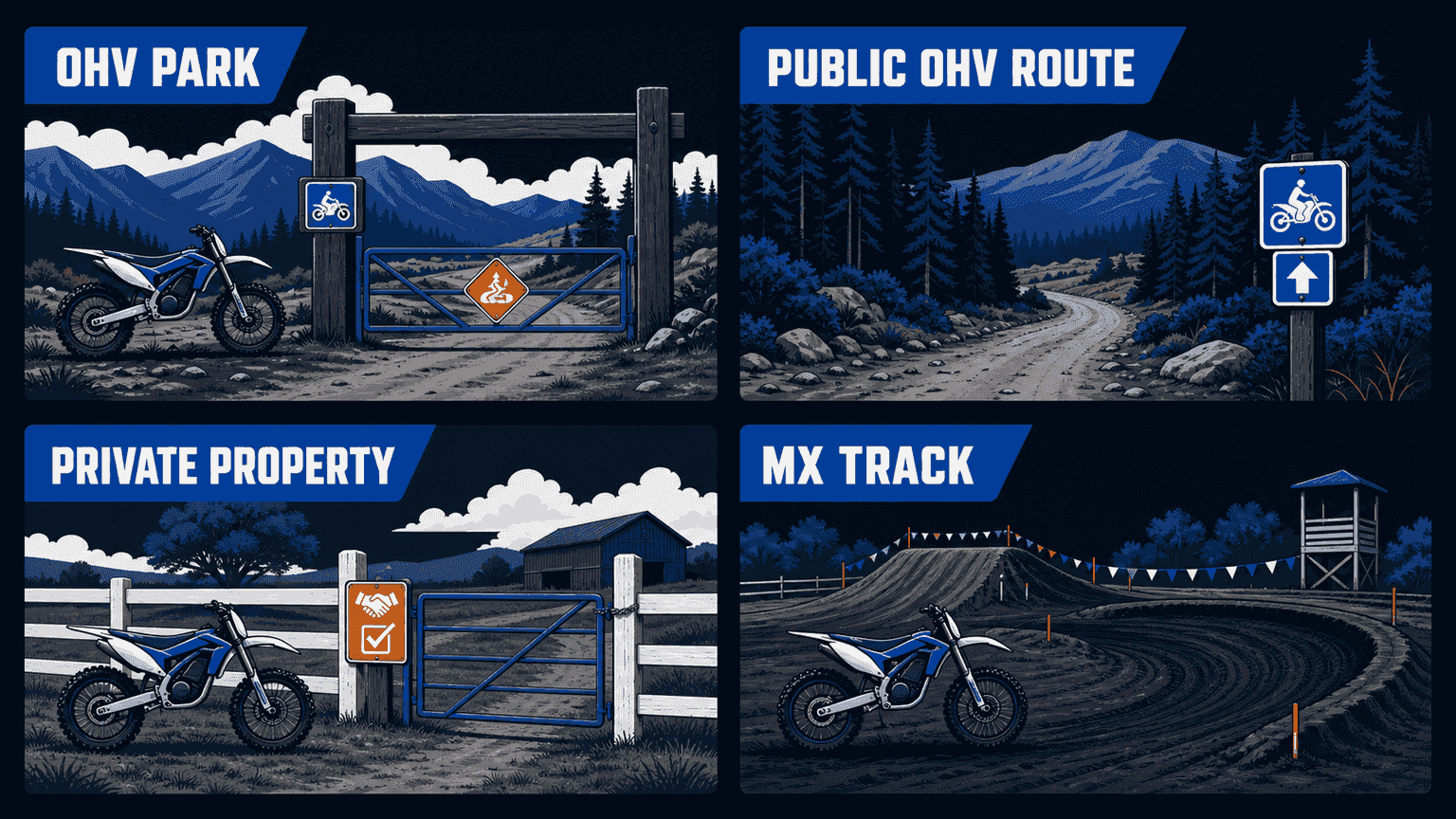
1. OHV parks and state vehicular recreation areas. The best option for most riders: purpose-built off-road parks with legal trails, jumps and open areas, usually needing an OHV permit or sticker.
2. National forest and BLM OHV routes. Vast federal public land includes trails specifically designated for off-highway motorcycles — but only those marked routes, not the whole forest.
3. Private property. Land you own, or someone else's with explicit permission. The simplest legal riding there is.
4. Membership motocross tracks and private trail systems. Local MX tracks and members-only trail networks give you legal, maintained, insured places to ride, often with electric-friendly hours because of the noise advantage below.
Expect to pay for a sticker, in every state
We checked all fifty. Every one has some permit, sticker, decal or registration regime attached to off-highway use — the specifics vary enormously, the existence of one does not.
That matters for two reasons. Riding an unregistered machine on land that requires a decal is a citation regardless of whether you were riding responsibly. And these regimes are often invisible until you are already there: Illinois, for instance, requires an Off-Highway Vehicle Usage Stamp under 20 ILCS 862/26 and a separate OHV Access Permit under 20 ILCS 862/25.5 for park use — two different pieces of paper, in a statute most riders never open.
One wrinkle that shows how far behind the law is: Illinois sets both usage-stamp fee tiers purely by engine capacity in cubic centimetres. An electric motor has no displacement, so an electric machine falls into neither tier while the prohibition still reaches it. Ask the agency which tier applies rather than assuming you are exempt.
Where you genuinely cannot ride
- Bike paths, greenways and multi-use paths. These are for bicycles and e-bikes; a Sur-Ron-class machine is prohibited, and several states ban it statewide.
- Hiking and mountain-bike singletrack, unless the trail is specifically marked for motorised use.
- Most city and county parks, where motor vehicles are typically banned outright.
- Public streets, in the states with no legal path at all — where the bar is usually structural rather than procedural. California's SB-586 forecloses conversion; New York fixes a machine's certified top speed regardless of any modification made afterwards; New Jersey and Pennsylvania define the vehicle by its federal-safety-standard non-compliance, a test fixed at manufacture. In those states no amount of equipment changes the answer.
Being electric changes none of this. The classification, not the sound, sets the rule.
The one real advantage electric gives you
Quiet is an access superpower. Noise complaints close more riding areas than anything else — it is the single most common reason land gets posted or a trail system loses its permit. A near-silent bike is genuinely easier to get permission for, easier to ride on a smallholding without a neighbour calling, and welcome at tracks with sound limits or restricted hours.
If you are asking a landowner for access, lead with that. It is the strongest argument you have and it happens to be true.
How to find legal riding near you
- Check your state's tier first on our legality index — whether you are in a no-path, conversion, restricted or clear-path state changes what you should even be looking for.
- Your state's OHV division or state parks site lists vehicular recreation areas and the permit rules that actually apply.
- onX Offroad and the motorised layers on trail apps map OHV-designated routes and land ownership.
- Local OHV and motocross clubs know the open public land, run the tracks, and often hold leases on private trail systems. This is the fastest way in, and it is underrated.
- The managing agency — Forest Service, BLM, state park — confirm the specific route is open before you tow out to it.
What we do not yet have, and would rather say so: we do not publish a named list of specific parks and trailheads by state. Our legality pages tell you what the law permits; they do not tell you that Hollister Hills or Durhamtown exists. That gap is real and it is on our list. Until then, the state OHV division and a local club will get you there faster than we will.
The bottom line
An electric dirt bike is an off-highway vehicle, and it is legal on off-highway land: parks, designated public-land routes, private property and tracks.
But do not assume the road is closed to you without checking. A number of states offer some public-road access without a conversion — the list is above — usually decided by a county or township rather than the state, and it is the single most overlooked answer to "where can I ride this."
VoltRipper is independent and reader-supported. Riding laws and land access vary by state, agency, and locality and change often — always confirm current rules with the managing agency before you ride. Affiliate disclosure is included on monetized pages.
FAQ
Where can you legally ride an electric dirt bike?
On off-highway-vehicle (OHV) land: designated OHV parks and state vehicular recreation areas, marked OHV routes in national forests and on BLM land, private property you own or have permission to use, and membership motocross tracks. A Sur-Ron-class bike is an off-road motor vehicle, so it's allowed where OHVs are allowed — not automatically where bicycles or e-bikes are.
Can you ride a Sur-Ron on the street?
Not as sold. These bikes ship without DOT lighting, mirrors, or a VIN, so they're not street-legal out of the box. Riding one on public streets, sidewalks, or bike/multi-use paths risks tickets and, in some cities, confiscation. Street riding requires a conversion (lights, mirrors, horn), a title/registration, insurance, and a motorcycle license where your state allows it — see our conversion guide.
Can you ride an electric dirt bike in the woods or on hiking trails?
Only on trails specifically designated for off-highway motorcycles. Most singletrack hiking and mountain-bike trails prohibit motorized vehicles — including electric ones — and 'it's quiet and electric' is not a legal exemption. Look for OHV-designated motorized routes on national forest and BLM maps, and never assume a mountain-bike trail is open to a Sur-Ron.
How do you find legal places to ride near you?
Use onX Offroad or the motorized layers on trail apps to find OHV-designated routes, check your state parks/OHV division site for vehicular recreation areas, join a local OHV or motocross club (they know the open land and often lease private tracks), and confirm public-land rules on the managing agency's site before you go. Our per-state legal pages summarize where each state allows off-road riding.
Sources
Specification sources
- Sur-Ron Light Bee XATV Wholesale Outlet - 2026 Sur-Ron Light Bee X (72V/35Ah, 10 kW), $4,699 from $4,999Checked
- Talaria Sting MX5 ProTalaria Canada - Sting MX5 Pro specificationsChecked
- Onyx RCROnyx Motors — RCR 80V 45AhChecked