Tracked price checks
Bikes in this guide
Sur-Ron
Light Bee X
Enormous aftermarket and parts ecosystem — the most-supported e-dirt-bike platform
Trade-off: Advertised range collapses at speed — plan for real-world miles well under the claim
We may earn a commission if you buy through this link, at no extra cost to you.
Check price at ATV Wholesale OutletStark
Varg MX 1.2
The fastest electric motocrosser made — up to 80 hp from a 360V, 7.2 kWh system
Trade-off: Halo price (~$12k) — competes with premium gas MX, not trail e-bikes
We may earn a commission if you buy through this link, at no extra cost to you.
View official pageTalaria
Sting MX5 Pro
72V/2.88 kWh Samsung-cell platform is a real power and range step up from the 60V Sting and X3 family
Trade-off: Ships limited to 20 mph, so the high-speed numbers assume derestriction and local-law risk
We may earn a commission if you buy through this link, at no extra cost to you.
Check price at Luna CycleThe short answer
An electric dirt bike has no cc — there is no conversion, and we are not going to invent one.
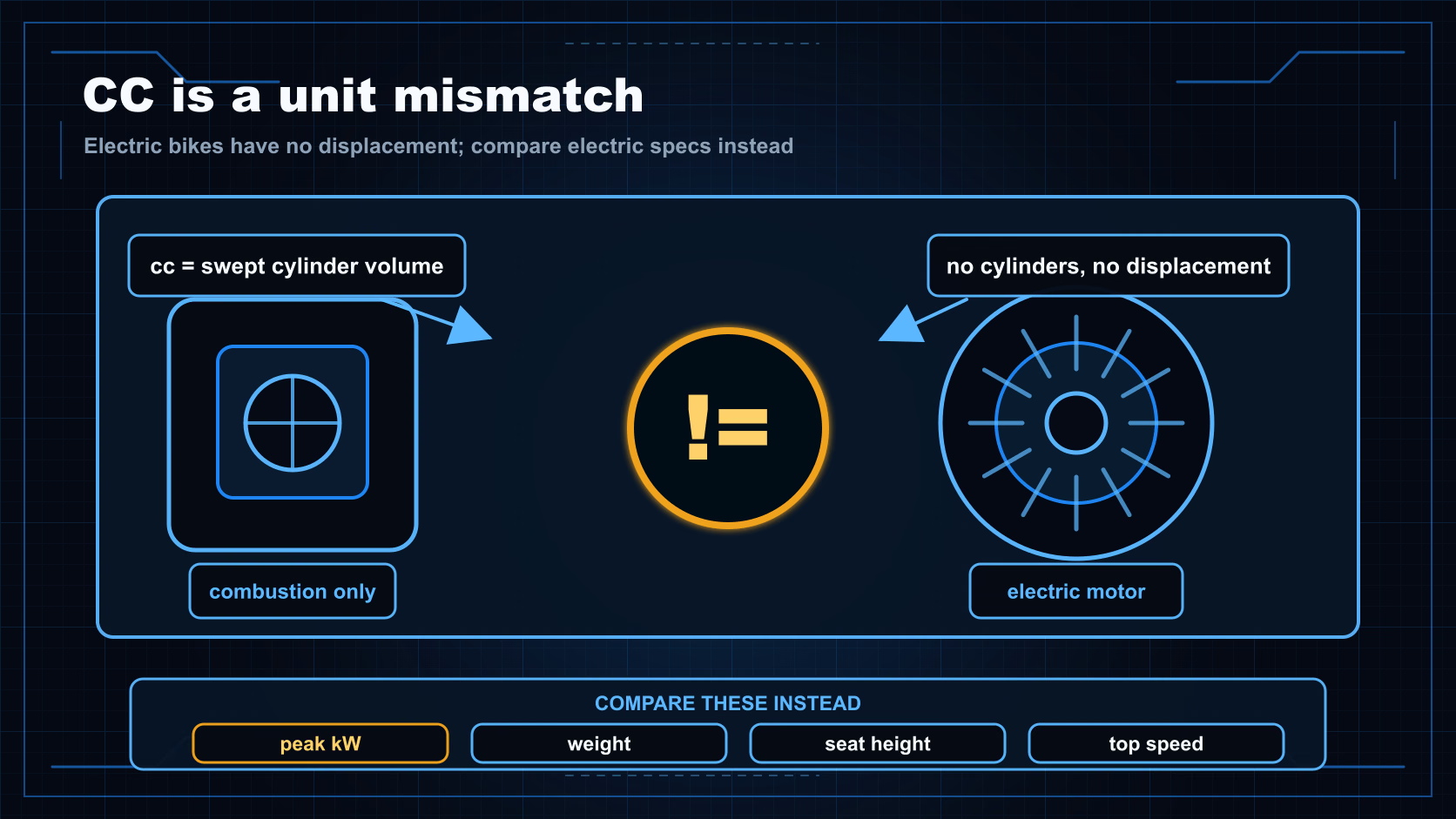
CC (cubic centimeters) measures displacement: the volume a combustion engine's cylinders sweep on each stroke. It is a description of an engine's plumbing. An electric motor has no cylinders and sweeps no volume, so there is nothing to measure. Asking for a Sur-Ron's cc is like asking for its fuel tank size.
The reason people ask is completely reasonable — cc was the shorthand everyone learned for "how much bike is this?" But the honest service is not to fake a translation. It is to show you why that shorthand fails, and then give you the four numbers that answer the real question.
Why we stopped publishing a cc conversion table
We used to run one. We took it down, because the more carefully we checked it, the less it survived.
1. CC never measured power in the first place. A 125cc two-stroke motocross bike makes north of 30 hp in a narrow, peaky band. A 125cc four-stroke trail bike makes about 10–12 hp in a soft spread. Same displacement, roughly three times the power, completely different machines. Any sentence of the form "this electric is a 125" is therefore ambiguous before it even reaches the electric bike — you would have to ask "which 125?" So a conversion table is not a slightly rough approximation. It is anchored to a number that was never precise.
2. The torque curves are not comparable shapes. A combustion engine makes little torque at idle and has to rev into its band; an electric motor makes peak torque from a standstill. Match a gas bike and an electric bike on peak power and they still will not feel alike — the electric launches harder, the gas bike pulls further at the top. There is no single number that reconciles two different curves, and "feel" comparisons quietly pick whichever end flatters the point being made.
3. The weight and the gearbox change the bike more than the power does. Most bikes in this class run 86–195 lb, against a comparable gas bike's 200-plus. Most are single-speed with no clutch and no shifting. A rider stepping across is changing weight, gearing, engine braking, and control layout all at once. Displacement describes none of that, and those are the things that decide whether you can pick the bike up, hold it on a hill, or ride it all day.
Put together: two bikes that "match on cc" can differ more from each other than from bikes two tiers away. That is not a spec. It is a vibe with a number attached, and we would rather give you real ones.
The four specs that actually answer "how much bike is this?"
- Peak power (kW) — the honest headline. Insist on peak, not nominal or "rated": the same bike is often marketed both ways, and the gap between the two figures runs from about 1.5× to over 3×. Our peak-vs-continuous guide covers the trap.
- Weight (lb) — how the bike behaves when it is not moving forward: picking it up, holding it on a slope, loading it, catching it in a slow tip-over. For most new riders this decides more than power does.
- Seat height (in) — whether you can get a foot down, which governs confidence more than any performance number. Measure your inseam, not your ambition.
- Top speed (mph) — the ceiling, and the one to sanity-check against where you can legally ride. Treat manufacturer claims as claims; see our claimed-vs-real range and speed work.
Battery capacity in watt-hours is the fifth number, and it governs how long you ride rather than how hard.
The VoltRipper power ladder — electric against electric
This is the replacement for the cc table: the same "how much bike is this?" ladder, built from specs that mean the same thing on both sides of every comparison. Every figure is from our verified catalog.
| Tier | Peak power | Representative bike | Top speed | Weight | Seat height |
|---|---|---|---|---|---|
| First bike | 250–750 W | Hiboy DK1 | 15.5 mph | 38 lb | 23.6 in |
| Youth | 2.5–5 kW | Greenger CRF-E2 | 20 mph | 106 lb | 24.8 in |
| Youth, premium | 5 kW | GasGas MC-E 5 | not published | 89 lb | 24.9 in |
| Entry performance | 6–8 kW | Talaria Sting MX3 | 47 mph | 123 lb | 33.9 in |
| The mainstream class | 10 kW | Sur-Ron Light Bee X | 50 mph | 130 lb | 32.7 in |
| Mainstream, more power | 13.4 kW | Talaria MX5 Pro | 59 mph | 165 lb | 33.1 in |
| Fast trail | 18 kW | Onyx RCR | 65 mph | 155 lb | 32.5 in |
| Full-size | 24.5 kW | Sur-Ron Ultra Bee | 59 mph | 195 lb | 35.8 in |
| Race | 60 kW | Stark Varg MX | 68 mph | 260 lb | 37.8 in |
Note what the ladder shows that a displacement column would have hidden: the Sur-Ron Hyper Bee makes 8 kW at 86 lb while the Sur-Ron Storm Bee makes 22.5 kW at 280 lb. Those two are the same brand, three tiers apart, and the weight gap matters to a real rider at least as much as the power gap. That is the kind of thing a cc number flattens away.
So which tier should you buy?
Decide the riding, and the tier follows:
- A young child learning → the first-bike and youth tiers. Start at best electric dirt bikes for kids, and size on seat height first.
- Trail riding, commuting, getting into the sport → the 10–13 kW mainstream class. This is where most adults should look.
- You already ride and want real speed → the fast-trail and full-size tiers, 18–25 kW.
- You actually race → the race tier. Only if you actually race.
Not sure? The Find Your Ride configurator sizes it from how and where you ride, which is what the cc question was always reaching for anyway.
The bottom line
There is no cc equivalent, and the honest version of this page is the one that says so. CC measures something electric bikes do not have, it never measured power cleanly even for gas bikes, and the differences that matter most when you switch — weight, single-speed drivetrain, instant torque, seat height — are exactly the ones displacement cannot express.
Compare peak kW, weight, seat height, and top speed, and compare electric bikes against other electric bikes, where both sides of the comparison mean the same thing. That is a harder answer than "it's basically a 125," and it is the one that will actually get you on the right bike.
VoltRipper is independent and covers electric dirt bikes only — we do not rank, sell, or recommend gas bikes, and we no longer publish gas-displacement equivalents for the machines we cover, because the comparison cannot be made honestly. Every power, weight, seat-height and speed figure above is a verified manufacturer spec from our catalog; where a manufacturer does not publish a figure, we say so rather than estimate. We are spec-verified and data-driven rather than hands-on. Affiliate disclosure is included on monetized pages.
FAQ
What cc is an electric dirt bike?
None — and that is the accurate answer, not a dodge. CC measures the swept volume of a combustion engine's cylinders. An electric motor has no cylinders and burns no fuel, so there is no displacement figure to quote. The specs that actually describe how much bike you are buying are peak power in kilowatts, weight, seat height, and top speed. Any site that hands you a confident cc number for an electric bike has invented a conversion that does not exist.
What cc is a Sur-Ron?
A Sur-Ron has no cc, and the popular shorthand answer is less useful than it sounds. The Light Bee X makes 10 kW peak, weighs 130 lb, and tops out around 50 mph — those four numbers tell you far more than any displacement comparison, because a gas bike matched to it on peak power would be roughly 70 lb heavier, deliver its torque completely differently, and need gears to do it. Compare the Sur-Ron to other electric bikes, where the specs mean the same thing on both sides.
Why don't electric dirt bikes use cc?
Because cc — cubic centimeters — measures the volume a combustion engine's cylinders sweep, which sets how much fuel and air it burns per stroke. An electric motor makes power from current and magnetism, with nothing being swept or burned. The honest electric equivalents are peak power (kW), battery capacity (watt-hours), weight, and top speed.
Is a Sur-Ron faster than a 125cc dirt bike?
That question has no single answer, which is exactly the problem with the comparison. 'A 125' is not one machine: a 125cc two-stroke motocross bike and a 125cc four-stroke trail bike differ from each other by around three times in power while sharing a displacement number. Whichever answer you got, it was about one specific gas bike someone had in mind, not about the class. If you want to know whether a bike is fast enough for you, look at its top speed and peak kW and compare it against other electric bikes.
Sources
Specification sources
- Sur-Ron Light Bee XATV Wholesale Outlet - 2026 Sur-Ron Light Bee X (72V/35Ah, 10 kW), $4,699 from $4,999Checked
- Stark Varg MX 1.2Stark Future — Varg MXChecked
- Talaria Sting MX5 ProTalaria Canada - Sting MX5 Pro specificationsChecked