Tracked price checks
Bikes in this guide
Sur-Ron
Light Bee X
Enormous aftermarket and parts ecosystem — the most-supported e-dirt-bike platform
Trade-off: Advertised range collapses at speed — plan for real-world miles well under the claim
We may earn a commission if you buy through this link, at no extra cost to you.
Check price at ATV Wholesale OutletTalaria
Sting MX5 Pro
72V/2.88 kWh Samsung-cell platform is a real power and range step up from the 60V Sting and X3 family
Trade-off: Ships limited to 20 mph, so the high-speed numbers assume derestriction and local-law risk
We may earn a commission if you buy through this link, at no extra cost to you.
Check price at Luna CycleRawrr
Mantis X Pro
15 kW peak and 65+ mph — a big step above the base Mantis X for $900 more at $3,899
Trade-off: 65 mph / 15 kW is a lot of bike for newer riders
We may earn a commission if you buy through this link, at no extra cost to you.
Check price at Rawrr (official)The short answer
Yes for most riders, and the reasons people give are mostly the wrong ones.
The case usually made for electric is "cheap to run." We measured that across our catalog and it is true to the point of being irrelevant: electricity works out to about 1.3 cents a mile, and a full charge on the average adult machine costs 48 cents. That is real, and it will never be the reason you are better or worse off.
The number that actually decides whether one of these is worth it is the purchase price divided by the range you really get — and across the bikes where we hold both figures, that runs from $40 to $371 per real-world mile. That is a ninefold spread inside one category. It is where the decision lives.
What running one actually costs
We computed this from the catalog rather than repeating a rule of thumb: take each bike's real battery capacity, charge it at the US average residential rate of about 17 cents per kilowatt-hour, and divide by the range riders actually get.
| cost | |
|---|---|
| Cheapest full charge we track (a 432 Wh kids' bike) | $0.07 |
| Median adult machine | $0.43 |
| Biggest pack we track (7.2 kWh) | $1.22 |
| Average adult full charge | $0.48 |
| Electricity per mile, averaged across bikes with real-world range data | ~1.3¢ |
Ride one hard every weekend for a year and the electricity bill is somewhere around twenty to forty dollars. A comparable gas bike burns that in a couple of tanks.
So the running-cost argument is won, decisively, and then it stops mattering — because it is rounding error against everything else you will spend.
The number that actually decides it
Price divided by the range you genuinely get. Not the claimed range — the real one.
At the efficient end of the catalog, a bike works out to roughly 56 dollars of purchase price for every real-world mile of range it delivers. At the expensive end, the same calculation lands near 370. Same units, same method, 6.6 times the cost per mile.
The cheap end of that spread is the Heybike Villain, at $1,499 for about 25 real miles. The expensive end is the Cake Kalk OR and the Kuberg Ranger, both boutique machines carrying four-figure premiums for build quality and warranty rather than for range.
Read that as a capability measure rather than a value judgement. A Cake Kalk OR is not a bad machine; it is a boutique product with a build quality and a warranty behind it that a budget import does not have. But if what you want is miles of trail per dollar spent, the arithmetic is not close, and nobody selling you the expensive one will run it for you.
The cost nobody puts in the brochure
Here is the number that dominates the whole ownership question, and it is not electricity.
A replacement battery for an adult e-moto costs between about $1,600 and $2,000.
Those are real prices from the replacement packs we track. A 72V pack for the Light Bee platform lists at $1,999.99. A 60V 45Ah Talaria Sting spare lists at $1,950, and a 60V 53Ah extended-range pack at $1,600. Those are battery prices, not bike prices. On a $4,000 bike, that is 40 to 50% of the purchase price, for a wear item.
Put the two together and the picture inverts the usual sales pitch:
- Electricity, over five years of regular riding: maybe $150
- One replacement battery, somewhere in that window: $1,600–$2,000
The battery is roughly ten times every other running cost combined. Anyone telling you an electric dirt bike is cheap to own without saying that number is selling you something.
Two things make it less alarming than it sounds. Battery life tracks how you treat it, so the charging habits in our charging guide are worth real money rather than being generic advice. And on kids' machines the maths is completely different: a replacement pack for the MX650 platform lists at about $141, because it is a small sealed lead-acid unit rather than a lithium traction pack.
What electrics genuinely do better
Noise, and what it buys you. This is the underrated one. A near-silent bike can be ridden on land where a gas bike gets you a complaint, a warning, and eventually a ban. It extends where and when you can ride more than any spec on the sheet.
Maintenance that mostly does not exist. No oil, no filters, no valves, no carburettor, no spark plug, no jetting for altitude. Chain, brakes, tyres, and that is close to the list.
Torque from zero, which flatters a learner. No clutch, no gears, no stalling. A rider who would spend their first month learning to not stall a gas bike spends it learning to ride instead.
Instant on. No warm-up, no kicking, no flooding.
The real dealbreakers
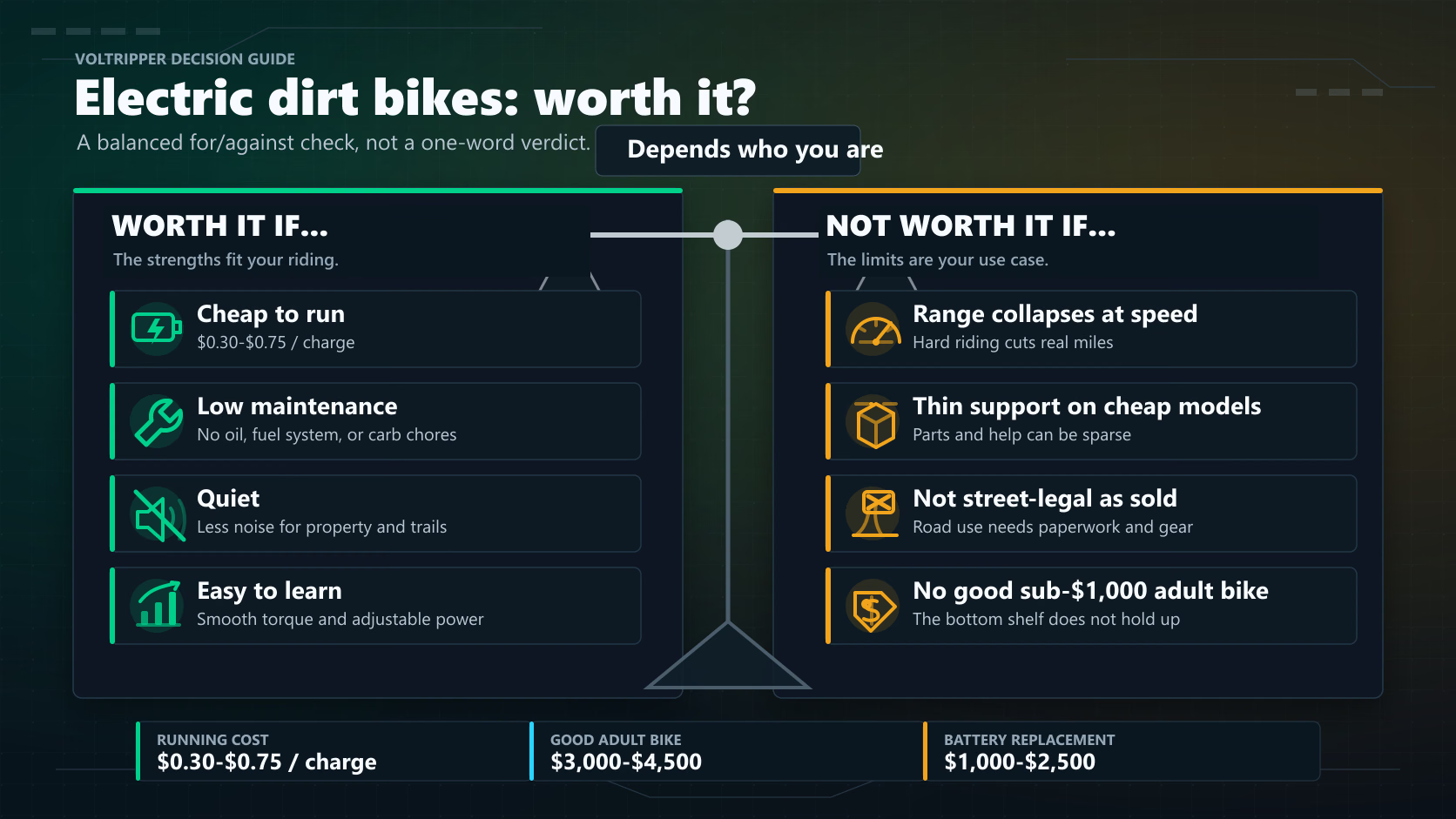
Range collapses at speed, and the claim is not the number. Across the 31 bikes where we hold both a manufacturer claim and a credible real figure, real range averages 59.4% of the claim. A 50-mile bike is a 30-mile bike, and a 20-mile bike in the cold. If you ride all day far from a socket, that is a genuine problem rather than an inconvenience — see claimed versus real range.
Support is the category's actual weak point. When we aggregated the documented trade-offs across our whole catalog, support and parts availability outranked every mechanical problem — and more than eight in ten bikes publish no warranty term at all. The problems guide has the numbers.
Almost none of them are street legal as sold, and in several states they cannot be made so at any price. Check your state before you buy, not after.
The battery is a wear item with a four-figure price, as above.
So — is it worth it for you?
Buy one if you ride mostly on private land, trails or an OHV area; your sessions are under a couple of hours; noise is a constraint where you ride; you value low maintenance; or you are teaching someone to ride.
Think hard if you want all-day range far from power, you race long motos, you are shopping the bottom of the market where support is thinnest, or you need to ride on public roads and live somewhere that forecloses it.
The honest test: work out your realistic ride length, halve the manufacturer's range claim, and see if the two are compatible. If they are, the rest of the case is strong. If they are not, no amount of torque fixes it.
The honest bottom line
Electric dirt bikes are worth it for most of the people considering one, but not for the reason the marketing gives. The running cost is trivial and always will be. The purchase price and the battery are the whole decision.
Spend your attention on price per real mile, on whether anyone will sell you parts in three years, and on whether you can legally ride the thing where you live. Those three will decide whether you are happy in two years. The electricity bill never will.
VoltRipper is independent — our guidance comes from verified specs and the transparent VoltRipper Score, not commissions. Running-cost and battery figures are typical ranges, not guarantees. We are spec-verified and data-driven rather than hands-on. Affiliate disclosure is included on monetized pages.
FAQ
Are electric dirt bikes worth it?
For the right rider, yes — they are cheaper to run, near-silent, far lower-maintenance than gas, and their instant torque makes them easy to learn on. For the wrong rider they are not: if you need long range at high speed, a street-legal bike out of the box, or a sub-$1,000 adult machine, gas or a different category serves you better. The honest answer depends entirely on how and where you ride.
Are electric dirt bikes cheaper than gas to own?
Day to day, clearly yes: a full charge costs roughly $0.30–$0.75 of electricity versus gallons of fuel, and there are no oil changes, no carburetor, no fuel system, and far fewer moving parts. The one real long-term cost is eventual battery replacement — roughly $1,000–$2,500 after several years. Upfront, a good adult bike still costs $3,000–$4,500, so the savings are in running it, not buying it.
What's the biggest downside of an electric dirt bike?
Range at speed. Advertised ranges are low-speed figures that collapse when you ride hard — plan for real-world miles well under the claim. The other common downsides are thin support and parts on budget/off-brand models, and the fact that most are sold off-road only, so street-legal use needs a kit and depends on your state. None of these is a dealbreaker for the right rider, but all three surprise buyers who didn't expect them.
Who should not buy an electric dirt bike?
Skip it if you need long high-speed range (the range collapses), if you must have a street-legal bike with no conversion work, if your budget is genuinely under $1,000 for an adult (nothing good exists there), or if you want the deepest possible aftermarket and pick an obscure off-brand to save money. For those needs, gas, a different vehicle category, or waiting and saving serves you better.
Sources
Editorial sources
Specification sources
- Sur-Ron Light Bee XATV Wholesale Outlet - 2026 Sur-Ron Light Bee X (72V/35Ah, 10 kW), $4,699 from $4,999Checked
- Talaria Sting MX5 ProTalaria Canada - Sting MX5 Pro specificationsChecked
- Rawrr Mantis X ProRide Rawrr — Mantis X ProChecked