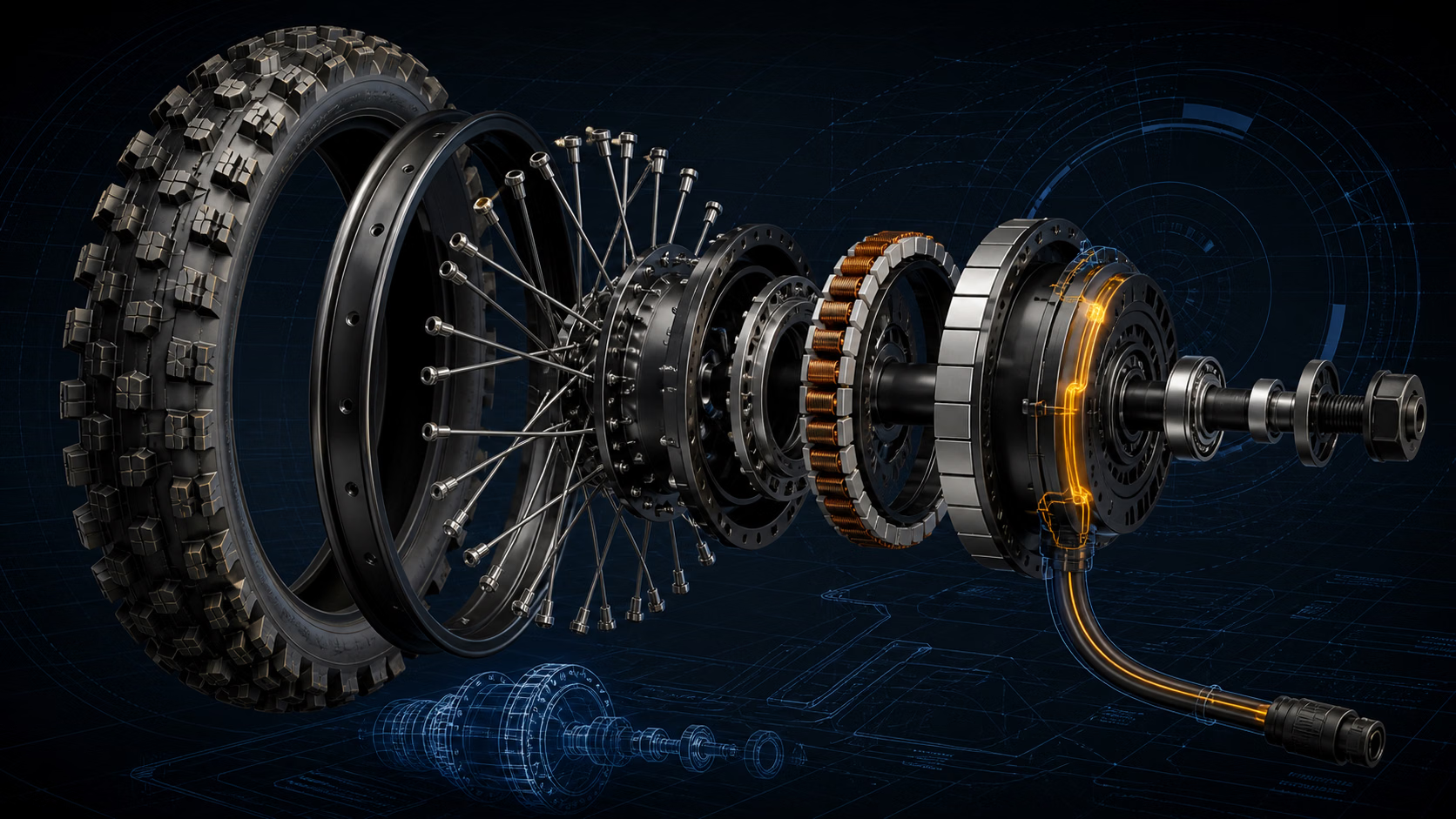
The short answer
Wheels and motors are the deep end of building a Sur-Ron or Talaria. Most riders never need either — a better tire and the Stage-2 upgrades come first. But when you do:
- A complete wheelset opens up a supermoto (street) setup, a different diameter, or stronger rims — as long as it fits your exact bike and generation (hub, axle, rotor).
- A motor swap is a major conversion, not a bolt-on — a performance motor needs a matching controller and a battery that can feed it.
Two rules keep both from going wrong.
The rules
Wheels: fitment is hub/axle/rotor + generation specific. A wheelset is built around a specific hub width, axle size, spacer stack, and brake-rotor pattern — and those differ across generations (the 2026 Light Bee X, the Talaria models, the MX5's special hubs). Confirm the seller pins your bike and year, and verify the axle/rotor details before you swap.
Motors: a swap is a full conversion. A performance motor is not a standalone part — it requires its matching controller (EBMX X-9000, VTB V9600, Torp TC1000), a battery that delivers the current/voltage, upgraded brakes and drivetrain, correct wiring/gearing, and often cooling. It's the top of the build pyramid.
Wheelsets: supermoto (street)
A supermoto setup swaps to 17-inch street wheels and sticky road tires — a pavement machine (it doesn't make the bike street-legal, which is a separate job). Matched to your platform:
The MX5's hubs are special-sized — its kit does not fit other Talarias, and theirs won't fit it.
Wheelsets: off-road (different diameters, stronger rims)
An off-road wheelset in a different diameter (16/19, 18/21) opens up the full moto-tire catalog and adds strength. Verify the rotor adapters and chain length for your bike:
The Ultra Bee's 18/21 setup disables traction control — a fair trade for many, but know it going in.
Wheel service parts
Rebuilding or servicing a wheel? The hub and bearings are the wear points:
Motors: the honest conversion
First decide which job you're doing — they're completely different.
Replacing a failed motor (OEM, keep everything else). A like-for-like stock replacement restores the bike with no electrical changes:
Upgrading power (performance motor + its ecosystem). These need a specific controller and a high-current battery — a full conversion, for experienced builders only:
The EBMX XTA-60 on a Talaria MX5 needs its adapter kit (the motor is separate):
Every one of these is paired with a controller (EBMX X-9000, VTB V9600) and a battery that can deliver the current — budget for the whole system, not just the motor. See the controller and battery guides.
Everything on this page, cheapest first
| Part | Type | Fits | Price |
|---|---|---|---|
| Talaria rear hub bearing 6202 | Service | Talaria Sting | $11.99 |
| EBMX XTA-60 adapter kit | Motor fitment | Talaria MX5 | $30.00 |
| Talaria front hub assembly | Service | Talaria MX3/MX4 | $161.99 |
| Luna supermoto wheel set, 17in | Supermoto | Sur-Ron | $440.00 |
| Luna supermoto wheel set, 17in | Supermoto | Talaria Sting MX4 | $500.00 |
| KKE 18/21 billet wheel set | Off-road | Ultra Bee | $589.99 |
| Luna supermoto wheel set, 17in | Supermoto | Talaria MX5 | $650.00 |
| Talaria MX4 motor | Motor (OEM replacement) | Talaria MX4 | $795.00 |
| VTB / Ventus 41 kW motor | Motor (upgrade) | Ultra Bee | $899.00 |
| Warp 9 16/19 wheelset | Off-road | Talaria MX3/MX4 | $1,049.00 |
| EBMX XTA-60 motor | Motor (upgrade) | Talaria | $1,149.89 |
| EBMX XLB-60 liquid-cooled motor | Motor (upgrade) | E-Ride Pro SS 2.0 | $1,299.00 |
The same conversion costs 48% more depending on which bike you own
The three Luna supermoto sets do the identical job — 17-inch wheels so you can run street rubber — and the price depends entirely on the platform underneath:
| Platform | Supermoto set |
|---|---|
| Sur-Ron | $440 |
| Talaria Sting MX4 | $500 |
| Talaria MX5 | $650 |
$210 more, or 48%, for the same conversion on an MX5 than on a Sur-Ron. Nobody publishes that, because no single product page compares across platforms — you only see the price for the bike you already own, by which point the decision is made.
It is worth knowing before you buy the bike, not after. If supermoto is in your plans, the Sur-Ron platform is materially cheaper to convert, and that is a real ownership cost sitting outside every spec sheet and every review including ours.
The $30 part that gates the $1,149.89 one
The EBMX XTA-60 motor is $1,149.89 and on an MX5 it also needs the $30 adapter kit — so the real number is $1,179.89, and the build does not happen at all without a part that costs 2.6% of the motor.
That is the shape of every motor swap on this page. As our motor upgrade guide sets out at length, none of these is a bolt-on, and the motor is the last upgrade rather than the first — the controller decides how much current reaches it, and a bigger motor on a stock controller behaves almost exactly like the one you removed.
One entry here is not an upgrade at all: the $795 Talaria MX4 motor is an OEM replacement. You buy it when yours has died. It is the cheapest motor on the page and the only one that leaves your bike exactly as fast as it was.
Which is for you?
- Want street or a different tire range → a wheelset (supermoto or off-road), matched to your exact bike.
- Rebuilding a wheel → a hub or bearing.
- Failed motor → a stock OEM replacement — keep your controller and battery.
- Chasing max power and you've done everything else → a performance motor + its controller + a battery that feeds it. Top of the pyramid, experienced builders only.
The bottom line
Wheels and motors are where a build gets ambitious — and where fitment matters most. A wheelset unlocks supermoto, a new diameter, or stronger rims, but only if the hub, axle, and rotor match your exact bike and year. A motor swap is a full conversion: a performance motor needs its controller, a battery that can feed it, and upgraded brakes/drivetrain — while a stock OEM motor is just a repair. Do the Stage-2 upgrades first, match every part to your bike, and if you're still choosing the bike itself, run the Find Your Ride configurator.
VoltRipper is independent — we don't sell parts and our recommendations aren't pay-to-play. Wheel and motor fitment is generation- and system-specific — confirm hub/axle/rotor for your exact bike and year, and treat a performance motor as a full conversion requiring a matching controller, a battery that can deliver the current, and upgraded brakes/drivetrain. Affiliate disclosure is included on monetized pages, and we're spec-verified/data-driven rather than hands-on until first-hand testing exists.
FAQ
Do I need a whole new wheelset, or just tires?
For most riders, just a tire — a better tire on the stock wheels gets you most of the benefit for the least money and effort. You'd move to a complete wheelset when you want something the stock hoops can't do: a supermoto (17-inch street) setup, a different diameter combo (16/19 or 18/21) to open up the full moto-tire catalog, or stronger rims for hard riding. A wheelset is a bigger spend and a fitment project — hub width, axle size, spacers, and brake-rotor mount all have to match your exact bike and model year. So swap a tire for grip; swap the wheelset only when you specifically want the size, strength, or street conversion the stock wheels can't give.
Will a wheelset made for a Sur-Ron fit my exact bike?
Only if it's confirmed for your exact model and generation — and this catches people, especially on the newest bikes. Wheelsets are built around a specific hub width, axle diameter, spacer stack, and brake-rotor bolt pattern, and those can differ across generations (the 2026 Light Bee X, different Talaria models, and the MX5's special hubs are all examples where 'for a Sur-Ron/Talaria' isn't specific enough). A wheelset that's slightly off won't seat, won't align the brake, or won't run true. So confirm the seller pins your bike and year, verify the axle and rotor details for your generation, and if a listing can't confirm your exact bike, treat that as a reason to keep checking rather than to gamble.
Is a motor swap on a Sur-Ron worth it?
Only for serious, experienced builders who understand it's a major conversion, not a bolt-on. A performance motor can dramatically increase power, but it is not a standalone part: it requires a matching high-performance controller (an EBMX X-9000, a VTB V9600, a Torp TC1000, depending on the motor), a battery that can actually deliver the current and voltage it wants, upgraded brakes and drivetrain to handle the power, correct wiring and gearing, and often cooling. Get any of those wrong and you have an expensive, unreliable, or unsafe bike. For most riders a controller or battery upgrade delivers more usable gain for far less complexity; the motor swap is the top of the build pyramid, worth it only when you've done everything else and genuinely need more.
Can I replace a Sur-Ron or Talaria motor without changing anything else?
Only if it's a like-for-like stock (OEM) replacement — those keep your existing controller and battery and just restore the bike. A stock replacement motor (for example a Talaria OEM motor) is a straightforward repair swap that doesn't change performance. A performance motor is a completely different story: it's designed around a specific aftermarket controller and a high-current battery, so it changes the whole electrical system and is a full conversion. So decide which you're doing first: replacing a failed motor (OEM, keep everything else) versus upgrading power (performance motor plus its controller, battery, and supporting mods). Don't confuse the two — buying a performance motor expecting a bolt-on is how builds go wrong.