The short answer
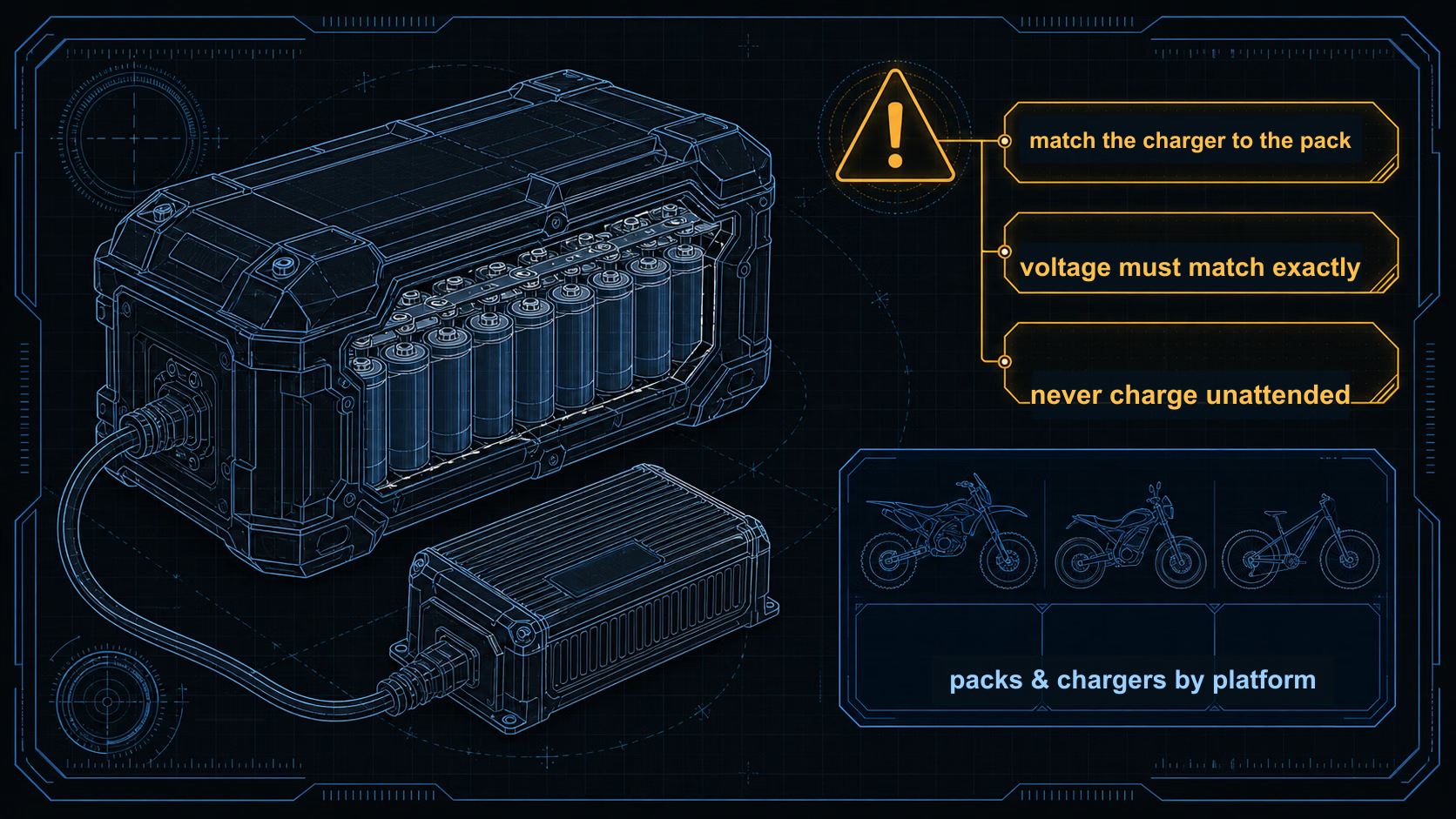
The battery is the most expensive, most important, and most dangerous part of a Sur-Ron, Talaria, or Segway. Get the buying decision right and it's the heart of the bike; get it wrong and it's a fire risk. Three rules govern everything below:
- Voltage-match is non-negotiable — the charger voltage must match the pack voltage. A 72V charger on a 60V pack overcharges it. This is how battery fires start.
- Generation is sacred — a pack "for a Sur-Ron" is not necessarily for your Sur-Ron's year. Match voltage, physical fit, and connector to your exact bike.
- Never charge unattended, near combustibles, or a hot/swollen/damaged pack.
Then the packs and chargers, by platform.
The fire-safety spine (read before you buy)
This is the part most affiliate pages skip, and it's the part that matters most.
Match the voltage across the whole system. The pack, the controller, and the charger all live at the same voltage. You cannot mix them. A higher-voltage pack is a conversion, not a swap — everything moves together, with correct high-current wiring. Mismatched voltage is the classic cause of a lithium fire.
Match the pack to your generation. These platforms change year to year: an older 60V bike versus a current 72V one, different Talaria Sting years, different Segway variants. A listing that says "fits Sur-Ron" may mean a different Sur-Ron than yours. Confirm the seller names your bike and model year, the voltage, and the connector/controller.
Charge like it matters. Use the correct matched charger, stay nearby, keep the pack away from anything flammable, and never charge one that's hot, swollen, or damaged. The battery-care guide covers the habits that keep a pack healthy and safe for years.
> Because generation fitment is a safety issue, we won't list a pack we can't confirm fits your exact bike. If a source can't pin the year and voltage, we leave it off — not on it.
The replacement-cost reality
The traction pack is a consumable that slowly loses capacity, and it's the single most expensive part on the bike — typically around $1,000–$2,500 to replace, more for a large high-voltage pack. That's why battery health dominates a used bike's value, and why the cheapest "upgrade" is often just taking care of the pack you have.
Sur-Ron Light Bee X (72V)
The current Light Bee X is a 72V bike. A high-capacity 72V pack adds real range — and remember it stays 72V through the charger and controller:
Its matched 72V charger — and the caveat that defines this whole page: never put it on a 60V bike:
Talaria Sting — MX3 / MX4 (60V)
The Talaria Sting MX3 and MX4 are 60V bikes (the MX5 is a different, 72V machine — don't cross the two). An OEM-style spare/upgrade pack adds range:
A higher-capacity aftermarket 60V pack is the range-max option:
And the matched 60V Sting/XXX charger — explicitly not for the 72V MX5:
Talaria MX5 (72V)
The MX5 is the 72V Talaria — a different voltage from the Sting, with its own matched charger:
Segway X260 (60V)
The X260 is a 60V bike with a swappable OEM pack. This is the one official buy path we could confirm (recheck the price, which has swung on dealer availability):
Sur-Ron Ultra Bee (74V)
The Ultra Bee runs a 74V system — again, its own voltage, its own matched charger:
Faster charging (aftermarket packs only)
A fast charger cuts charge time — but only on the aftermarket packs it's built for, at the exact voltage you select. It is not for OEM packs, and fast-charging the wrong pack can exceed its limits:
Fast charging trades battery longevity for speed — use it when you need the turnaround, not as your everyday default.
The 12V / kids / SLA world (a separate universe)
Kids' bikes and 12V accessories live in a completely different, lower-voltage world — do not confuse these with a Sur-Ron traction pack. Razor SLA packs are matched to a specific model and voltage:
...each with its own matched SLA charger (never a 24V charger on a 36V pack, or vice-versa):
For maintaining an individual 12V module or accessory battery over winter, a smart maintainer is the tool — but note it charges 12V, not a whole series pack or an HV traction pack:
(The full Razor parts picture is in the Razor replacement-parts guide.)
Why we don't list every "Sur-Ron battery" you'll see
Search "Sur-Ron battery" and you'll find high-capacity packs at tempting prices whose listings don't pin the generation — 60V packs for older bikes, 72V packs that don't confirm current-year compatibility, or sellers we can't verify. Buying one of those on a guess is a fitment and fire risk. So we hold them off this page until the year, the voltage, and a legitimate source are confirmed. That's the rule, and it's the whole point of an independent authority.
Everything on this page, by voltage
Voltage is the first column for a reason. It is not a preference — a charger that does not match your pack is the one genuinely dangerous purchase on this site.
| Part | For | Price |
|---|---|---|
| LotFancy 24V 1.5A charger | Razor MX350 only | $18.99 |
| Generic 36V 1.5A charger (3-pin XLR) | Razor MX500/MX650 only | $26.59 |
| NOCO GENIUS1 maintainer | 6V/12V SLA modules and accessories | $29.99 |
| Battery Tender Junior | 12V SLA modules and accessories | $47.66 |
| AlveyTech 24V pack | Razor MX350 V33+ only | $68.86 |
| AlveyTech 36V pack | Razor MX500/MX650 only | $141.45 |
| Charged Cycle Works 15A fast charger | Aftermarket 60V packs — not OEM | $160.00 |
| EBMX 72V fast charger | 72V packs — never a stock 60V bike | $199.99 |
| Talaria Sting/XXX 60V charger (12A) | 60V Talaria only | $250.00 |
| Talaria MX5 15A fast charger | Talaria MX5 | $380.00 |
| FactoryZ Ultra Bee 74V charger (12A) | Sur-Ron Ultra Bee 74V only | $489.99 |
| eWatt 60V 53Ah extended pack | 60V Talaria Sting MX3/MX4 only | $1,600.00 |
| Talaria Sting 60V 45Ah spare pack | 60V Talaria Sting MX3/MX4 only | $1,950.00 |
| EBMX high-power 72V pack | Sur-Ron Light Bee X | $1,999.99 |
The 26x spread is voltage, not quality
Chargers on this page run $18.99 to $489.99 — a 25.8x spread — and almost none of that gap is "better." You cannot shop this category the way you shop tires. There is exactly one correct voltage for your pack, and the choice within it is amperage: how fast, not how good.
Which is why every caveat in that table is a restriction rather than a feature. "72V packs — never a stock 60V bike" is not marketing hedging; it is the difference between charging and a fire. Our battery safety audit found that 37 of 46 bikes publish no safety certification at all, so on most of this class the charger match is a control the manufacturer has not given you and you have to get right yourself.
Match the voltage first. Then, and only then, decide about speed.
A spare battery costs half a bike
The three packs at the bottom of that table are the most expensive things on the page by an order of magnitude, and against the bikes they fit:
- eWatt 60V 53Ah — $1,600, or 43.2% of a $3,700 Talaria Sting MX3.
- Talaria 60V 45Ah spare — $1,950, or 52.7% of the same bike.
- EBMX high-power 72V — $1,999.99, or 44.5% of a $4,499 Light Bee X.
A second battery is the only real fix for range, and it costs roughly half of another bike. That is worth knowing before "just get a spare pack" sounds like small advice — for the price of the Talaria spare you are most of the way to a second Sting MX3.
The honest middle path is the one nobody sells hard: a fast charger. The Talaria MX5 15A unit at $380 is a fifth of the spare pack and turns one battery into roughly two riding sessions in a day, which is what most riders actually want when they say they want more range.
The bottom line
Riding a Sur-Ron specifically? See the focused Sur-Ron battery-upgrade guide.
Batteries are where the biggest money and the biggest risk meet. Match the voltage across the whole system, match the pack to your exact generation, use the matched charger, and never charge unattended. Buy the pack that's confirmed for your bike and year — Sur-Ron 72V, Talaria Sting 60V (not MX5), MX5 72V, Segway X260 60V, Ultra Bee 74V — keep it healthy with the battery-care guide, and if you're still choosing a bike, run the Find Your Ride configurator.
VoltRipper is independent — we don't sell parts and our recommendations aren't pay-to-play. Battery voltage and fitment are safety-critical: match the charger to the pack, confirm a replacement pack fits your exact bike and model year, and charge attended, away from combustibles, on the correct matched charger. Prices for large packs swing with availability — confirm current pricing before you buy. Affiliate disclosure is included on monetized pages, and we're spec-verified/data-driven rather than hands-on until first-hand testing exists.
FAQ
Can I put a 72V battery in a 60V electric dirt bike?
Not as a simple swap — it's a full conversion, and getting it wrong is a fire risk. A higher-voltage pack needs a matching controller and, critically, a matching charger: a 72V charger will overcharge a 60V pack, and mismatched voltage anywhere in the system is exactly how battery fires start. Some riders do run higher-voltage conversions, but that means the battery, the controller, and the charger all move to the new voltage together, with correct high-current wiring. So no, you can't just drop a 72V pack into a 60V bike and ride — treat voltage as a whole-system decision, match every component, and if you're not confident with high-voltage electrical work, have it done by someone who is.
How much does it cost to replace an electric dirt bike battery?
For the main traction pack on a Sur-Ron, Talaria, or Segway, typically somewhere around $1,000 to $2,500, and sometimes more for a large high-voltage pack — it's the single most expensive part on the bike. That's why battery health dominates a used bike's value and why caring for the pack matters so much: a worn battery is a four-figure replacement, not a cheap consumable. Kids' bikes are the opposite end — a Razor SLA pack is a low-double-digit-to-low-triple-digit part. Always price the specific pack for your exact bike and generation before you buy, because capacity, chemistry, and fitment vary widely and the number swings a lot.
Is it safe to charge a Sur-Ron or Talaria indoors?
Charge it attended, away from anything flammable, on a hard non-combustible surface, and never leave a large lithium pack charging unattended or overnight while you sleep — that's the core rule regardless of where you do it. Lithium traction packs store a lot of energy, and while failures are rare, they're serious, so the sensible habits are: use the correct matched charger, don't charge a pack that's hot, swollen, damaged, or that was just run hard until it cools, keep it away from combustibles, and stay nearby. Many owners charge in a garage or shed rather than living space for exactly this reason. If a pack ever gets hot, smells, or swells, stop immediately and get it away from anything that can burn.
How do I know a replacement battery actually fits my bike?
Match three things to your exact bike and model year: voltage, physical fitment, and the connector/controller — and don't trust a generic 'fits Sur-Ron' claim. These platforms change across generations (a 60V older bike versus a 72V current one, different Talaria Sting years, different Segway variants), so a pack listed for 'a Sur-Ron' may not fit yours, and the wrong voltage is a safety problem, not just an inconvenience. Confirm the seller explicitly lists your bike and year, that the voltage matches your bike's system, and that the connector and controller are compatible. This is exactly why we only list packs whose fitment we can confirm — if we can't pin it to your generation, we leave it off rather than risk it.