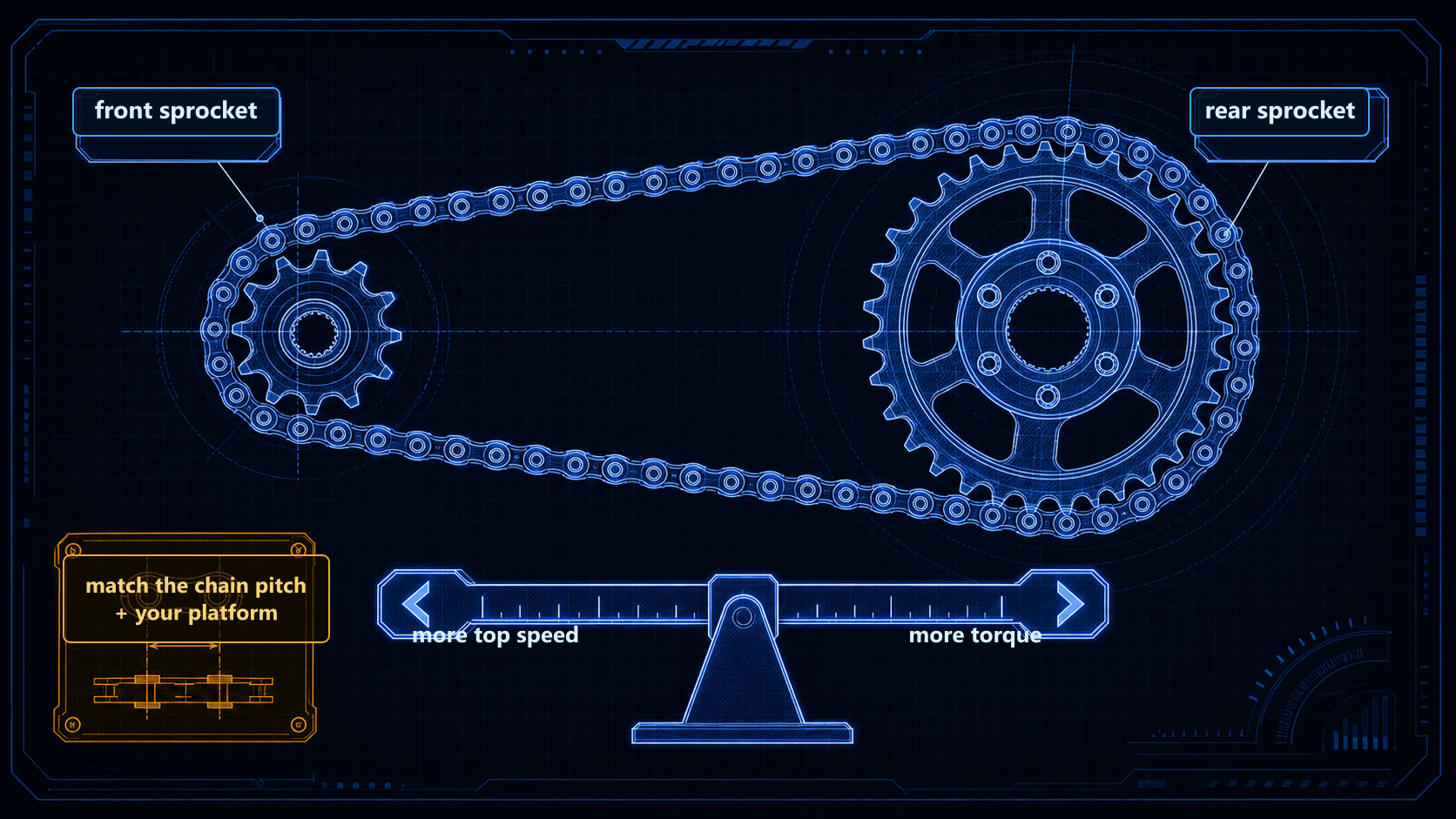
The short answer
Regearing is the cheapest performance change on a Sur-Ron or Talaria — a $20 sprocket noticeably changes how the bike feels. Two rules decide what fits and what it does:
- Gearing is a trade-off — bigger rear (or smaller front) = more torque/climbing, less top speed; smaller rear (or bigger front) = more top speed, less torque and more heat.
- Pitch + generation are fitment-critical — 420, 428, and 520 do not interchange. Match your bike's exact pitch and year (see the chain-size reference).
And a meaningful tooth change usually needs a different chain length. Here's the drivetrain, by part.
The gearing rule (what each change does)
- More torque / acceleration / climbing → a bigger rear sprocket or a smaller front. Costs top speed.
- More top speed → a smaller rear or a bigger front. Costs acceleration, adds heat/strain.
- Any big tooth change → re-check chain length (more teeth usually = more links).
The gearing guide explains the math; below are the parts.
Front (countershaft) sprockets — the cheapest change
A front sprocket is a few dollars and changes the ratio a lot per tooth. Match your exact pitch and bike:
Warp 9 makes the same part in 7075-T6 and sells it direct, which is the version we can price-check live:
Rear sprockets — the bigger range of change
The rear gives a wider spread of tooth options for fine-tuning. 420 family (Light Bee, Talaria Sting, Segway) and heavier 520 (Ultra Bee):
Confirm the bolt pattern matches your hub, and pair a bigger sprocket with the right chain length.
Chains — match the pitch, mind the length
Replace a worn chain with your bike's exact pitch and link count — and if you've regeared, get the length for your new tooth count (the Light Bee X pairs 106 links with the stock 48T, 112 with a 58T):
An O-ring or X-ring chain lasts far longer than a plain one — worth it. (Keep it alive with the chain-maintenance guide.)
Two chains worth knowing, both in the 420 x 106 size most of these bikes leave the factory with — a plain chain and a sealed O-ring one:
Remember the length rule. 106 links suits a stock 48T rear. Warp 9 publishes the full mapping — 104 links at 42T, 108 at 52T, 112 at 56–58T, 116 at 64T — so if you are changing the sprocket, size the chain to the sprocket, not to what came off the bike.
Belt-drive conversion — quiet & low-maintenance
A belt drive replaces the chain-and-sprocket final drive with a toothed belt: quieter, no lubing, no grime. It's a full conversion, not a swap — several hundred dollars, a fixed gearing, and more debatable under hard trail abuse (a chain is repairable anywhere). Great for calm street/commuter riding:
(The belt-vs-chain guide covers the full trade-off.)
Drivetrain accessories
A chain guard keeps the chain on and the grime contained (check clearance if you run a big rear sprocket):
Lightweight sprocket bolts and, for the MX5, a chain tensioner to set slack after a regear:
Every drivetrain part on this page, compared
| Part | Fits | Type | Price |
|---|---|---|---|
| Talaria chain tensioner | Talaria MX5 | Accessory | $8.99 |
| Luna Sur-Ron chain guard | Light Bee X | Accessory | $12.00 |
| DirtyBike front sprocket, 520/13T | Ultra Bee | Front sprocket | $17.00 |
| Sur-Ron OEM jackshaft sprocket, 420/14T | Light Bee X | Front sprocket | $18.99 |
| Talaria driving sprocket, 428/13T | Talaria MX5 | Front sprocket | $20.99 |
| REVRides titanium sprocket bolts (5) | Match your hub thread | Accessory | $26.00 |
| Talaria Canada rear sprocket, 420, 40-62T | Light Bee X / Talaria 420 | Rear sprocket | $35.99 |
| Talaria O-ring chain, 420/106 | Sting MX3 / MX4 | Chain | $36.99 |
| Heavy Hitter rear sprocket, 520, 46-60T | Ultra Bee | Rear sprocket | $42.99 |
| eDirtyBike 520 X-ring chain | Ultra Bee | Chain | $47.50 |
| Sur-Ron OEM 420 O-ring chain | Light Bee X | Chain | $63.99 |
| Talaria chain, 428/108 | Talaria MX5 | Chain | $75.99 |
| Talaria rear sprocket, 428/48T | Talaria MX5 | Rear sprocket | $100.99 |
| Sur-Ron secondary belt driver kit | Light Bee | Belt conversion | $520.00 |
| Sur-Ron / Alien Rides complete belt kit | Light Bee | Belt conversion | $899.00 |
What it actually costs to re-gear, by platform
A tooth change usually needs a chain too — a longer rear sprocket eats chain length — so the honest number is the pair, not the sprocket:
| Platform | Front sprocket + chain | Rear sprocket + chain |
|---|---|---|
| Sur-Ron Ultra Bee | $64.50 | $90.49 |
| Sur-Ron Light Bee X | $82.98 | $99.98 |
| Talaria MX5 | $96.98 | $176.98 |
Two things fall out of that table that no single product page tells you.
The Talaria MX5 is the expensive platform to gear, by a lot. Its rear sprocket alone is $100.99 — more than a complete rear-and-chain re-gear on an Ultra Bee at $90.49, and nearly five times the Ultra Bee's front sprocket. If you expect to experiment with gearing, that is a real ownership cost that never appears on a spec sheet.
Change the front sprocket first, and not only because it is cheapest. A front sprocket is $17-$21 across all three platforms, one bolt pattern, and one tooth at the front moves the ratio about as much as three at the rear — so it is the cheapest change and the biggest single step. Start there, ride it, and only go to the rear if you need to fine-tune.
The belt conversion is not a gearing change
The two most expensive things on this page, at $520 and $899, are the odd ones out. They cost 31 to 53 times the cheapest front sprocket and they do not change your gearing at all — they change your maintenance. No chain to clean, lube, tension or replace, and a markedly quieter bike.
That can be worth it. Just be clear which problem you are buying: if the bike gears wrong for your terrain, a $17 sprocket fixes it and a $899 belt kit does not.
Which change is for you?
- More climbing / low-end punch → a bigger rear sprocket (+ the right chain length).
- More top speed → a smaller rear or bigger front (watch heat/strain).
- Quiet, clean, low-maintenance → a belt-drive conversion.
- Just worn out → a fresh O/X-ring chain in your exact pitch.
The bottom line
Regearing is the cheapest way to make a Sur-Ron or Talaria feel the way you want — bigger rear for torque, smaller for speed — as long as you match the pitch and generation (420/428/520 don't mix) and get the chain length for your new tooth count. Want quiet and clean instead? A belt conversion trades repairability for a smoother ride. Keep it all healthy with the chain-maintenance and maintenance guides, and if you're choosing a bike, run the Find Your Ride configurator.
VoltRipper is independent — we don't sell parts and our recommendations aren't pay-to-play. Drivetrain fitment is pitch- and generation-specific — confirm your bike's exact chain pitch, sprocket bolt pattern, and the chain length for your tooth count before buying (420/428/520 do not interchange). Affiliate disclosure is included on monetized pages, and we're spec-verified/data-driven rather than hands-on until first-hand testing exists.
FAQ
What does changing sprockets do on a Sur-Ron?
It re-gears the bike, trading top speed for acceleration and torque or the reverse — it's the cheapest performance change you can make. A bigger rear sprocket (or a smaller front) gives more low-end torque, quicker acceleration, and better hill-climbing, at the cost of top speed; a smaller rear (or a bigger front) raises top speed but softens acceleration and can add heat and strain. Nothing about the motor or battery changes — you're just changing the ratio. It's popular precisely because a $20-40 sprocket noticeably changes how the bike feels. The catch is that a meaningful tooth change often needs a different chain length, so plan the chain with the sprocket.
Do I need a new chain if I change my sprocket?
Often yes, if the tooth change is significant — the chain has to physically reach around the new sprocket with correct tension. A larger rear sprocket increases the chain path and typically needs more links, while a smaller one may need fewer; running the wrong length leaves the chain too tight or with the adjuster maxed out. For example, sources for the Light Bee X pair a 106-link chain with the stock 48T rear and a 112-link chain with a 58T upgrade. So when you regear, check the chain length for your new tooth count and buy the correct chain (in your bike's pitch) at the same time rather than assuming the old chain will fit.
What chain pitch does my electric dirt bike use?
It's specific to your bike and generation, and pitches do NOT interchange — a 420 part will not fit a 428 or 520 drivetrain. In this class, many older/60V Sur-Ron Light Bee, Talaria Sting MX3/MX4, and Segway models use 420 chain; the Talaria MX5 uses 428; and the Sur-Ron Ultra Bee uses a heavier 520. Confirm your bike's exact pitch (it's stamped or in the manual, and our chain-size reference maps it) before buying any chain or sprocket, because mixing pitches simply won't work and can be unsafe. When in doubt, match the OEM part number or the pitch your current chain shows.
Is a belt-drive conversion worth it on a Sur-Ron?
For quiet, clean, low-maintenance riding it can be, but understand it's a full conversion, not a bolt-on sprocket swap — and it costs several hundred dollars. A belt drive replaces the chain-and-sprocket final drive with a toothed belt, which runs quieter, doesn't need lubing, and won't fling chain grime, which many street and commuter riders love. The trade-offs are cost, the install effort of a conversion, a fixed gearing choice, and durability questions under hard trail or jump abuse compared with a chain you can quickly repair anywhere. So it's a great quality-of-life upgrade for calmer riding, and a more debatable one for aggressive off-road use where a chain's repairability wins.