The short answer
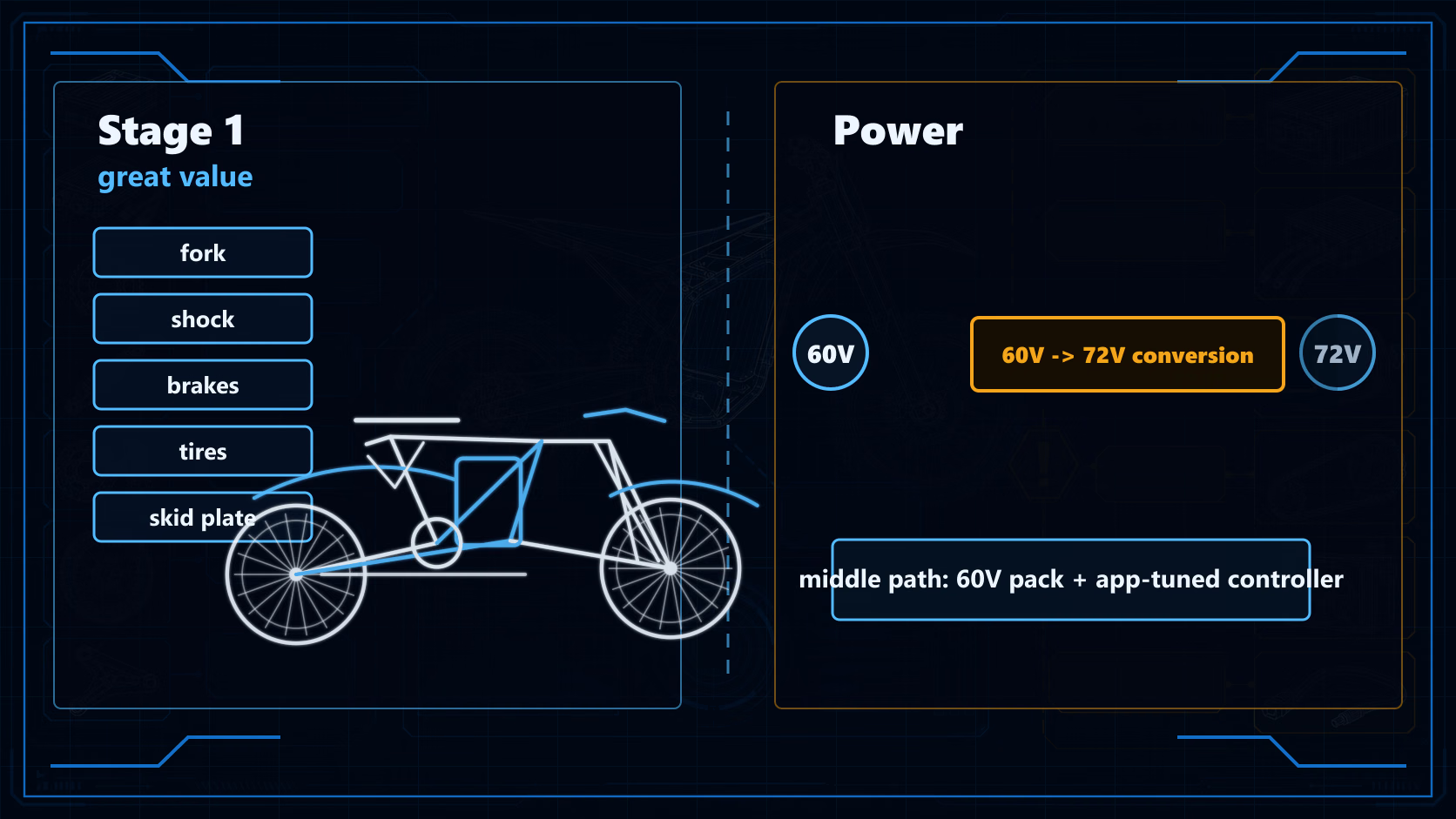
The Talaria Sting MX3 and MX4 are value bikes, and they build like one — the Stage 1 chassis upgrades are excellent value and share the same clone-family parts as a Sur-Ron. Where the Sting is different is power: it's a 60V bike, so a serious power step means a 72V conversion, and that changes the math. Build it right and the order is the same as any bike:
> Stage 1 — ride, stop, grip, fit. Great value, same clone parts as a Sur-Ron. > Stage 2/3 — power is a conversion decision, not a bolt-on, on a 60V bike.
For most Sting owners, Stage 1 makes it the great-handling value bike it should be — and that may be the whole build.
Stage 1: the chassis — same value, same clone parts
The Talaria Sting MX3/MX4 sits close enough to the Light Bee-class clone frame that many mechanical upgrades are sold to fit both bikes. That's good news: the Sting gets the same high-value Stage 1 build a Sur-Ron does.
Suspension. Upgrade forks and rear shocks sold for the Sting MX3/MX4 fix the soft stock suspension. Note what is not here: the cheap re-spring trick that works on a Sur-Ron does not carry over, because the Sting's stock FastAce BDS53RC shock does not take the KKE spring. If you keep the stock shock, a suspension shop re-spring is the route; otherwise it is a fork and a shock:
Brakes. Better pads and a bigger-rotor set for the stock Sting caliper, plus the full moto conversion when you want it:
Tires for your terrain — the Sting runs a 70/100-19 front; a knobby for dirt, or a grippy DOT trials tire the Talaria crowd loves:
And a skid plate protects the motor on a value bike you'll ride hard:
Keep the chain clean, and the Sting handles and stops like a much more expensive bike. This is the highest-value money on the Sting, and for a value-focused rider it's often the entire build.
Stage 2/3: power on a 60V bike is a conversion decision
Here's where the Sting differs honestly from a Sur-Ron. The classic Sting (MX3/MX4/X3) is a 60V system. To add serious power, you're generally looking at a 72V conversion — a new pack, a matching controller, and a matching 72V charger, together, because you can't just bolt a 72V part onto a 60V bike (and a mismatched charger is a fire risk — see the compatibility guide).
The middle path (no voltage conversion): you don't have to go full 72V to improve the Sting. A higher-capacity 60V pack adds range, and an app-tuned controller that runs on the stock 60V system adds real power without a conversion — matched to the 60V charger (never the MX5's 72V one):
For the full step — a 72V conversion — done properly, that's a real performance bike. But the cost climbs toward what a 72V bike costs from the factory — so the honest question isn't "which controller," it's:
- Enjoy the Sting as a dialed value bike? Stage 1 done, ride it. This is the right answer for most.
- Convert it to 72V? A committed, capable project that ends up near Light Bee X money in parts.
- Or step up to a 72V bike? If you know you want the power, a bike that's 72V from the factory — like the Sur-Ron Light Bee X — may be the cleaner path than converting a 60V one.
There's no wrong answer, but there is a wrong order: don't start a power conversion before the Stage 1 brakes and suspension are done. Our controller guide covers the power side; the upgrades guide sets the general order of operations.
The fitment traps to avoid
- MX3/MX4/X3 are 60V; the MX5 is a different 72V chassis. MX3 parts do not fit the MX5 (it's a bigger frame with its own voltage and its own charger). Confirm the part is listed for your Sting.
- Mechanical parts cross-fit the clone family; electrical parts never cross a voltage line. A Sur-Ron fork may fit your Sting; a Sur-Ron 72V battery or charger will not.
Both are covered in depth in the parts compatibility guide.
Every Sting part on this page, cheapest first
Against a $4,100 Sting R MX4, the live bike on this platform — the MX3 is discontinued, so a Sting owner shopping today is almost certainly on the MX4:
| Part | Job | Price | Share of bike |
|---|---|---|---|
| Kool-Stop disc brake pads | Consumable | $20.00 | 0.5% |
| Shinko SR241 trials tire | Tire | $75.00 | 1.8% |
| Dunlop Geomax MX34 front | Tire | $82.95 | 2.0% |
| Luna 220mm floating rotor set | Braking | $115.00 | 2.8% |
| Heavy Hitter V2 skid plate | Protection | $199.89 | 4.9% |
| Talaria Sting/XXX 60V charger | Charging | $250.00 | 6.1% |
| Volar Sport front brake kit | Moto conversion | $625.99 | 15.3% |
| FastAce ALX13RC 2.0 fork | Suspension | $649.99 | 15.9% |
| Torp TC500 2.0 controller | Power | $1,095.00 | 26.7% |
| EXT Arma MX rear shock | Suspension | $1,150.00 | 28.0% |
| eWatt 60V 53Ah battery | Range | $1,600.00 | 39.0% |
| All eleven | $5,863.82 | 143% |
The parts list costs more than the bike
Fit everything here and you have spent $5,863.82 on a $4,100 machine — 143% of it. That is not a hypothetical: it is the sum of the products this page recommends.
Worse, you do not need all eleven to get there. The four most expensive parts alone come to $4,494.99, which is already more than the bike. Battery, shock, controller, fork — each one individually reasonable, and any three of them is most of a second Sting.
That reframes the page. On a $4,100 bike the big-ticket items are not upgrades in the ordinary sense; they are a decision about whether to keep this platform at all. A $1,600 battery and a $1,150 shock on a Sting is most of the way to a bike that arrives with better versions of both.
The bottom three are where a Sting owner should actually spend: $177.95, or 4.3% of the bike, covering pads and tires for the ground you ride. That is the set that changes how the bike behaves on your next ride, and it costs less than the freight on some of the parts above it.
One note on the platform: the Sting MX3 is discontinued, so most of what follows assumes the MX4 unless a part says otherwise. Check fitment against your exact model and year — Talaria has changed this chassis more than once.
The bottom line
Build a Talaria Sting the same way you'd build any bike — ride and stop first — and enjoy that the Stage 1 parts are the same great-value clone-family upgrades a Sur-Ron uses. Just go in clear-eyed about power: on a 60V Sting it's a 72V conversion, not a bolt-on, and at that point stepping up to a factory-72V bike is a fair alternative. For a value rider, a Stage 1 Sting is a lot of bike for the money. Keep it running with the maintenance guide, and if you're still choosing, run the Find Your Ride configurator.
VoltRipper is independent — we don't sell parts and our recommendations aren't pay-to-play. Confirm every part against your exact Sting model and year, match the voltage of any electrical part exactly, and upgrade braking and suspension alongside any power increase. Affiliate disclosure is included on monetized pages, and we're spec-verified/data-driven rather than hands-on until first-hand testing exists.
FAQ
What should I upgrade first on a Talaria Sting?
The chassis — suspension, brakes, tires, and fit — exactly like a Sur-Ron, and using many of the same parts. The Talaria Sting MX3/MX4 shares enough frame geometry with the Light Bee-class clones that upgrade forks, big-rotor brake kits, and moto brake conversions are sold to fit it, and those Stage 1 changes are the same high-value money they are on a Sur-Ron. Fix ride and stopping first; it makes the bike better and safer for every rider and costs far less than chasing power.
Can you put a bigger controller and battery on a Talaria Sting?
Yes, but on the 60V Sting it's a conversion, not a simple bolt-on, and that changes the decision. The classic Sting (MX3/MX4/X3) is a 60V bike; a serious power step usually means converting it to a 72V system — a new pack, a matching controller, and a matching 72V charger together. Done right that's a real performance bike, but the cost climbs toward what a 72V bike costs new. So the honest question is whether to convert the Sting or simply enjoy it as a great-handling value bike after Stage 1 — or step up to a bike that's 72V from the factory.
Do Sur-Ron parts fit a Talaria Sting?
Some do, and it's specifically the mechanical clone-family parts. The Talaria Sting MX3/MX4 sits close enough to the Sur-Ron Light Bee-class frame that certain forks, big-rotor discs, and moto brake kits are sold to fit both — that's why the Sting's Stage 1 build looks a lot like a Sur-Ron's. What does NOT cross over is anything electrical: the 60V Sting and the 72V Light Bee run different voltages, so batteries, chargers, and controllers are not interchangeable. Always confirm the exact part is listed for your bike and year.
Is a Talaria Sting MX5 the same as an MX3 for parts?
No — this is a common and costly mix-up. The Sting MX5 (and MX5 Pro) is a bigger, newer 72V chassis, not a trim of the 60V MX3/MX4. It has different geometry and a different voltage, so MX3/MX4 parts do not fit the MX5, and the MX5 even uses its own voltage-matched charger for that reason. If you have an MX5, don't buy MX3 parts; confirm the part is listed specifically for the MX5.