The short answer
The Razor Dirt Rocket is the bike a huge number of kids learn on — and its wear parts are cheap and easy to replace, which is most of why it lasts. Battery, charger, chain, throttle: all straightforward swaps. But there's one rule that matters more than any other:
> The MX350 is 24V. The MX650 is 36V. Their parts do not cross.
Buy a part for the wrong model and best case it doesn't fit; worst case a 36V charger overcharges a 24V pack. So before anything else, know which bike you have — then use the right section below.
Which Dirt Rocket do you have?
Check the sticker and count the batteries:
- MX350 Dirt Rocket — 24V, two 12V sealed lead-acid batteries. The smaller, younger-rider bike.
- MX650 Dirt Rocket — 36V, three 12V batteries. The bigger, faster one.
There's also a version number on the sticker that matters for electrical parts: later MX350s (Version 33+) and MX650s (Version 14+) use specific throttle/control parts. Note your version before ordering anything electrical, and when in doubt, match the Razor part number stamped on the old component.
MX650 (36V) parts
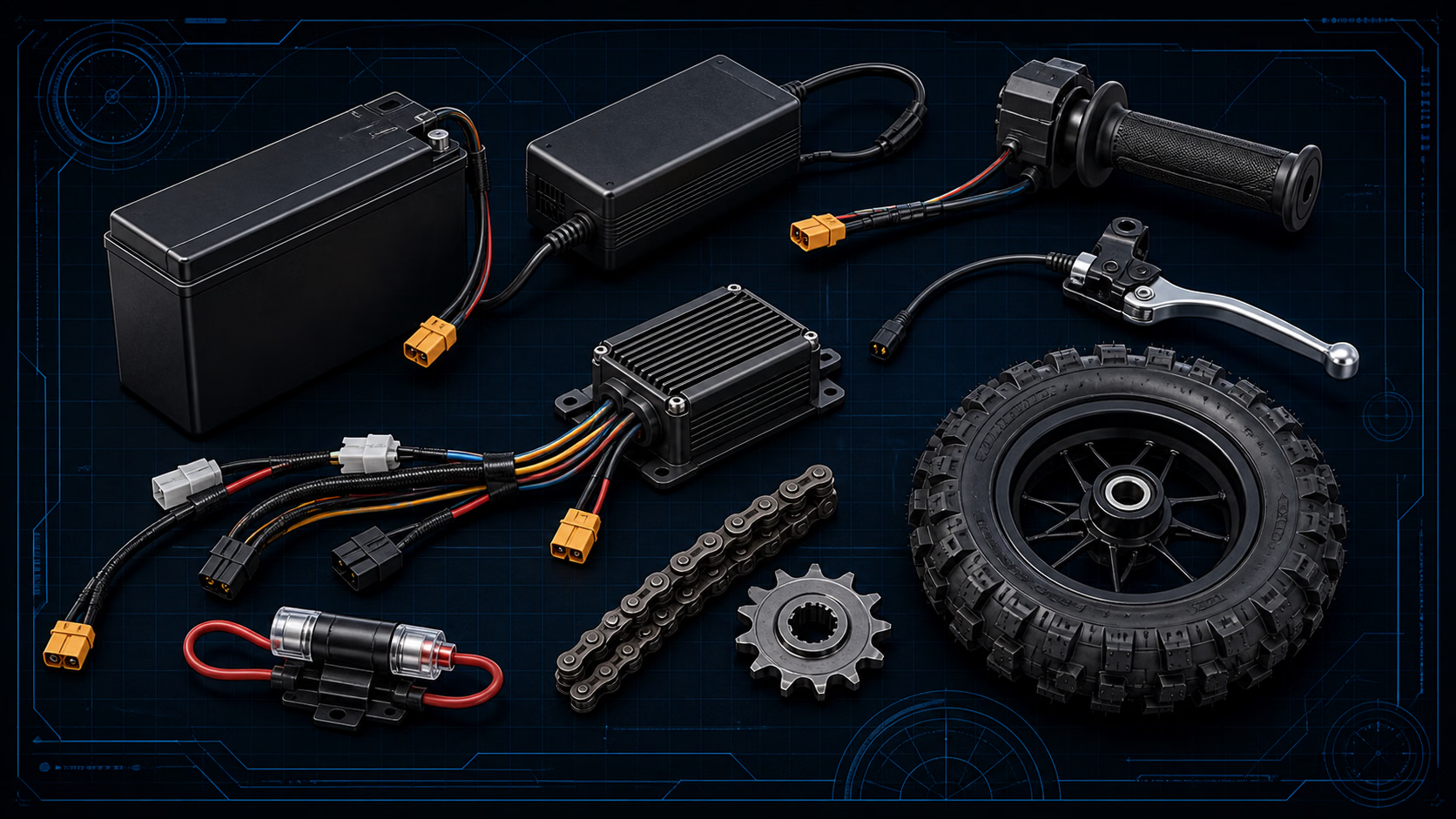
Battery — the most common replacement. The MX650's three-battery 36V SLA pack is a wear item; when range falls off, replace the whole pack as a matched set. This one includes the wiring harness.
Charger. Must be a 36V SLA charger with the right connector — never a 24V MX350 unit.
Chain. The MX650 uses a #25, 132-link chain — the longer one. Don't fit the shorter MX350 chain.
Throttle (Version 14+). A worn or sticky throttle is a cheap fix — but the connector is version-specific, so confirm you have a Version 14+ MX650 before ordering.
MX350 (24V) parts
Battery. The MX350's two-battery 24V SLA pack, with harness. Later bikes (V33+) use this pack — not the 36V MX650 battery.
Charger. A 24V SLA charger — never the 36V MX650 charger.
Chain. The MX350 uses a 25H, 126-link chain — the shorter one. Not the MX650's 132-link chain.
Electrical kit (Version 33+). When the throttle and controller age together, this factory kit replaces both at once for later MX350s.
Both parts sets side by side
Same four jobs, two incompatible voltages. Reading them together is the fastest way to avoid ordering the wrong one:
| Job | MX350 (24V) | Price | MX500 / MX650 (36V) | Price |
|---|---|---|---|---|
| Battery pack | AlveyTech 24V (V33+ only) | $68.86 | AlveyTech 36V | $141.45 |
| Charger | LotFancy 24V 1.5A | $18.99 | Generic 36V 1.5A, 3-pin XLR | $26.59 |
| Chain | KAMIER 25H, 126 links | $9.99 | Generic #25, 132 links | $9.99 |
| Throttle / electrics | MX350 electrical kit (V33+) | $48.01 | 6-wire twist throttle | $24.99 |
| All four | $145.85 | $203.02 |
The chains are the trap. Both cost exactly $9.99 and they are not the same part: 25H at 126 links for the MX350, #25 at 132 links for the MX500/MX650. Identical price, different pitch, different length. Nothing about the listing price will tell you that you bought the wrong one.
The batteries and chargers are the expensive version of the same trap, and they are the two parts most likely to be bought in a hurry by a parent whose kid's bike stopped working.
When to stop fixing it
This is the number the parts listings never put next to each other:
- A full refresh of an MX350 — battery, charger, chain and electrics — is $145.85
against a $299 bike. That is 48.8% of buying a new one.
- The same four parts for an MX650 are $203.02 against a $699 bike, or 29.0%.
So the honest guidance splits by model. On an MX650, a full refresh is comfortably worth it: under a third of the price for a bike that is otherwise fine, and the 36V pack alone at $141.45 is a sensible buy on its own. On an MX350, replacing everything at once is close to a coin flip, and you are putting half the price of a new bike into a machine whose other parts are the same age.
The sane MX350 rule: replace the battery, and only the battery. At $68.86 it is 23% of the bike and it is the part that actually fails. If the charger, chain and throttle have all gone too, the bike is telling you something.
The safety basics
These are kids' bikes, so keep the repairs safe and simple:
- Match the voltage, always. 24V charger to a 24V bike, 36V to a 36V bike. A mismatched charger overcharges the pack — a real hazard, not a technicality.
- SLA batteries are the weak point. They die if stored flat, so charge fully after every ride and before storage, and replace the pack as a matched set (both batteries on the MX350, all three on the MX650) — not one at a time.
- Skip lithium unless it's a proper kit. The stock charger and wiring are built for lead-acid; a lithium swap without a matching charger and kit is a safety risk.
- Confirm the version on electrical parts, and match the Razor part number on the old component if you're unsure.
The bottom line
The Razor Dirt Rocket earns its reputation by being cheap and easy to keep running — a fresh battery, a chain, or a charger brings a tired one back to life for very little. Just respect the one rule: the MX350 is 24V and the MX650 is 36V, and their parts never cross. Get the model, voltage, and version right and the repair is a quick, safe job. For the fuller maintenance routine, see the maintenance guide, and if you're weighing a bigger step up, the Find Your Ride configurator helps you choose.
VoltRipper is independent — we don't sell parts and our recommendations aren't pay-to-play. Replacement parts and battery charging are safety-critical, especially on children's bikes: match the exact model, voltage, and version, use only the correct charger for your pack, and follow the manufacturer's instructions. Affiliate disclosure is included on monetized pages, and we're spec-verified/data-driven rather than hands-on until first-hand testing exists.
FAQ
What's the difference between MX350 and MX650 parts?
Voltage, and it's the whole game. The Razor MX350 runs a 24V system (two 12V sealed lead-acid batteries); the MX650 runs a 36V system (three 12V batteries). That means the battery, the charger, and even the chain are different between them, and they are not interchangeable. A 36V MX650 charger will overcharge a 24V MX350 pack, and the MX650's longer 132-link chain won't fit the MX350's 126-link setup. Always confirm you're buying the part for your exact model — MX350 (24V) or MX650 (36V) — before you order.
How do I know which Razor Dirt Rocket I have?
Check the model name on the frame sticker and count the batteries. The MX350 Dirt Rocket is 24V with two 12V batteries; the MX650 Dirt Rocket is 36V with three 12V batteries. There's also a version number on the sticker that matters for some parts — later MX350s (Version 33 and up) and later MX650s (Version 14 and up) use specific throttle and electrical parts, so note your version before ordering electrical components. When in doubt, match the Razor replacement part number stamped on the old part.
Why does my Razor Dirt Rocket battery keep dying?
Because it uses sealed lead-acid (SLA) batteries, which are a wear item and don't last forever — especially if the bike sits partly discharged. SLA packs lose capacity over time and die completely if stored flat, so the most common Dirt Rocket repair is simply a fresh battery pack. Charge it fully after every ride and before storage, don't let it sit dead, and when range drops off replace the whole pack (both 12V batteries on the MX350, all three on the MX650) as a matched set rather than one battery at a time.
Can I put a lithium battery in a Razor Dirt Rocket?
Not as a simple swap — and it's easy to get wrong. The Dirt Rockets are built around lead-acid packs and their stock chargers are SLA chargers, so dropping in a lithium pack means the charger and sometimes the wiring no longer match, which is a safety risk. Unless a pack maker explicitly sells a drop-in lithium kit for your exact model with a matching charger, stick with the correct-voltage SLA replacement (24V for the MX350, 36V for the MX650). Getting the voltage and chemistry right is more important than chasing lithium on a kids' bike.