The short answer
We checked what every manufacturer in our catalogue publishes about battery safety certification — 53 of our 59 records researched against manufacturer and dealer pages (the other six are not yet researched).
Forty publish nothing at all. Thirteen publish something. And of those thirteen, only six name an accredited testing laboratory — all of them Razors. Five are Dirt Rockets, from the MX125 at $229 to the MX500 at $699. The sixth is Razor's adult Stage2 M1, whose owner's manual names its lab even though its product page does not.
The whole-system standard that fits this class is UL 2272, and only Razor publishes it with a named lab. UL 2849 is the e-bike standard, and it requires functional pedals. CPSC's 2026 proposed rule treats a bike without pedals as a sit-down e-scooter under UL 2272.
Read that carefully, because it is a statement about disclosure, not about danger. An uncertified pack is an unverified pack, not a burning one. But if you came looking for evidence, the honest finding is that for most of this class it does not exist.
The three standards, and why the difference matters
The certification acronyms get used interchangeably in marketing. They are not interchangeable.
| Standard | What it covers |
|---|---|
| UL 2271 | The battery pack in a light electric vehicle — construction, electrical safety, performance |
| UL 2849 | The whole electrical system of an e-bike: pack, charger, drive electronics, including the pack meeting UL 2271. An e-bike under UL 2849 must have functional pedals |
| UL 2272 | The whole electrical system of personal e-mobility devices, e-scooters included. CPSC's proposed rule puts a product without pedals here as a sit-down e-scooter, so this is the system standard for a pedal-less dirt bike |
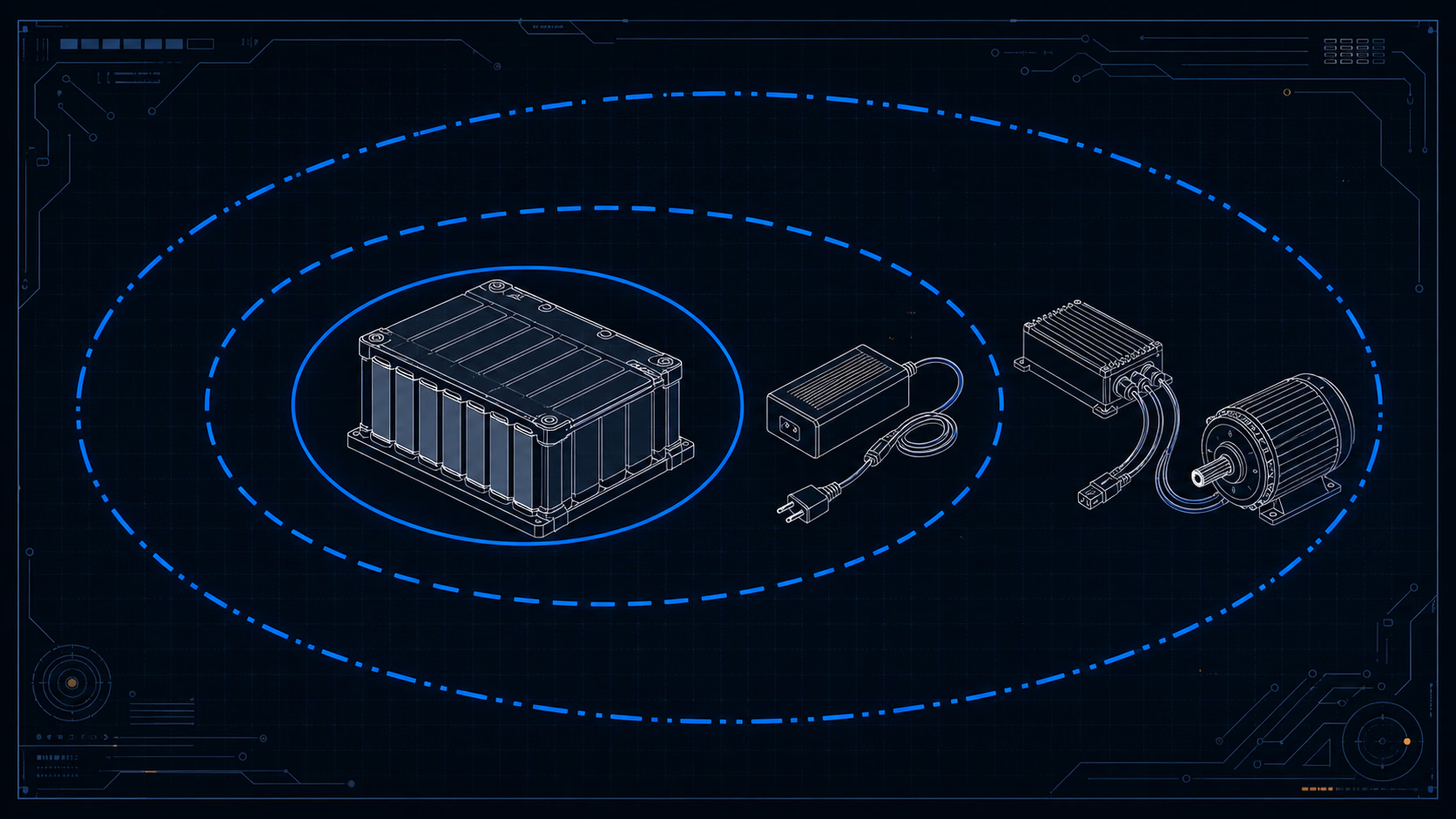
The practical hierarchy runs the other way from how it is usually quoted. A whole-system certification is the strongest claim, because the failures that start fires are rarely the cells alone. They are the charger, the battery management system, and the interaction between them. A pack certified in isolation and then paired with an uncertified charger is a partial answer.
Which system standard applies turns on one question: does the bike have pedals? Most of this class has none, so for most of it the system standard is UL 2272, not UL 2849. That is what makes the catalogue result striking: the system standard that fits the class is published with a named lab only by Razor.
The three strengths of claim, and how to tell them apart
We record every claim at one of three strengths, because "UL" on a spec sheet can mean three very different things.
1. Certified or listed — a named lab. The Razor MX650's page states its electrical system is certified compliant with UL 2272 by Guangdong UTL, and the MX350's names ACT Lab LLC. The other Dirt Rockets name Guangdong UTL too, and so does the Stage2 M1's owner's manual. A named accredited lab is the difference between a claim and evidence. Six bikes, all Razors. (The Segway Xaber 300's UL 2271 battery certification appears only on a press-release spec sheet, so we hold it as unverified.)
2. A compliance assertion — no lab named. The GT73 says "UL 2849 Compliant". The Tuttio Soleil01 says the pack "Meets UL 2272 Safety Standards". The VALTINSU EM-5 Pro cites a "CE-certified charger". These may be entirely true. They are also unfalsifiable as written: no lab, no file number, nothing to look up. Three bikes.
3. "UL-approved", naming no standard at all. Three more say some version of this. "UL-approved" is not a UL term of art. Without a standard number it does not identify what was tested or against what. Three bikes — and all three cover only the charger.
The charger trap
This is the one that catches careful buyers, because it looks like the answer to the question they asked.
Four of the thirteen bikes' claims cover the charger only — the E-Ride Pro SS 3.0, the Burromax TT250 and TT350R, and the VALTINSU EM-5 Pro's "CE-certified charger". A certified charger is genuinely worth having. It is also not what you were asking about: it says nothing about the pack, the battery management system, or the drive electronics, which is where thermal runaway begins.
Read the scope of every claim before you read the standard number. "UL-approved 4Amp charger" and "UL 2272 certified system" are not the same sentence with different words in it.
The price inversion
Here is the part we did not expect.
Among the 31 researched bikes priced at $3,000 and above, exactly three publish any certification claim at all — and one of those is a Razor. Among the 22 under $3,000, ten do.
The cheap end of this market is several times more likely to tell you something about battery safety than the premium end. A $299 Razor names its testing lab. A $13,040 race bike says nothing.
There are plausible reasons — toy-adjacent products face retail and marketplace listing requirements that a specialist off-road machine sold direct does not, and CPSC scrutiny has concentrated on consumer micromobility rather than off-road motorcycles. None of those reasons help a buyer. If you are spending five figures, you are getting less published safety evidence than a parent buying a Razor at a big-box store, and that is worth knowing before you accept it as normal.
What to actually do
Certification is one input. It is not available for most of this class, so here is the rest.
- Ask in writing before you buy. "Is the pack certified to UL 2271 or the system to UL 2272 (or UL 2849 if the bike has pedals), by
which lab, and what is the file number?" A seller who answers has told you something. A seller who changes the subject has also told you something.
- Use the charger the manufacturer specifies. Mismatched chargers are a leading cause of pack
damage, and it is the cheapest risk on this list to eliminate.
- Never charge unattended, and never in the only way out. Not in the hallway, not against the
garage door you would need to open.
- Stop using a pack that has been crashed, submerged, or has swollen. Physical damage to cells is
not something a battery management system reliably catches.
- Be more careful with aftermarket packs, not less. A [high-power upgrade
pack](/parts/electric-dirt-bike-battery-care) sits further outside any certification the bike originally carried.
What we are not saying
We are not saying uncertified bikes are unsafe. We have no incident data, we do not test batteries, and the absence of a published certification is the absence of evidence rather than evidence of a defect. Most of these bikes will do exactly what they are supposed to for years.
What we are saying is narrower and, we think, more useful: the evidence a careful buyer would want mostly is not published, the system standard that fits this class is published with a named lab only by Razor, and the claims that do exist need reading for scope before they are read for reassurance.
We will update this page as manufacturers publish more. We would genuinely like to be able to rewrite it.
Correction, 2026-09-14: this page previously called UL 2849 the standard written for this class and ranked it the strongest claim. UL 2849 is the e-bike standard and requires functional pedals. For bikes without pedals, CPSC's proposed rule points to UL 2272. The catalogue findings are unchanged.
FAQ
Are electric dirt bike batteries safe?
Almost certainly safer than the headlines suggest, and almost impossible to verify from what manufacturers publish. We checked the published certification claims for 53 of the 59 electric dirt bikes we track: 40 publish nothing at all, and only six name an accredited testing lab — all of them Razors. That is a disclosure problem rather than a proven safety problem — an uncertified pack is an unverified pack, not a dangerous one — but it does mean the evidence a careful buyer wants mostly does not exist.
What is the difference between UL 2271, UL 2272 and UL 2849?
Scope, and whether the bike has pedals. UL 2271 covers the battery pack in a light electric vehicle. UL 2849 covers the whole electrical system of an e-bike, and an e-bike under UL 2849 must have functional pedals. UL 2272 covers the whole electrical system of personal e-mobility devices, and CPSC's 2026 proposed rule states that products without pedals are not e-bikes and fall under UL 2272 as sit-down e-scooters. So for a pedal-less electric dirt bike, the system-level standard that fits is UL 2272, with UL 2271 covering a pack on its own.
Which electric dirt bikes are UL certified?
In our catalogue, six publish a certification naming an accredited lab, and all six are Razors: the five Dirt Rockets we track (MX125, MX350, MX500, SX500 McGrath and MX650), each certified to UL 2272 at device level, and the adult Stage2 M1, whose owner's manual names Guangdong UTL for its UL 2272 certification. The Segway Xaber 300 publishes a UL 2271 battery certification, but on a press-release spec sheet rather than its live product page, so we record it as claimed and unverified. The only UL 2849 claim in our catalogue is the pedal-equipped GT73's, with no lab named.
Does a 'UL-approved charger' mean the bike is certified?
No, and this is the most common way the claim misleads. Four of the claims we found cover the charger only, and 'UL-approved' is not a UL term of art — it names no standard and no file number. A certified charger tells you nothing about the pack, the battery management system, or the drive electronics, which is where the risk actually sits.
Should I avoid a bike with no published certification?
Not on that basis alone, or you would rule out most of the class including nearly every premium bike. Treat it as one input among several: prefer sellers who answer the question in writing, buy the charger the manufacturer specifies, never charge unattended or on the only exit route, and stop using a pack that has been crashed, submerged or swollen.
Sources
Editorial sources
- UL Solutions — e-bike certification to UL 2849, the whole-electrical-system standardChecked
- SGS — Understanding e-bike standard UL 2849, including how it relates to UL 2271 for the packChecked
- CPSC — proposed rule on lithium-ion batteries in micromobility products (FR 2026-12749): products without pedals are not eBikes and fall under UL 2272Checked
- Razor — MX650 Dirt Rocket, electrical system certified compliant with UL 2272 by Guangdong UTLChecked
- Razor — MX350 Dirt Rocket, electrical system certified compliant with UL 2272 by ACT Lab LLCChecked
- Razor — Stage2 M1 owner's manual (rev US_240723), electrical system certified compliant with UL 2272 by Guangdong UTLChecked
Specification sources
- Razor Stage2 M1Razor - Stage2 M1 60V Electric Dirt Bike product page (price, motor, pack, modes, weight, seat height, 10.5 in ground clearance, 200 lb limit, 90-day warranty)Checked
- Segway Xaber 300Segway - Xaber 300 official specificationsChecked
- Riding Times GT73Riding'times — GT73 product pageChecked