Boots are the piece of protection riders postpone longest. People buy three helmets before their first pair, and ride in trainers for a season or two in between.
That order is backwards for the way these bikes are actually ridden. Instant torque at low speed in technical terrain is exactly the situation where a foot comes off the peg, and a foot trapped between a peg and the ground is the injury that most reliably ends a season. A trainer offers nothing against it.
The standard, and where it starts
EN 13634 is the European standard for motorcycle footwear. It tests impact abrasion, cut resistance, transverse rigidity and ankle restraint — the things that separate a motorcycle boot from a tall work boot with buckles.
In our catalog the certification starts at $159.95. Below roughly $150 you are into boots that look the part and carry no test behind them, which in this category is the difference that matters. A boot is not a comfort purchase.
The ladder, and what each step buys
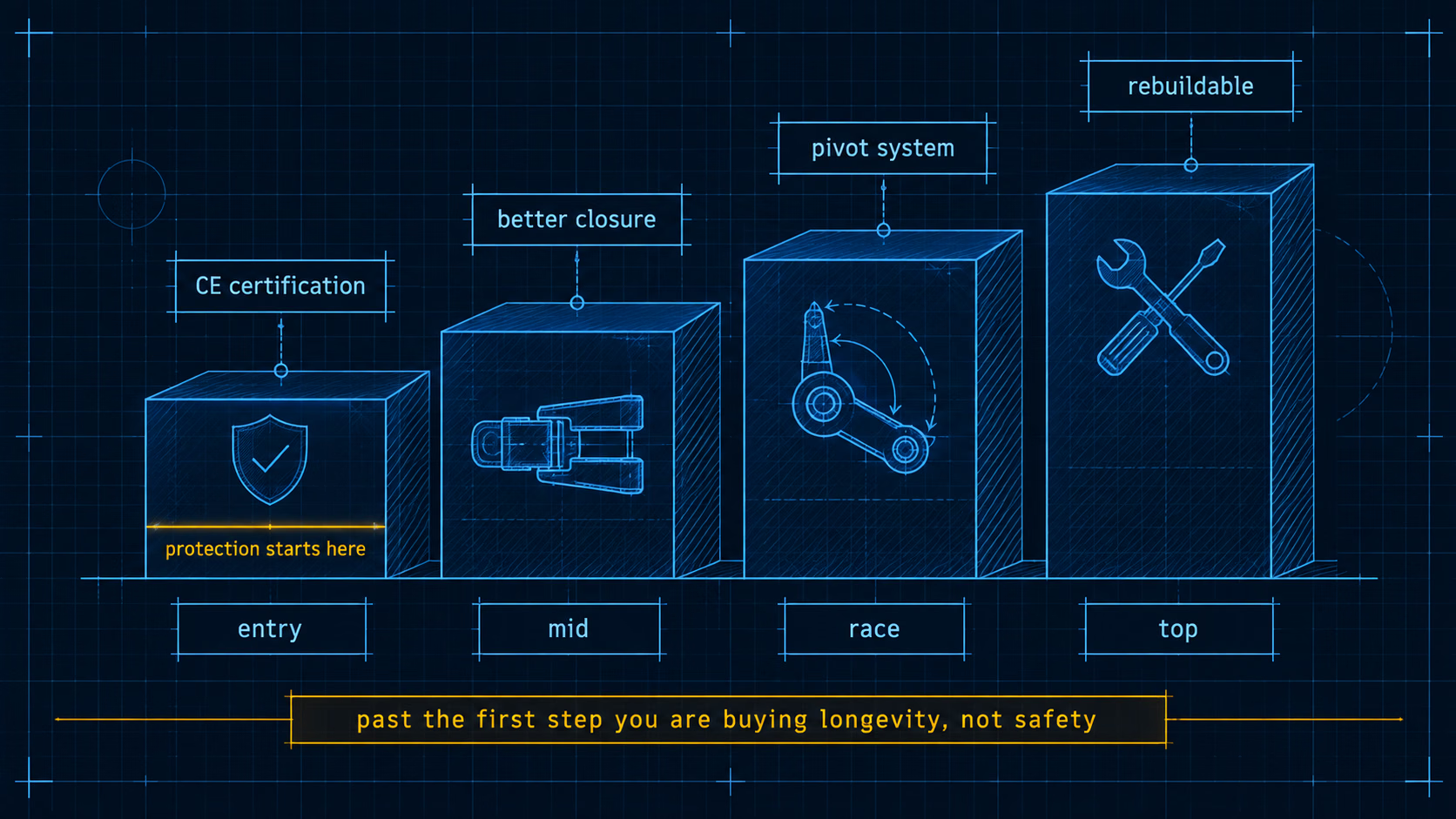
Entry — where certification starts
The cheapest CE-rated boot we track. It gets you the certification, a real shin plate and a motocross sole. What it does not get you is buckles that will still work in three seasons, and that is the honest trade.
For most riders buying their first pair, this is the right amount of money.
Mid — the one most riders should own
At $269.95 the Tech 3 is the volume seller in the category for a reason: better closure hardware, a more supportive chassis and a boot that survives regular use. The step from entry is durability and comfort rather than a higher rating.
Race — the pivot systems
The Tech 5 at $399.95 brings a proper pivot arrangement: the ankle flexes forward for standing and braking while resisting the twist that injures it. That is a genuine functional difference for anyone riding fast, and largely irrelevant for someone doing slow technical trails.
Top — rebuildable
At $569.99 you are buying a boot that gets rebuilt rather than replaced — soles, buckles and straps are serviceable parts. For a rider putting real hours in, the cost per season can be lower than the entry boot, which is the argument for it. For a weekend trail rider it is more boot than the riding justifies.
For a young rider
Youth boots are sized by shoe size and, like everything else for children, should be bought to fit now rather than to grow into. A boot too large moves on the foot, which defeats the ankle restraint that is the point of it.
Why you cannot buy these for someone else
Two variables, and shoe size only covers one.
Fit is model-specific. A rider who takes a 10 in one brand may take a 9.5 or an 11 in another. There is no reliable conversion.
Calf circumference is the second constraint and it is the one that catches people out. Two riders with identical shoe sizes can need different boots because one of them cannot close the top buckle. This is also the reason women riders report boot fit as the worst-served item in the category — the sizing was developed around a male calf.
If you are buying a gift, buy something else and make boots a shopping trip. Full measuring guidance is in the gear sizing guide.
What to look for when trying them on
Stand up on the pegs, or approximate it. A boot that is comfortable seated and blocks the ankle when standing is the wrong boot — standing is how these bikes are ridden in the terrain that matters.
Check the shin plate against your knee protection. A tall boot and a long knee guard can meet at the shin and push each other out of position. Bring the knee protection you actually wear.
Accept that they are stiff. A new motocross boot should feel like a ski boot. Ones that feel comfortable in the shop are usually the ones without the structure.
The bottom line
Buy the certified entry boot if the budget is tight — the certification is what matters, and $159.95 buys it. Buy the mid boot if you ride most weekends, because the durability difference is real. Buy the race or rebuildable boots only if you ride fast or ride often enough that a boot is a consumable.
And whatever the budget, buy them before the fourth helmet.
VoltRipper is independent and spec-verified. Prices are what we verified at the retailer on the date shown — confirm before you buy, and always try boots on.
FAQ
What is the cheapest CE certified dirt bike boot?
In our catalog the Thor Blitz XR at $159.95 is the entry point for a genuinely certified motocross boot. Below roughly $150 the market is dominated by uncertified boots and work-boot styling, and boots are one of the categories where the certification is the reason to buy the product at all.
Can I buy dirt bike boots as a gift?
Only with their exact size, and ideally the brand and size of their current boots. Fit is model-specific and does not carry across makers, and calf circumference is a second constraint that shoe size does not tell you. This is the riskiest protective item on the site to buy blind.
What does a more expensive MX boot actually give you?
Above the entry step you are buying longevity and comfort rather than a higher certification: better buckles that survive a season, a pivot system that lets the ankle flex forward while resisting the twist, and at the top of the market replaceable soles and straps so the boot is rebuilt rather than replaced.
Do I really need MX boots on an electric dirt bike?
More than on a comparable gas bike, arguably. These machines put out instant torque at low speed in technical terrain, which is exactly where a foot comes off the peg and gets trapped between the peg and the ground. A trainer offers nothing against that, and it is the injury that most reliably ends a season.