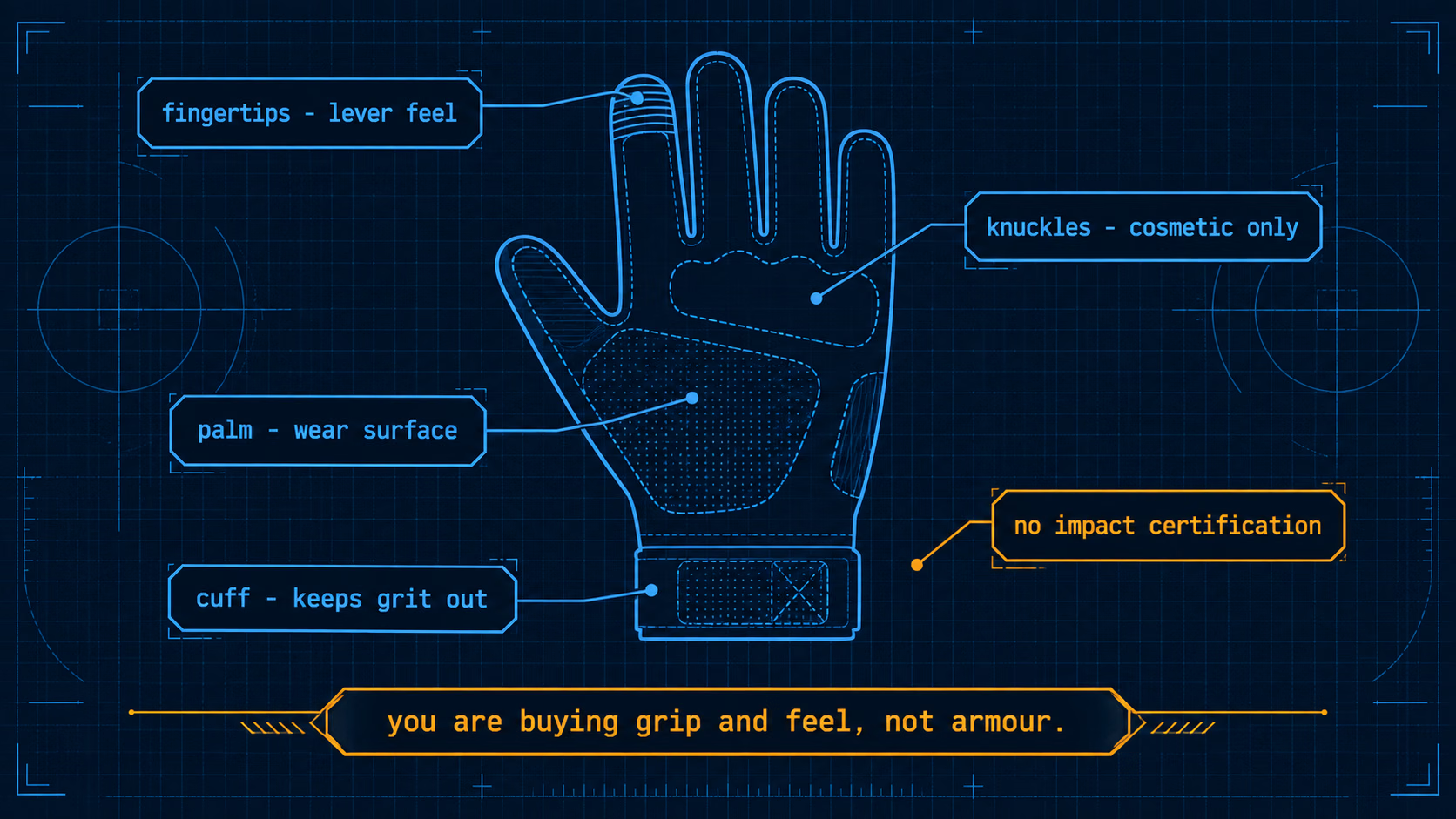
Start with the thing gear pages usually skip: motocross gloves carry no impact certification, at any price. That is not a scandal, it is the category. A standard exists — EN 13594, the European motorcycle glove standard — and road and adventure gloves carry it. MX gloves are built thin deliberately, because lever feel and grip matter more on a dirt bike than abrasion armour does.
So when you buy a glove here you are buying four things, none of which is armour.
What you are actually buying
Palm material and construction. This is the wear surface and the thing that fails. A single-layer palm with minimal seams under the grip is what lasts; decorative panels stitched across the palm are what blisters.
Lever feel. Thin fingertips let you brake and modulate with one or two fingers, which is how these bikes are ridden. A thick, padded glove that feels reassuring in the shop is the one that makes the brake vague.
A cuff that keeps grit out. Short-cuff gloves are the norm off-road; the job is to stop dust and debris rather than to armour the wrist.
Knuckle panels, which are mostly cosmetic. A soft TPR knuckle looks protective and is doing very little in an impact. That is fine — it is not what the glove is for — but do not pay for it as protection.
Why e-moto riders get through palms faster
Two small things compound. Instant torque means more time holding a twist throttle firmly at low speed, where a gas bike would be idling through the same section. And these bikes are quiet enough that rides get longer and more technical before anyone notices — which is the whole appeal, and it is also more hours with hands on grips.
Treat a palm as a consumable. Anyone riding regularly is on a second pair within a season.
The two we track
The Dirtpaw is the default off-road glove and the widest size range in the category, which is why it is the safe answer when buying for someone else. Thin palm, simple construction, cheap enough to replace without thinking about it.
The Dakar is the step up: heavier construction aimed at longer adventure and dual-sport riding, with a more durable palm and a better cuff. It is the right glove for someone riding long days rather than short laps, and the wrong one for someone who wants the thinnest possible lever feel.
Neither carries an impact certification, and neither claims to.
Sizing, when they are not there
Measure around the palm at the knuckles, excluding the thumb, and use the brand's own chart.
If you cannot measure, size up. A slightly loose glove is a minor annoyance; a tight one is unwearable and gets abandoned. As a rough default, Large fits an average adult man and Medium an average adult woman — but note that most off-road gloves are sold in men's sizing, so a woman typically takes a size below her usual glove size.
Full measuring instructions for every piece of kit are in the gear sizing guide.
What to spend
Under $50 buys a competent glove from a real off-road brand with a proper size range. That is where most riders should be, and it is where both of our picks sit.
Above $50 buys durability, cuff design and materials. It does not buy certification, because none is on offer.
Under $20, in this category, generally buys a glove whose palm delaminates. Gloves are cheap enough that the bottom of the market is not worth the saving.
The one glove-adjacent thing worth buying
Only relevant if the rider wears knee braces — but if they do, they own exactly one worn pair of these and have never thought to replace them.
The bottom line
Buy a thin, simply-constructed glove from a brand that makes off-road kit, size it by palm measurement, and expect to replace it. Do not pay for knuckle armour that is not certified, and do not buy a padded glove hoping it protects — if impact protection is the goal, the honest answer is that this category does not sell it, and the money is better spent on knees, chest or a better helmet.
For the rest of the kit, see protective gear.
VoltRipper is independent and spec-verified. Prices are what we verified at the retailer on the date shown — confirm before you buy.
FAQ
Do dirt bike gloves have safety ratings?
Almost never, and that is normal for the category. The European standard for motorcycle gloves, EN 13594, exists and is carried by road and adventure gloves; motocross gloves are built thin for lever feel and generally do not meet or claim it. If armour matters more to you than feel, you are shopping for an adventure glove rather than an MX one.
What size dirt bike gloves should I buy?
Measure around the palm at the knuckles, excluding the thumb, and use the brand's chart. Size up rather than down if you are between sizes — a loose glove is uncomfortable and a tight one is unusable. Most off-road gloves are sold in men's sizing, so a woman typically takes a size below her usual glove size.
Why do gloves wear out fast on an electric dirt bike?
Two reasons. Instant torque means more time gripping hard on a twist throttle at low speed, and the near-silent running of these bikes encourages longer, more technical rides than a loud gas bike does. The palm is a consumable on any dirt bike and slightly more so here.
Are expensive dirt bike gloves worth it?
Up to a point. Above roughly $50 you are buying durability, a better cuff and material quality rather than protection, because the category carries no impact certification at any price. A $45 glove from a maker with a real off-road range is the sensible middle.