Nine of the fifty-two bikes we track are discontinued, and in several cases the maker has gone quiet rather than merely moved on. Honda and Greenger stopped building the CRF-E2. Talaria discontinued the Sting MX3. Volcon's current line-up no longer includes the Grunt EVO. Delfast, Stealth and Torp have each stopped selling the machine we have on file.
If you own one of these, the useful news is that the bike does not stop working when the company does. What stops is support, and support is only decisive for a small number of parts.
Here is what actually breaks, sorted by whether anyone else makes it.
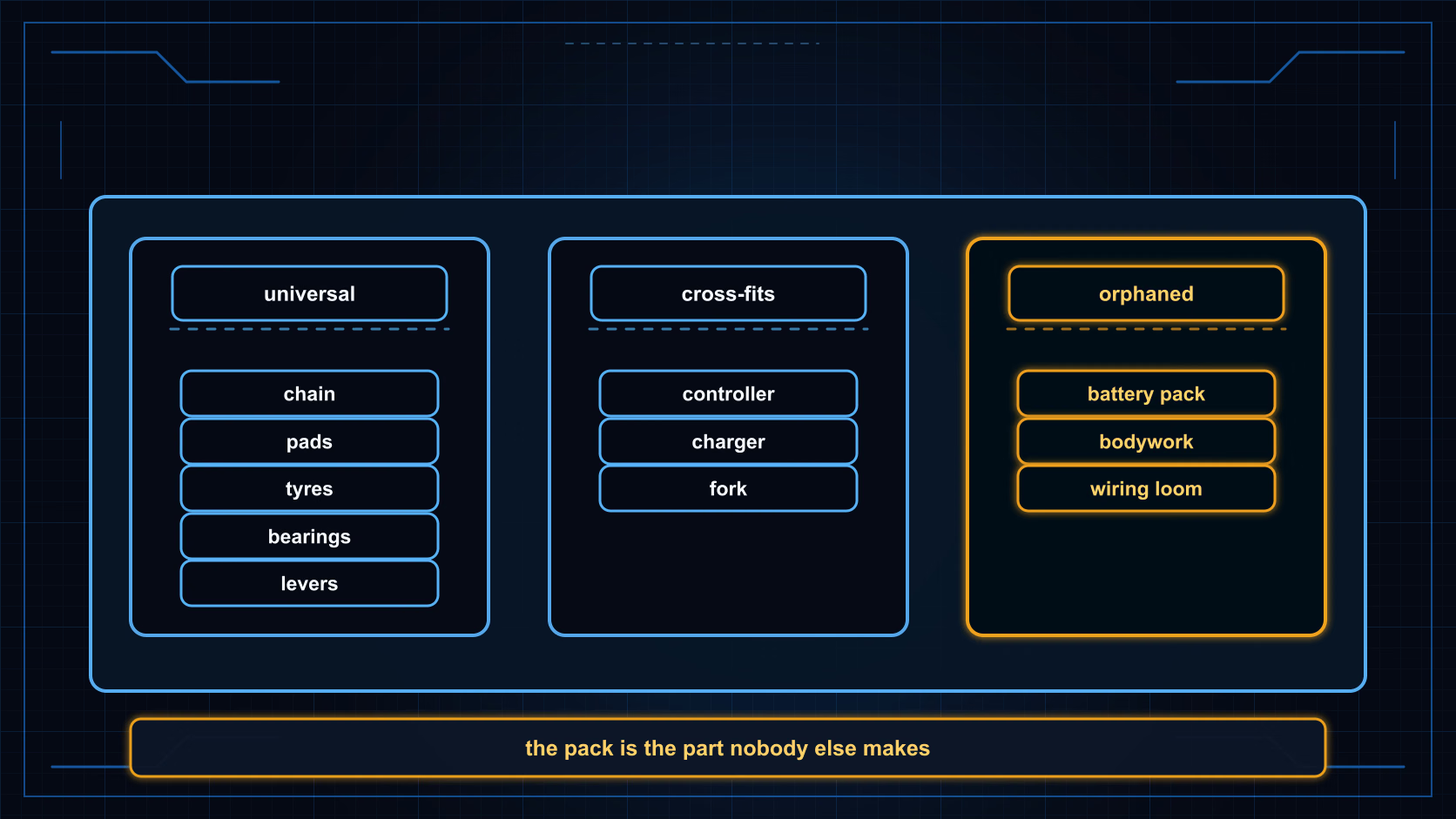
The good news: most of the bike is universal
These bikes are mechanically simple and they mostly use industry-standard components. The parts that wear out are the parts everyone makes.
Chain and sprockets. Standard pitches, widely available.
Brake pads, fluid and levers. Most of this class uses common hydraulic calipers with pad shapes shared across many bikes.
Tyres and tubes. Sized in standard motorcycle sizes; nothing proprietary.
Bearings and seals. Standard sizes, sourced by dimension rather than by brand. This is the part where a caliper and a bearing catalogue replaces a parts department entirely.
Grips, controls and cables. Universal.
The middle: things that cross-fit if you know what you have
Controllers. Widely replaced with third-party units in this class, matched to pack voltage and motor rather than to the bike's badge. This is a well-trodden path and there is a real aftermarket.
Chargers. Generic units exist for every common voltage — but voltage and connector must match exactly, and this is the one place where getting it wrong is a fire risk rather than an inconvenience. Buy from someone who can tell you which revision you have.
Suspension. Forks and shocks are frequently swapped between bikes in this class because the mounting dimensions are shared more than the branding suggests. Measure before assuming.
The problem: three parts nobody else makes
The battery pack. This is the one that ends bikes. It is model-specific, it is expensive, and when the maker is gone there is often no source at all. On the platforms where packs are still available they run roughly $1,600 to $2,000.
If a pack for your bike is still on sale and you intend to keep the machine, buy it now. That is the single piece of advice on this page that has a deadline.
Bodywork and plastics. Model-specific, cheap to make and never remanufactured once the tooling stops. Fenders, side panels and headlight surrounds disappear from the market within a year or two and then only exist used.
The wiring loom. Rarely fails, catastrophic when it does, and effectively unobtainable. Nothing to do about it except not to cut into it.
What to do this month
- Find out whether a pack is still available, and what it costs. That single answer determines
whether your bike has a two-year future or a ten-year one.
- Buy the model-specific plastics you are likely to break, if any are still listed. They are cheap
now and gone later.
- Photograph the wiring and connectors before you ever need to. A phone full of pictures of how it
left the factory is worth a great deal when there is no manual to consult.
- Find the owner community. For every discontinued bike in this class there is a forum or a group
where someone has already solved the problem you are about to have, and where used parts change hands.
- Write down what it actually is — pack voltage, controller model, fork diameter, wheel and tyre
sizes, bearing numbers. Once you are sourcing by dimension rather than by part number, that list is the parts catalogue.
Should you keep it or sell it?
Keep it if the pack is healthy and the chassis is sound. Everything else is cheap and mostly universal, and a discontinued bike that runs is worth more to you than to the market.
Sell it while it still runs if the pack is fading and no replacement exists. A bike with a dying, unobtainable pack is worth considerably less than the same bike two months earlier, and the decline is not gradual.
Be honest in the listing either way. The buyer's guide to checking a used bike is what a good buyer will run, and a seller who has already answered those questions sells faster.
The bottom line
The company going away is much less serious than it sounds, with one exception. Chains, pads, tyres, bearings, controllers and suspension all remain sourceable. The pack does not, and the pack is the bike's lifespan. If one is still available for your machine, that purchase is the decision — everything else on this page can wait.
If you are considering buying a discontinued bike rather than already owning one, the closeout framework is the page you want.
VoltRipper is independent and spec-verified. Parts availability changes quickly for discontinued models — confirm before relying on any source.
FAQ
What happens to my electric dirt bike if the company goes out of business?
The bike keeps working and the support does not. Most wear items are universal or cross-fit from other bikes, so chains, pads, tyres, bearings and levers stay available. What becomes hard is the battery pack, the bodywork and the wiring loom, because nobody else makes those for your specific machine.
Which parts should I buy immediately if my brand disappears?
The battery pack if one is still available and you can afford it, because it is the only part with no substitute and the one that ends the bike's life. After that, any bodywork or model-specific plastics you are likely to break, since those disappear from the market quickly and are never remanufactured.
Can I still get a controller or charger for an orphaned bike?
Often yes, from the aftermarket rather than the maker. Controllers in this class are commonly replaced with third-party units matched to the pack voltage and motor, and chargers are available generically — but voltage and connector must match exactly, and a mismatch is a fire risk rather than a compatibility annoyance.
Is a discontinued electric dirt bike worth keeping?
Usually yes if the pack is healthy and the chassis is sound, because everything except the pack is cheap and mostly universal. The decision changes when the pack fails: at that point you are weighing a replacement that may not exist against the value of a bike nobody supports.