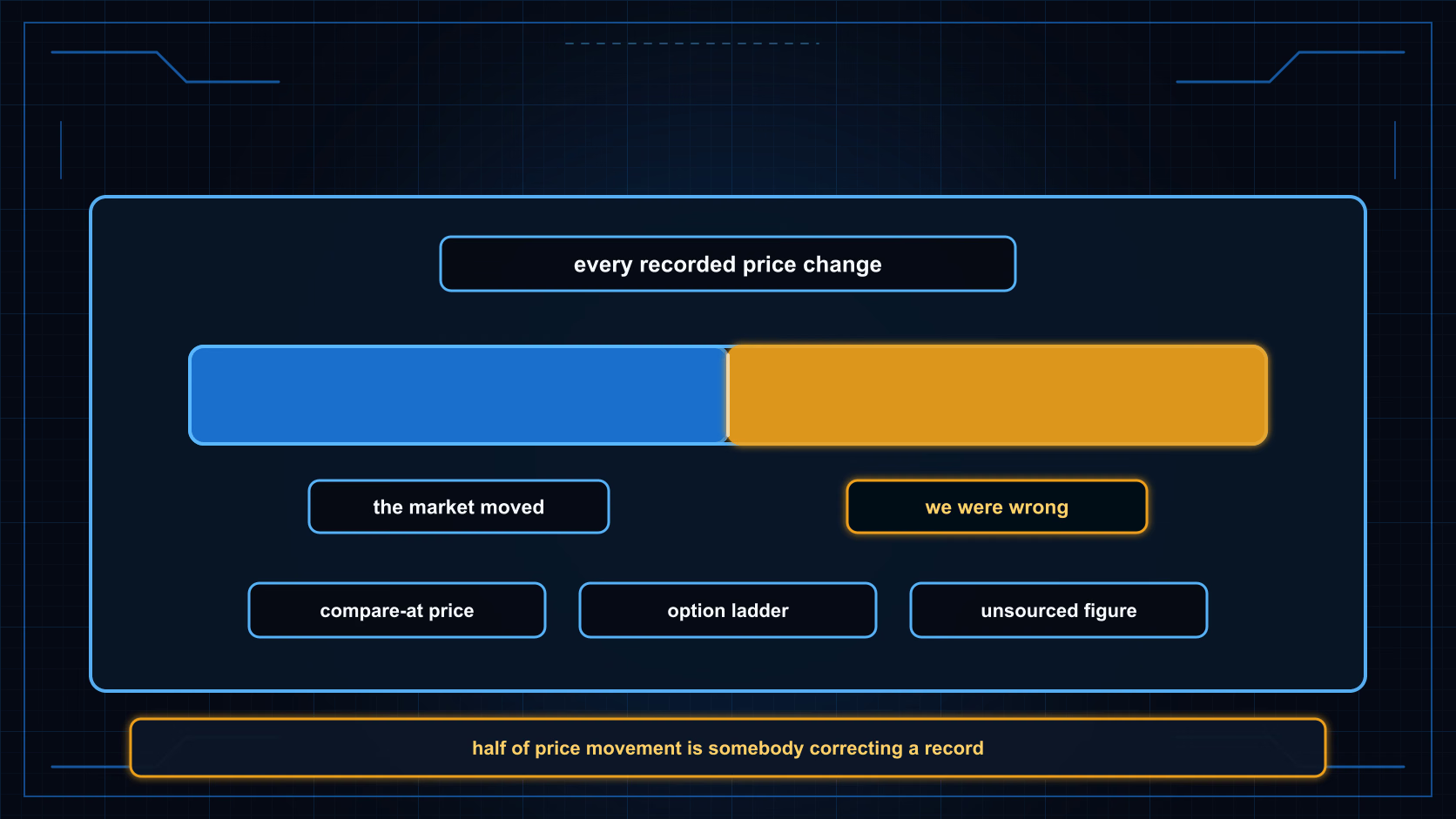
We keep a dated record of every price in our catalogue. Between 2026-07-05 and 2026-09-09 that record was revised 252 times across 52 bikes, and 25 bikes changed price.
Here is what nine weeks of that looks like, and the finding that surprised us most.
Prices in this category move both ways
| count | |
|---|---|
| Bikes whose recorded price changed | 25 of 52 |
| Net higher than when we first recorded them | 13 |
| Net lower | 12 |
There is no general downward drift in this class. That matters because the assumption behind waiting — that if you hold off, it gets cheaper — is not supported by anything in our data. Prices move, frequently, in both directions, on small manufacturers' own schedules.
The largest moves we recorded
| Bike | Recorded move | Net |
|---|---|---|
| Kuberg Ranger | was $4,545, now $6,836 | +$2,291 |
| Stark Varg MX | was $13,490, now $11,990 | -$1,500 |
| Greenger CRF-E2 | was $2,950, now $1,799 | -$1,151 |
| STACYC 20eDRIVE | was $1,599, now $2,599 | +$1,000 |
| Talaria Sting R MX4 | was $4,999, now $4,100 | -$899 |
| Riding Times GT73 | was $2,298, now $1,499 | -$799 |
| STACYC 16eDRIVE Elite | was $1,499, now $2,199 | +$700 |
| Talaria MX5 Pro | was $4,299, now $4,990 | +$691 |
| Talaria Sting MX3 | was $3,099, now $3,700 | +$601 |
| Apollo RFN Ares | was $4,199, now $4,799 | +$600 |
| Rawrr Mantis X Pro | was $4,499, now $3,899 | -$600 |
Any one of these is large enough that a buyer working from a stale figure would have made a materially wrong decision.
The finding that surprised us: half of it was us
This is the part worth reading twice.
A large share of the movement above is not the market repricing. It is us correcting our own record. The Onyx RCR went from $5,199 to $4,699 in our data this week, and Onyx did not cut its price — we discovered we had been publishing the fully-optioned SKU as the price of the bike. The Sur-Ron Light Bee X's price was once supported by no source at all. Several figures moved because we found the number we had was a compare-at price, an option ladder, or a dealer's page we had never re-read.
That is uncomfortable to publish and it is the most useful thing in this dataset, because if a site whose entire job is tracking these prices had that many wrong, the number on a random listing is worse than you think.
The practical consequences:
A crossed-out "was" price is a marketing choice, not a fact. It is set by the seller and is least policed at the budget end. We eventually removed a discount bonus from our own Score for exactly this reason: a $9 markdown was scoring identically to an $1,100 one.
The advertised price is often not the price of the bike you would receive. Option ladders, freight, and configuration differences all sit between the headline and the invoice. Ask for the delivered price of the exact configuration.
Check the date on any price you read, including ours. Every bike page on this site carries the date we last verified its price. A figure without a date is a figure without a claim behind it.
Discontinuation does not mean cheaper
The clearest counterintuitive result in the data. The Talaria Sting MX3 rose $601 after it was discontinued — from $3,099 to $3,700 — because what remained was last stock at last-stock pricing.
The same logic applies across the category. A discontinued bike with remaining inventory and continued demand gets more expensive, not less. Our discontinued buying guide has the framework for which closeouts are actually worth taking.
So when does a price genuinely fall?
Three situations, from the data rather than from intuition:
A model is superseded. The reliable one. Dealers clear the previous generation when a new one is announced. This is happening now around the Sur-Ron Light Bee X as the Light Bee 2 arrives.
A brand repositions. The Stark Varg MX dropped $1,500 and the Rawrr Mantis X Pro dropped $600 — those read as manufacturers repricing against competitors rather than seasonal discounting.
A product is failing in the market. The Greenger CRF-E2 dropped $1,151 and was then discontinued outright; the GT73 dropped $799 and is down to limited stock. A large fall on a bike with a thin dealer network is worth understanding before you treat it as a bargain.
What to do with this
Do not wait for a seasonal sale. There is no pattern in our data supporting one, and the Black Friday guide covers why the structure of this market works against it.
Do watch for a model announcement. That is where the real discount lives.
Do check the date on every price, and confirm the delivered price of the exact configuration before you pay.
The bottom line
Twenty-five of fifty-two bikes changed price in nine weeks, split almost evenly between rises and falls, and a large share of that movement was us fixing our own record rather than the market moving. Both halves of that sentence are useful: prices here do not reliably fall, and published prices in this category — ours included, until we checked — are less trustworthy than they look.
VoltRipper is independent and spec-verified. This page describes our own recorded price history, which mixes genuine market movement with corrections to our data; past movement is not a forecast.
FAQ
Do electric dirt bike prices go down over time?
Not reliably. Across 52 bikes tracked from July, 25 changed recorded price and they split 13 rises against 12 falls. There is no general downward drift in this category — small manufacturers reprice in both directions, and discontinuation sometimes raises a price rather than lowering it.
What is the biggest price change you have recorded?
The Kuberg Ranger, which we recorded moving from $4,545 to $6,836. The largest fall was the Stark Varg MX at $13,490 to $11,990. Both of those are large enough that a buyer relying on a stale figure would have made a materially wrong decision.
Why would a discontinued bike get more expensive?
Because what remains is last stock rather than clearance. We watched the Talaria Sting MX3 go up $601 after it was discontinued: the earlier figure was its normal selling price, and the later one was what the remaining units cost once supply was finite. Discontinuation means scarcity as often as it means a sale.
Can I trust a crossed-out compare-at price?
Treat it as a marketing choice rather than a fact. Compare-at pricing is set by the seller, is least policed at the budget end of the market, and was the reason we removed a discount bonus from our own scoring — a $9 markdown was scoring the same as a $1,100 one. Check the price against more than one retailer instead.