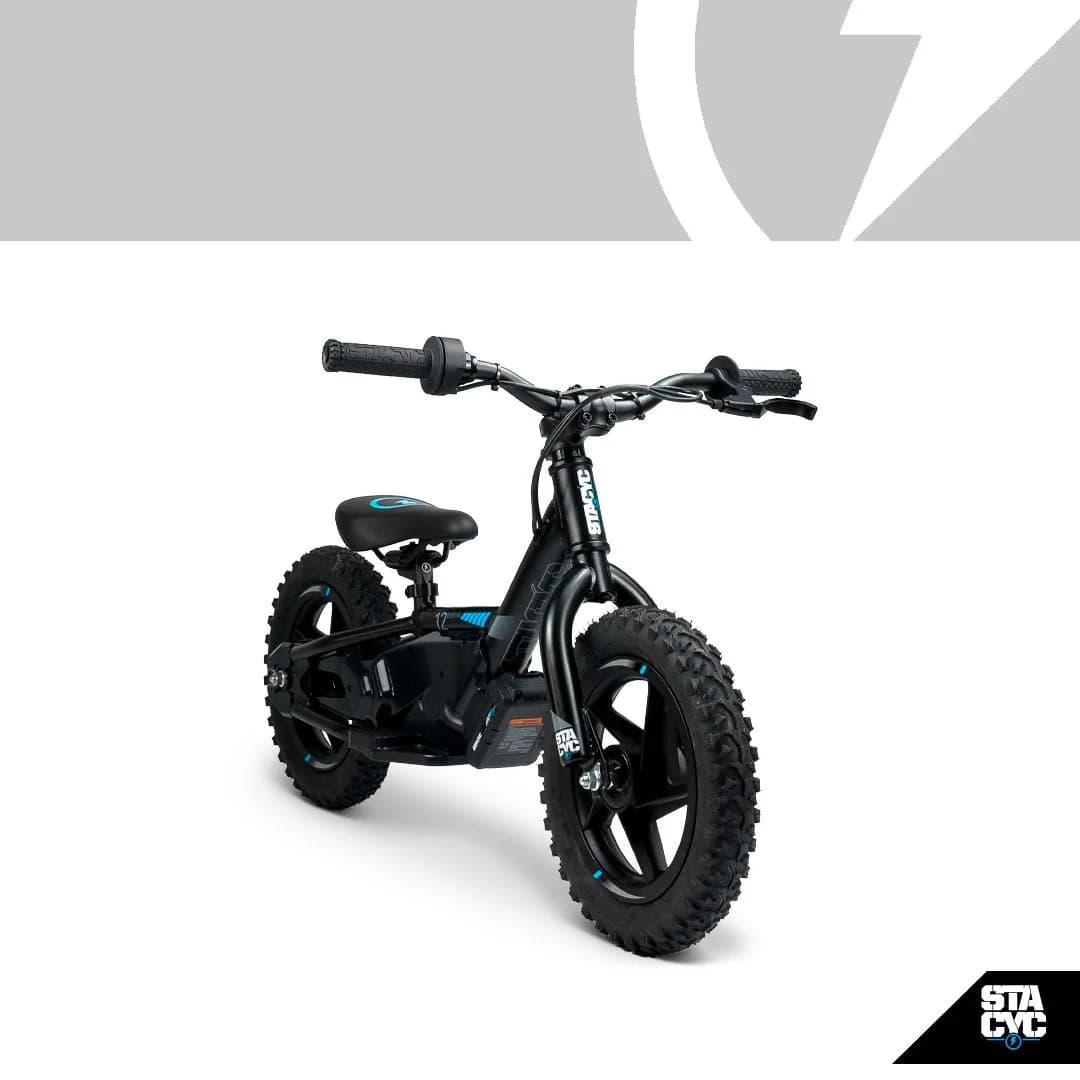
The verdict
This is the bike the rest of the STACYC range is built on top of, and until now we carried only the top two rungs. If a family ends up with a 20eDRIVE at $2,599, this is almost always where they started.
At $799 it is expensive for a balance bike. It is also 17 lb, rated 3 to 5 years, and the only bike in our catalogue a three-year-old is genuinely rated for.
What STACYC publishes
From stacyc.com, checked 2026-09-13.
| Rider age | 3–5 years |
| Weight limit | 75 lb |
| Inseam | 16–19" |
| Speed modes | 5 / 7 / 9 mph |
| Weight | 17 lb with battery |
| Seat height | 15" |
| Run time | 30–60 minutes |
| Charge time | 30–60 minutes |
| Wheels | 12", pneumatic |
| Brake | Enclosed rear drum |
| Price | $799 |
The thing STACYC does that nobody else does
It publishes an inseam range.
Age is a poor proxy for fit. A tall four-year-old and a small six-year-old are the same rider as far as a bike is concerned, and every other manufacturer on this shelf asks you to guess. STACYC gives you 16–19 inches and lets you measure.
That single number makes the whole range decidable:
| Model | Age | Inseam | Weight limit |
|---|---|---|---|
| 12eDRIVE | 3–5 | 16–19" | 75 lb |
| 16eDRIVE Elite | 6–9 | 20–21" | 115 lb |
| 20eDRIVE | 9–12 | 24–26" | 115 lb |
Measure the child, read down the inseam column. That is the decision, and it is a better one than any age-based guess.
Why 17 lb matters more than it sounds
A three-year-old will drop this bike, get stuck on it, and need to pick it up. At 17 lb with the battery they can. Most powered bikes at this size are half again as heavy, and a bike a child cannot right without help is a bike that gets ridden less.
The three speed modes work the same way. 5 mph is roughly the speed they can already push a non-powered balance bike, so the first ride is familiar, and the higher modes exist for later.
Where it falls down
It is not a dirt bike. No pedals, no suspension, no gears. It teaches balance and throttle control. Ranking it against a Razor MX125 would be comparing two different products, which is why we categorise it as a balance bike on its own terms.
75 lb ends it. That is the real constraint, and it arrives before the age rating does for a big child. A five-year-old at the top of the range may get a year out of it.
$799 is a lot for something with that lifespan. The honest counterweight is resale: STACYCs hold value second-hand better than anything else in this category, so the cost of ownership is meaningfully lower than the sticker.
Who should buy it
A family committed to the sport, with a child aged three to five and a 16–19 inch inseam, who expects to move up the STACYC ladder and recover some of the cost when they do.
For a cheaper first try, the Hiboy DK1 at $359 is rated from three and has a 140 lb limit, though it is a different kind of machine. Our STACYC alternatives guide covers the range by age, and the under $1,000 picks put this against the rest of the band.
VoltRipper is independent and spec-verified — we have not ridden this bike. Specifications, ages, inseam ranges and weight limits are quoted from STACYC's own pages on the date shown.
FAQ
What age is the STACYC 12eDRIVE for?
STACYC publishes ages 3 to 5, a 75 lb weight limit and — more usefully — a 16 to 19 inch inseam. The inseam is the figure that actually decides fit, because a tall four-year-old and a small six-year-old are the same rider to a bike.
Is the STACYC 12eDRIVE a dirt bike?
No, and it matters. It is an electric balance bike: no pedals, no suspension, and a 15-inch seat. It teaches balance and throttle control before a child moves to a bike with pedals or gears. We categorise it honestly rather than ranking it against dirt bikes it is not competing with.
How fast does the STACYC 12eDRIVE go?
Three modes: 5, 7 and 9 mph. The progression is the point — a three-year-old starts at roughly walking-push speed and the higher modes unlock as balance improves.
Is the STACYC 12eDRIVE worth $799?
It is expensive for something a child outgrows at 75 lb, and there is no way around that. What the money buys is build quality, a Harley-Davidson dealer network behind it, and strong resale — these hold value unusually well second-hand, which changes the real cost of ownership.